

Summary
- Apache Airflow, Dagster and Prefect suit Python teams; Airflow 3 is now the current major version.
- Prefect announced in July 2026 that it is acquiring Dagster, which keeps its name, license and Dagster+.
- Kestra fits teams that want YAML workflows with tasks in any language.
- Skyvia and Keboola give teams without data engineers orchestration built into a data platform.
- A free license isn't a free orchestrator: compare pricing units and who runs upgrades before you choose.
It usually starts with a few cron jobs. Then the CRM load runs long, the revenue model fires on schedule anyway, and Monday’s dashboard shows last Thursday’s numbers without telling anyone. Picking from the data orchestration tools on the market is how most teams get out of that loop, and the wrong pick swaps one problem for another: a platform nobody has time to upgrade, or a bill that grows with every task run.
The market has also moved since most roundups were written. In July 2026, Prefect announced it is acquiring Dagster; Airflow 3 (out since April 2025) reached Google’s managed service this year; and Google renamed Cloud Composer. Many guides still quote 2024 plans and prices.
We checked seven tools on their vendors’ own pricing pages, docs and release notes in October 2026, and compared them on who builds the workflows, where they run, how runs start and what they cost. Below is how the seven compare.
Our quick picks among data orchestration tools
You’ll notice data orchestration tools fall into two groups, because some are code-first orchestrators that need an engineer nearby while others are data platforms where orchestration comes as part of the package. That makes the opening question an easy one to ask, though not always to answer. Who’s going to build these data pipelines, and who keeps them alive?
Python engineers on staff? Weigh Apache Airflow, Dagster and Prefect. YAML fans, and teams writing in more than one language, tend to get along better with Kestra. For a team where nobody writes code, Skyvia or Keboola (both have orchestration built in) gets the pipelines running, and nobody has to sit on call for them.
| Tool | Type | How you define workflows | Hosting | Pricing unit | Free option | Paid entry point |
|---|---|---|---|---|---|---|
| Apache Airflow | Open-source orchestrator | Python DAGs | Self-hosted, or managed by Astronomer, AWS or Google | Your infrastructure (managed: hours of compute) | Free, Apache-2.0 | Astro deployments from $0.35/hr |
| Dagster | Open-source orchestrator + Dagster+ cloud | Python assets and jobs | Self-hosted, Dagster+ Serverless or Hybrid | Credits (asset materializations and ops) | Free open source; 30-day Dagster+ trial | Solo $10/month + $0.040 per credit |
| Prefect | Open-source orchestrator + Prefect Cloud | Plain Python flows | Self-hosted, Prefect Cloud, bring your own compute | Seats and workspaces | Free open source; Hobby tier | Starter $100/month |
| Kestra | Open-source orchestrator | YAML, tasks in any language | Self-hosted (Docker, Kubernetes); Enterprise anywhere | Per instance (Enterprise) | Free open source | Enterprise by quote |
| Luigi | Open-source Python package | Python tasks | Self-hosted | Your infrastructure | Free, Apache-2.0 | None |
| Skyvia | No-code cloud data platform | Visual: Control Flow, Data Flow | Cloud | Records per month | Free plan | Basic from $79/month billed annually; Control Flow needs Professional, from $399/month |
| Keboola | Cloud data platform | Flow Builder, SQL and Python | Cloud (multi-cloud) | Compute minutes / time credits | Free plan | $0.14 per extra minute; Enterprise by quote |
Before you fall for any of them, find out what happens when a task fails at 2 a.m., because that night will come. By month three you’ll care far more about retries, alerts and rerunning from the failed step than about anything listed on the pricing page.
So what does data orchestration actually do?
Here’s the short version: it’s the bit of your data pipelines that says go, says wait (because an input isn’t there yet), and picks up the pieces when a step breaks. Take a typical night. Extract, load, a dbt model, then a dashboard refresh, and the orchestrator is the one holding every dependency, trigger, retry, log and alert along that chain. Load dies halfway through? Nothing after it runs on partial data, it just sits. And someone gets a ping long before a stale chart lands in a Monday meeting.
The heavy lifting on the data (pull the records, reshape them, write them to a warehouse) is what ETL and ELT tools are for. Orchestration sits above them. Our guide to ETL vs ELT covers that layer; this one covers the layer that coordinates it.
A cron job isn’t orchestration either. It starts a script at 3 a.m. but knows nothing about whether yesterday’s load finished. Even Luigi’s docs own up to it. There’s nothing in Luigi that triggers a run, so people bolt on crontab or something like it.
And Kubernetes? Where does it fit? It is, for containers, which isn’t the same thing as orchestrating data. It runs pods for you, scaling them as load goes up and down. What it can’t tell you is that the orders table needs to land before the revenue model kicks off. Plenty of data orchestrators sit on top of it anyway, and Airflow’s KubernetesExecutor spins up one pod per task.
What changed in data orchestration during 2026
Plenty of the guides ranking for this topic were written for the 2024 market and haven’t caught up. Three changes matter if you’re choosing now.
Prefect is acquiring Dagster. Dagster Labs and Prefect went public with the deal on July 13, 2026: Prefect is acquiring Dagster Labs, taking the product, the codebase and many members of the team. Per the announcement, Dagster keeps both its name and its open-source license, and Dagster+ stays on sale; customers’ deployments, contracts and pricing don’t change. The companies said the combined business would operate under the Prefect name starting in August 2026. If you’re signing a Dagster+ contract now, ask your account team how renewals and the roadmap will work under the new owner, and get the answer in writing.
Airflow 3 is now the version to plan for. Airflow 3.0 went GA on April 22, 2025, so by now it’s had time to settle. Quite a lot came with it, honestly: a rewritten React UI, DAG versioning, scheduler-managed backfills, event-driven scheduling on data assets, and a Task Execution Interface plus Task SDKs for running tasks in other environments. If you’re installing today, you’d get 3.3.2, the stable build from September 2026. The Airflow 2 line? Marked deprecated. A team still on Airflow 2 is planning a migration, not a minor upgrade.
Google renamed Cloud Composer. On April 15, 2026, Google’s managed Airflow service became Managed Service for Apache Airflow, and Airflow 3 became generally available in it the same day. Searches and old docs still say Cloud Composer; it’s the same service.
Pricing moved as well. Dagster+ now sells Solo, Starter and Pro plans billed per credit, and Prefect’s paid tiers are Starter and Team, priced by seats rather than runs.
How we compared the tools
We judged every tool on the same six points:
- Who builds: Python people, YAML people, SQL people, or folks who’d rather drag boxes in a visual editor?
- Where it runs: your servers, a managed cloud, or hybrid, which is the split where the vendor keeps the control plane and the work happens on your compute.
- How runs start: maybe a schedule, maybe an event, maybe fresh data upstream, maybe somebody calling the API.
- Observability and reliability: what you get for retries, logs, lineage and alerts without any extra wiring (a silent failure tends to drag downstream reports down with it).
- Pricing unit and entry price: what you’re billed on and the cheapest real starting point, with the billing basis.
- The first limit you hit: the constraint a buyer runs into before anything else.
Every price here was taken from the vendor’s US pricing page in October 2026. Full disclosure: Skyvia is our product, which is why its limits sit right beside its strengths.
Code-first orchestrators for engineers
These five data orchestration tools define workflows as code or configuration. They give engineers the most control, and they expect an engineer to own them.
Apache Airflow
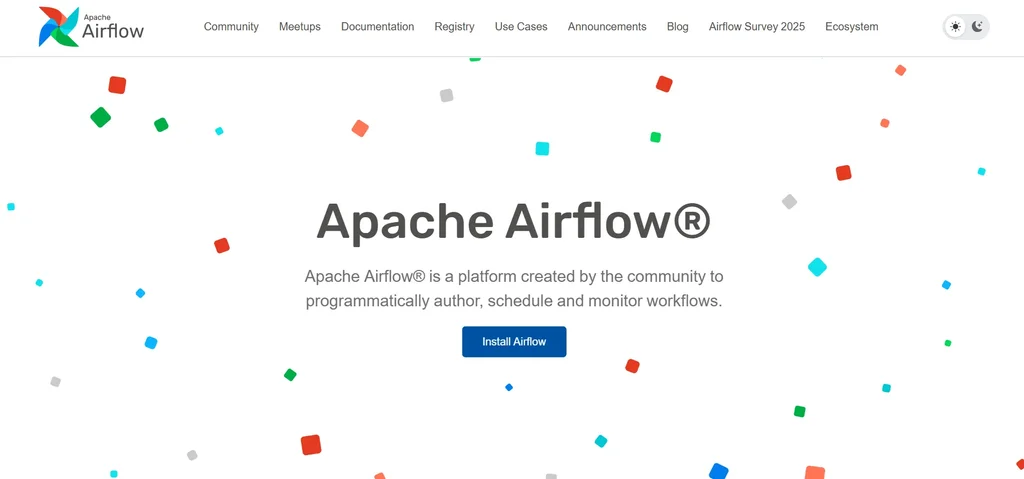
Ask around and Apache Airflow is the name you’ll hear first; it’s the open-source standard, and everything in it gets written, scheduled and monitored in Python. In Airflow terms, a pipeline is a DAG (directed acyclic graph), basically tasks plus arrows showing who waits on whom. It’s released under the Apache-2.0 license.
Best for: Python teams after a free orchestrator that plenty of teams already know, as long as somebody (you or a vendor) is going to run it.
Key features:
DAGs in Python, covering dependencies, retries, branching and schedules.
Executors to match your scale. Small setup? The LocalExecutor keeps tasks inside the scheduler. Bigger one? CeleryExecutor, KubernetesExecutor or EdgeExecutor ship them off to workers, pods or remote machines.
With Airflow 3 you also got DAG versioning, scheduler-managed backfills, event-driven scheduling on data assets and a new-looking UI.
Limits: You operate it. Production runs on Linux only; on Windows you need WSL2 or Linux containers. Features like single sign-on enforcement and long audit-log retention come from managed distributions (on Astronomer’s Astro, for example, SSO enforcement starts on the Business plan).
Pricing: the Apache-2.0 license costs nothing, though the servers it runs on certainly do. Managed options price by compute time:
Astronomer Astro: pay-as-you-go and billed monthly, with deployments from $0.35 an hour on Developer and from $0.42 on Team. Its workers begin at $0.13 an hour, and when there’s nothing to do they drop to zero. Business and Enterprise plans are quote-only.
Amazon MWAA: pay for environment hours by size, billed per second, with no minimum fees. AWS’s own example prices a large environment at $0.99 an hour in the US East (Northern Virginia) region.
Google Managed Service for Apache Airflow (formerly Cloud Composer): Gen 3 environments are billed in compute units (milli DCU-hours) for the time they run.
For a wider list of Airflow replacements, see our roundup of Apache Airflow alternatives.
Dagster
Dagster flips the usual model around. You declare data assets in Python (tables, files, models) and it keeps a record of how each one gets made. That’s why lineage and data quality checks are in the pipeline from the start, not something you tack on after an incident.
Best for: analytics and platform folks who don’t trust a green job until they know the table behind it is correct and fresh.
Key features:
One tool for both asset-based and workflow-based orchestration.
Asset checks, freshness policies, partitions and backfills.
Branch deployments so you can test changes, lineage at the asset level, and hooks into dbt tests.
Limits: Teams used to thinking in tasks will need a while to get comfortable with assets. Role-based access control on Dagster+ begins at Starter. SSO, SAML and audit logs? Pro only. And the Prefect deal leaves the long-term roadmap a little uncertain, stated commitment to Dagster or not.
Pricing: nothing to pay for the open-source project (Apache-2.0). Dagster+ is pay-as-you-go:
Solo: $10 a month plus $0.040 per credit, one user.
Starter: $100 a month plus $0.035 per credit, up to three users.
Pro: custom.
A credit is one asset materialization or one op execution. On Serverless you pay $0.010 a minute for compute; Hybrid deployments run on your own infrastructure, so there’s no compute charge there. Whichever plan you pick, there’s a 30-day trial up front.
Prefect
Prefect keeps it light. Slap a decorator on a plain Python function, and you’ve got a workflow, complete with retries, caching and recovery when it runs. Under Prefect Cloud sits that same open-source framework. Go hybrid and Prefect’s cloud only holds the control plane, while code and data stay on compute you own.
Best for: engineers who want their orchestration code to read like any other code they ship, plus runs that fire on events.
Key features:
Flows written as standard Python, with retries and caching.
Automations that respond to workflow events, plus webhooks so outside systems can trigger runs (from the Starter plan up).
Run it on your own compute, or deploy hybrid or inside a VPC.
Limits: Only Python flows are supported, which means a mixed-language team ends up wrapping its other code in tasks. You’ll need Enterprise for SSO, object-level RBAC and IP allowlisting. Free Hobby accounts keep run history for seven days.
Pricing: charged per seat and workspace rather than per run or task, and billed monthly (annual billing exists only on sales-assisted plans):
Hobby: free, two users, up to five deployments, 500 minutes of Prefect Serverless.
Starter: $100 a month, three users, up to 20 deployments.
Team: $100 per user a month for four to eight users, up to 100 deployments.
Enterprise: custom.
Kestra
Kestra is declarative. Flows are YAML, yet whatever runs inside a task can be written in pretty much any language. Analysts get a way in too (there’s a visual editor right beside the code one), so they can follow and tweak flows engineers wrote.
Best for: platform teams who think in infrastructure-as-code but refuse to pin every workflow on a single language.
Key features:
Workflows in YAML, kept in version control and reviewed like any other code.
Event-driven scheduling, and 2,100+ plugins by Kestra’s own count (vendor-reported).
A code editor and a no-code editor, and an MCP server for AI agents too.
Limits: Some teams love YAML. Others can’t stand it. Need SSO, LDAP, SCIM, RBAC or audit logs? That’s Enterprise Edition territory, and Kestra won’t publish a price for it, you have to ask for a quote.
Pricing: self-host the open-source edition on Docker or Kubernetes and you pay nothing. The Enterprise Edition is sold per instance on an annual subscription, with no cap on flows, tasks or executions. Kestra Cloud is available on request.
Luigi
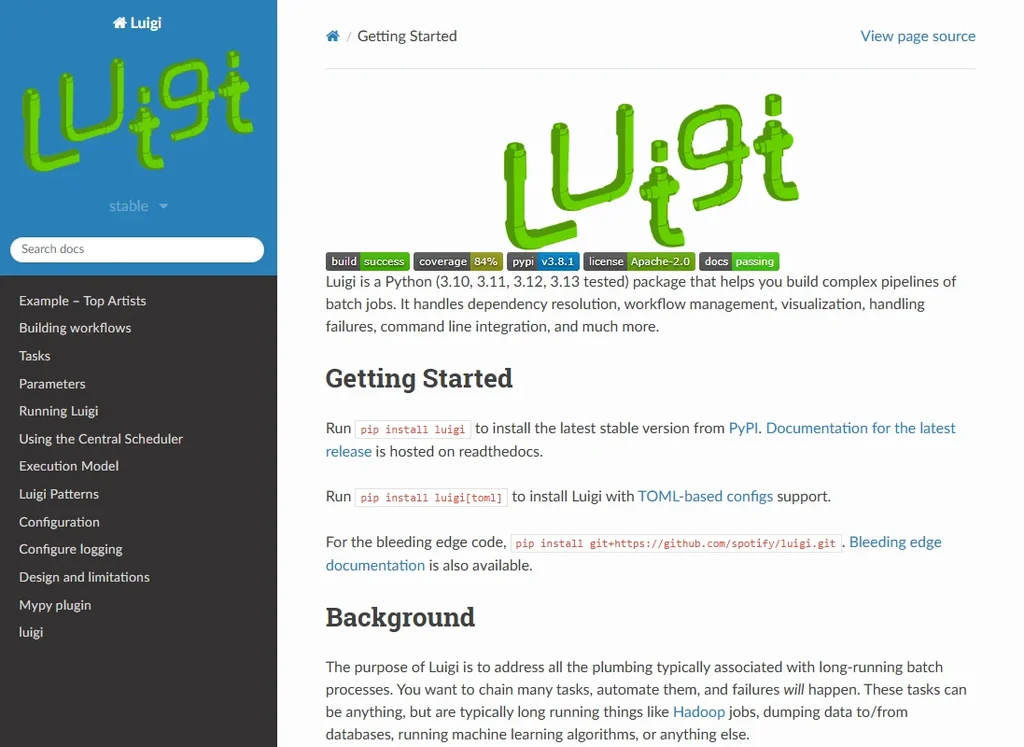
Luigi started at Spotify as a Python package for batch-job pipelines and was later open-sourced. Luigi figures out which tasks depend on which, shows that graph in a web view and copes with failures. Does anyone still maintain it? Yes, someone does: 3.8.1 shipped in May 2026.
Best for: a few small batch pipelines, when a lightweight library is plenty and a whole platform would be overkill.
Key features:
Tasks declare what they require and what they output, and Luigi runs them in order.
A central scheduler with a dependency visualization.
Failure handling for long-running batch jobs.
Limits: Luigi’s documentation is upfront about them. Because nothing inside Luigi triggers runs, cron or some other scheduler has to start each one. Execution stays on one machine rather than being spread across several. Its design expects every task to be a sizable chunk of work, and it isn’t built to go past tens of thousands of jobs.
Pricing: Luigi is free and open source under Apache-2.0.
Platforms with orchestration built in
Plenty of teams can skip a standalone orchestration platform altogether. Suppose most of your pipelines boil down to “load these apps into the warehouse, then transform, then push results back”; in that case a data platform with orchestration built in handles it, and nobody has to write DAGs.
Skyvia
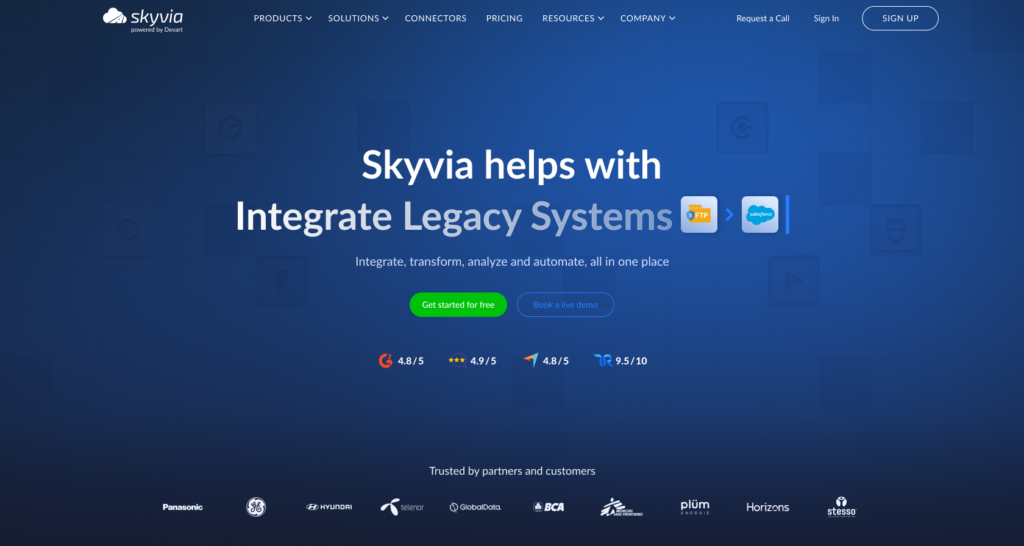
Skyvia is ours, a no-code cloud data platform. It has 200+ connectors (cloud apps, databases, warehouses), and Control Flow is the part that orchestrates the integrations once you’ve set them up.
Best for: teams who’d honestly rather click together SaaS-to-warehouse pipelines than recruit a data engineer to keep Airflow alive.
Key features:
Control Flow (Professional plan and up) chains integrations in sequence or runs them in parallel, and you get If conditions plus Try Catch error handling on top.
Data Flow (Standard and up) covers the multi-step stuff: several sources and targets, lookups, conditional splits, and an error output that catches failing rows.
Replication pushes data into BigQuery, Snowflake, Redshift, Azure Synapse, Databricks or a database of your choice. After that first full load, each run grabs just the new and changed records.
dbt Core runs: Skyvia can run your dbt project from Git right after replication, inside a Control Flow. We’ve written up the whole setup in our analytics-ready warehouse with Skyvia and dbt walkthrough.
Automation handles event-driven work between apps; a run can start on a schedule, when polling spots a change, or when a webhook comes in.
Limits: There’s no Python DAG authoring, so if a step needs custom code, you’ll want a second tool for it. Control Flow needs the Professional plan. Log-based change capture works only for SQL Server (other sources use timestamp-based incremental updates), and schema changes in a source aren’t detected automatically. Schedules run every minute on Professional, hourly on Standard and once a day on Basic and Free.
Pricing: by records per month, with a free plan and no credit card needed. On Data Integration, Basic begins at $79 a month billed annually ($99 billed monthly), while Professional, the plan with Control Flow, begins at $399 a month billed annually ($499 monthly) for 10M records. Users and connections are unlimited on every plan. Current tiers are on the pricing page.

Keboola
Keboola rolls ELT, storage (a Snowflake backend on the Free plan), SQL and Python transformations, and Flow Builder orchestration into a single platform. Keboola says it supports 1,500+ data sources.
Best for: SQL or Python data teams who like the idea of ingestion, transformation and orchestration all living in one managed project.
Key features:
Every plan, the Free one included, allows unlimited ETL and ELT pipelines.
Flow Builder for ordering extractors, transformations and writers.
A Keboola MCP Server for AI assistants.
Limits: The Free plan is one project, with transformations limited to Snowflake SQL and Python, hosted in Microsoft Azure in the EU. CDC and streaming, Git CI/CD, VPC deployment and SAML SSO are Enterprise features, priced by quote.
Pricing: Free gives you 120 minutes of compute in month one, and 60 minutes a month from then on. Go past that and it’s $0.14 a minute; run out entirely and jobs just pause until you buy more or next month’s refill shows up. Enterprise contracts are custom.
Open source vs managed: what orchestration costs to run
An Apache-2.0 license is free. Running the orchestrator isn’t. Running Airflow yourself means paying for a scheduler, workers, a metadata database and log storage, plus a person to handle upgrades, and the move from Airflow 2 to 3 showed how heavy an upgrade can be.
| Option | What you pay for | Entry price (October 2026) | Who runs the servers |
|---|---|---|---|
| Self-hosted Airflow, Luigi, Kestra or Dagster OSS | Servers and engineer time | $0 license | You |
| Astronomer Astro | Deployment and worker hours | Deployments from $0.35/hr, workers from $0.13/hr | Astronomer |
| Amazon MWAA | Environment hours by size, extra workers | No minimum; large environment $0.99/hr in US East (Northern Virginia) | AWS |
| Google Managed Service for Apache Airflow | Compute units (milli DCU-hours) | Billed for running time | |
| Dagster+ | Monthly fee plus credits | $10/month + $0.040 per credit | Dagster |
| Prefect Cloud | Seats and workspaces | Free Hobby; Starter $100/month | Prefect |
| Skyvia | Records per month | Free plan; Professional from $399/month billed annually | Skyvia |
| Keboola | Compute minutes | Free plan; $0.14 per extra minute | Keboola |
Two of these pricing models are worth testing against your own numbers before you commit. Per-credit pricing (Dagster+) grows with every asset materialization and op, so count a month of your real runs first. Hourly pricing (Astro, MWAA) bills the deployment or environment for every hour it’s up, so that base charge is the same on a quiet day as on a busy one; Astro’s workers, by contrast, scale to zero when idle.
How to pick a data orchestration tool
Find your starting point in the table, then put your top two through the checklist.
| Your situation | Start with | Why | Check first |
|---|---|---|---|
| Python team that wants a free, widely used standard | Apache Airflow (self-hosted or managed) | Free license, three managed options, event-driven scheduling in Airflow 3 | Who owns upgrades, and which Airflow version a managed service runs |
| Data quality and lineage are the main pain | Dagster | Assets, asset checks and lineage are built in | Your monthly credit count; contract terms after the Prefect deal |
| Python team that wants code to stay plain Python | Prefect | Decorators on normal functions; hybrid execution | Seats you’ll need; whether you need SSO (Enterprise) |
| Mixed languages, infrastructure-as-code culture | Kestra | YAML workflows, tasks in any language | Which governance features need the Enterprise Edition |
| A handful of batch jobs, no budget | Luigi | Lightweight library, no platform to run | Whether cron triggering and no distributed execution are acceptable |
| No data engineers, SaaS apps into a warehouse | Skyvia | Visual Control Flow, replication and dbt Core runs without code | That your sources are among the 200+ connectors; the plan your schedule needs |
| SQL and Python analysts who want one managed project | Keboola | Ingestion, transformation and Flow Builder together | Free plan region and compute minutes against your job lengths |
Paste the checklist below into your evaluation doc and give each candidate a score:
Data orchestration tool checklist
- Who will build and maintain workflows (Python / YAML / SQL / no-code)?
- Hosting: self-hosted, managed, or hybrid? Any data that can’t leave our network?
- Triggers needed: schedule / upstream data landed / external event / API
- Failure handling: retries, alerts (email, Slack), rerun from the failed step
- Observability: run history retention, logs, lineage
- Access: SSO, RBAC, audit logs, and which plan includes them
- Pricing unit (hours, credits, seats, records, minutes) and one month’s estimate on real volume
- Upgrade path: current major version, who runs upgrades
- Connectors or operators for our 5 most important sources and targets
- Exit plan: can we export workflows and data if we switch?
Did your shortlist boil down to “Airflow, except nobody can run it”? Then go no-code first: build the pipeline in Skyvia on the free plan and upgrade to Professional once you need Control Flow to chain replication, dbt runs and loads back into your apps.

FAQ for data orchestration tools

Which data orchestration tools are good examples?
On the open-source side there’s Apache Airflow, Dagster, Prefect, Kestra and Luigi, each defining workflows as code or configuration. Astronomer Astro, Amazon MWAA and Google’s Managed Service for Apache Airflow run Airflow for you. Then there are Skyvia and Keboola, which are data platforms that come with orchestration built in.
Is Kubernetes a data orchestration tool too?
No. It orchestrates containers, and data workflows are a different job. Pods get scheduled and scaled, but Kubernetes has no idea a table has to finish loading before the model built on it can run. That said, data orchestrators frequently run on Kubernetes; Airflow’s KubernetesExecutor, for instance, launches a pod per task.
Is Dagster still supported now that Prefect is buying it?
Yes. According to the July 2026 announcement, Dagster keeps its name and open-source license, Dagster+ carries on as a commercial product, and customers‘ deployments, contracts and pricing stay as they are. Signing or renewing a Dagster+ contract? Get the account team to spell out, in writing, how renewals and the roadmap will work.
Using dbt or an ETL tool already: do I need an orchestrator too?
Often, yes. ETL and ELT tools move data and reshape it; dbt does the modeling. What none of them does by itself is tell dbt to hold on until the load is done, or decide what happens if that load breaks. If your pipelines mostly mean app-to-warehouse loads with dbt afterward, Skyvia’s Control Flow can chain the replication and the dbt Core runs, and you can skip a separate orchestrator.
Why does self-hosted Airflow cost more than its free license suggests?
You don’t pay for the license. You do pay for the scheduler, workers, metadata database and log storage, and for engineer hours spent on upgrades. And Airflow 2 to Airflow 3 is a migration project, not a minor update. With Astro or Amazon MWAA you pay for compute hours instead, and keeping the servers healthy is their job.
Is it possible to orchestrate data pipelines without writing code?
Yes. Skyvia’s Control Flow, available on the Professional plan and up, runs integrations in order or in parallel with If conditions and Try Catch error handling, all in a visual editor. The catch: no custom Python steps, which you would get with a code-first orchestrator.
Want your apps, your warehouse and your dbt project working as one scheduled pipeline? Start with Skyvia Data Integration, grab the integrations you’re still running by hand, and hand Control Flow the job of deciding what goes first and what to do when a step fails.