
Summary
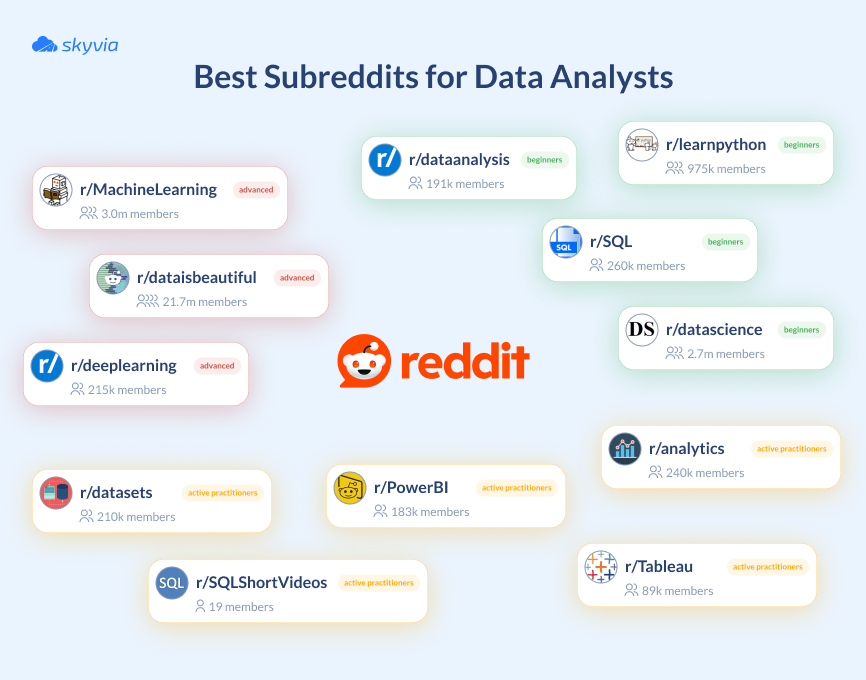
- In this article we gathered best subreddits for data analysts that include universal resources such as r/datascience, practical hands-on hubs like r/dataanalysis, r/analytics and r/learnpython, and industry specific communities like r/deeplearning.
Your dashboard shows one number, the finance sheet shows another, and the person who built the query left last spring. Plenty of analysts end up on Reddit at that moment, typing the problem into a search box and hoping someone has been there before.
Someone usually has. Spend a slow afternoon reading the best subreddits for data analysts and you'll catch one person untangling a SQL join, another fighting over what a KPI means, and a stranger giving away a dataset. Nothing there is private. That's the point: the next analyst with your headache can search and land on the same thread. Choosing the community is what takes effort. Pick the wrong subreddit and the thread may sit there for days with no replies at all. Pick the right one and an answer might show up within the hour.
The 11 subreddits below go by career stage. Foundation builders come first, then communities for sharpening skills, and last the ones for staying ahead. After the list there's a table that sends common questions to the right place, along with a few habits that help your posts get answered.
For the Aspiring Data Analyst: Building Your Foundation
So, you’ve made up your mind to become a data analyst. An exciting and challenging road lies ahead that could lead you (with persistence and a little luck) to a more interesting and financially rewarding career. The subreddits below belong to that rare corner of tech where simple questions aren’t punished, and newcomers are treated with friendliness.
r/dataanalysis
It is best described as a practice lab for the craft of analysis itself. With career questions and CV reviews being filtered into a separate subreddit, the feed stays focused on methods, tools, statistics, and “how do I reason about this dataset?” posts. It’s less about “how do I become a data analyst?” and more about “how do I think like one?”
r/learnpython
This is a great resource for beginners to practice challenges, get recommendations and roadmap advice. Beyond that it often feels like a museum of beginner errors, where almost every error message has already lived at least once. Broken code, confusing error traces, and the perennial “Which resource should I use?” questions are all welcomed and explained with patience.
r/SQL
A surprisingly deep community for an “old” language, where SELECT beginners share a feed with people debugging real production queries. The culture leans practical and precise: the best answers don’t just post a fix, but ask for sample data, compare alternatives, and discuss performance trade-offs.
In the process, the community cultivates a sense of “good SQL hygiene” and teaches learners to think like a database – not just memorize syntax.
r/datascience
With over 2.7 million members, this highly active community sits somewhere between a job-advice hub and a technical forum.
From portfolio expectations and “What should I learn next?” to debates about tooling, ethics, and automation, the discussions here show you what actually matters in the field – not just what courses teach.
For the Practicing Data Analyst: Sharpening Your Skills
So, you’ve departed from safe harbour and waded into the turbulent waters – dashboards breaking at 4 AM, SQL joins returning one suspicious row, stakeholders expecting miracles by Friday.
Welcome to the club! Now you have real problems to solve, real tools to sharpen – and real communities to tap into when your world crumbles apart.
r/analytics
This subreddit is laser-focused on applied analytics: web tracking, business dashboards, attribution puzzles, stakeholder questions, and all the tool chaos that comes with them.
The community is large and very active, with a lot of posts tagged as advice and solution requests – people asking which tools actually hold up in production, trying to untangle vague KPIs, or simply pouring their hearts out about the daily challenges of analytics.
r/PowerBI & r/Tableau
These two subs function as specialized clinics: Power BI and Tableau questions that might get lost in general data forums get answered by people who live in these tools every day – often with screenshots, workaround patterns, and “this is how we do it in production” explanations.
r/datasets
When r/datasets describes itself as “a place to share, find, and discuss datasets,” it genuinely lives up to that promise. Like a closet full of eclectic props, this sub is where you find the most unexpected datasets — from NASA-style satellite imagery to detailed NBA performance logs. It’s the go-to resource for sharpening your skills on data that isn’t tied to your employer’s projects.
r/SQLShortVideos
With its pool of helpful short SQL videos, this resource aims at those who like learning in small chunks and prefer videos over texts. The knowledge is taught via walk-through demonstration videos, optional practice exercises and quizzes, and a focus on building expertise in SQL Server.

For the Advanced Data Analyst: Staying Ahead of the Curve
Debugging production queries is just another Tuesday. You don’t panic when an ETL pipeline fails – you already have logs open and coffee brewing. You’ve developed the habit of questioning logic, tracing assumptions back to source, and treating data validation as a sport. You also have a beard, a dark-themed IDE, and a favorite logging tool nobody else understands.
If that sounds familiar, you’ll feel right at home in the subreddits below.
r/MachineLearning
This is one of Reddit’s oldest and busiest hubs for machine learning & AI research discussion. It’s not just about “how to build.” It’s: “What’s coming next, and does it belong in your stack?” Topics span from cutting-edge deep learning, statistical learning theory, model evaluation, to ethics and deployment challenges.
r/dataisbeautiful
This sub is a place to see that data is more than just numbers, and each dataset has a story waiting to be told. But don’t let pretty pictures mislead you – to work its way to the top, OC posts should not only be visually compelling but also informative.
This is one of Reddit’s top visualization hubs, where analysis gets a soul, and where seasoned analysts come for inspiration.
r/deeplearning
Here you’ll find lots of specialized content focused on neural network architecture, deep-learning research, libraries/frameworks, and practical issues like training pipelines, debugging, and scaling. This is not a place for simple questions – many participants have real-world experience building or deploying deep models.
Where Should You Post Your Question?
Right question, wrong place? It goes nowhere. Ask yourself which community already handles problems like yours, and post there.
| Your problem | Where to post | Why it fits |
|---|---|---|
| "How should I approach this dataset?" | r/dataanalysis | Focuses on methods, tools and statistics. Career questions go to r/dataanalysiscareers. |
| A Python error you can't read | r/learnpython | Beginners post broken code and confusing error traces and get patient explanations. |
| A SQL query that is slow or wrong | r/SQL | Answerers ask for sample data and compare alternatives and performance trade-offs. |
| A dashboard, attribution or stakeholder puzzle | r/analytics | Applied analytics: web tracking, business dashboards, KPIs and tool choices. |
| A Power BI or Tableau question | r/PowerBI or r/tableau | Users of these tools answer, often with screenshots and workarounds. |
| Practice data that isn't tied to your employer | r/datasets | A place to share, find and discuss datasets. |
| A chart you built and want feedback on | r/dataisbeautiful | OC posts should be visually compelling and informative. |
| "What should I learn next?" | r/datascience | Mixes job advice with technical discussion. |
Two rows fit? Go with the narrower subreddit. Take a Power BI question: r/PowerBI will usually answer it better than a general forum, since the people reading it use the tool every day.
Of course, Reddit is only one place to learn. If a thread sends you off to read up on something, try our guides to data analytics blogs, podcasts and YouTube channels for data analytics.
How to Be an Effective Member of Data-Focused Subreddits
As with any social platform, Reddit has norms, rules, and expectations that shape the interaction of its members – redditors. So, what should you know to be an effective member of data-focused communities?
Lurk Before You Leap
Before you fire up a post, spend a little time just watching. Every subreddit has its own unwritten culture – what gets upvoted, what gets ignored, what gets roasted. Read a dozen posts, skim the comment threads, check the rules in the sidebar (because some of them can be surprisingly strict).
After a bit of lurking, you’ll know whether this is a place for code snippets, full dashboards, research links, or philosophical ranting about KPIs.
Ask Smart Questions
If you’re asking for help, make sure to provide enough content. Reddit loves a good challenge, but hates guess-work. Posts with “Here’s my code, here’s my dataset, here’s where it breaks” get far better engagement than “Help, broken”. The clearer the question, the smarter the answers.
Give Back
Reddit isn’t just a place to consume knowledge, it’s a loop: what you take today, you return tomorrow. If you cracked a DAX formula that fought you for three days – share it.
If a beginner asks something you remember struggling with – jump in. You don’t have to be an expert to add value. Just be real in your desire to help others.
Use the Search Function
Before posting, try a simple search: your question may have already been answered. This should be a no-brainer, but it’s worth being reminded about. Searching first saves you time and spares those embarrassing moments when someone points out that the answer is just 10-seconds-search away from you.
Conclusion
In this article, we walked you through the best subreddits for data analysts, thoughtfully grouped by experience level and purpose. Their real power lies in peer support, when challenges and fears are shared openly, and where patterns, ideas, and techniques spread through the hive mind.
But applying that knowledge is an individual journey. When the moment comes to build something real, you need the right infrastructure that will not fail.
That’s where Skyvia earns its place in a professional analyst’s toolkit. This no-code data integration platform will help you integrate faster, automate deeper, and spend less time wrestling pipelines – and more time creating value.

FAQ for Best Subreddits for Data Analysts

Where on Reddit can I ask SQL questions?
Head to r/SQL. Both beginners and people debugging production queries share the feed there. A slow join on a Friday afternoon? Bring the query, a small slice of the data and the line where it breaks. The best answers there ask for sample data before suggesting a fix. Posts that clear tend to get precise replies.
Which subreddit is best for Power BI or Tableau questions?
Each tool has its own: r/PowerBI for Power BI and r/tableau for Tableau. Picture a DAX question sinking in a general data forum while nobody reading it lives in the tool. Here the readers use these tools every day, and answers often come with screenshots and workaround patterns.
Does Reddit have datasets to practice on?
It does, in r/datasets, which describes itself as a place to share, find and discuss datasets. The range is odd and wide, from satellite imagery to NBA performance logs. That makes it a handy spot to practice on data that has nothing to do with your employer’s projects. Look up a dataset’s license or source before it goes into public work.
How do r/dataanalysis and r/datascience compare?
r/dataanalysis is the workshop. The posts there are about methods, tools and statistics, and career questions go to another subreddit. In r/datascience you get more of a crossroads between a job-advice hub and a technical forum, with portfolio expectations, ‘what should I learn next?’ threads and debates about tooling, ethics and automation.
How do I get an answer on a data subreddit?
Sidebar rules come first, since some subreddits are surprisingly strict, so read them before you post. Then share your work, meaning the code, the dataset and the exact place it breaks. A post like that gets far better engagement than ‘Help, broken’. Search the subreddit first, too. Your question may already have an answer.