

Summary
- Skyvia – no-code integration built for teams that need results without the maintenance saga.
- Airbyte – open-source flexibility, at the cost of owning your own infrastructure.
- Estuary – the closest thing to genuine real-time CDC in this list.
- Talend – the enterprise choice when governance and on-premises execution aren’t optional.
Fivetran is undeniably one of the most powerful ELT tools on the market, which might easily cause messages from finance after your Monthly Active Rows bill goes up. If that’s why you’re here, you’re probably looking at Fivetran alternatives more eagerly than you had before they changed their pricing policy in 2025-2026.
Disclosure first: I work at Skyvia, so you can call me biased. But I did my best to offer comparison criteria that can do both – praise and criticize when it’s deserved. Also, I split everything by use case, and you’ll see my tool measured against the names that actually come up in any Fivetran competitor comparison – Airbyte, Estuary, Talend – on real pricing and real limits.
How Did We Test and Evaluate These Data Integration Tools?
This article comes from more than just reading changelogs and marketing pages of Fivetran competitors. Our data engineering team spent a little over 30 hours actually running these platforms side by side.
The setup: roughly 20,000 Salesforce rows loaded into a fresh Snowflake warehouse. Same source, same destination, same warehouse size, every time – the only variable was the tool sitting in between.
Our Fivetran’s competitor comparison stands on three whales:
- Pipeline setup time – from creating an account to seeing the first row land in Snowflake, timed with a stopwatch, not a marketing claim.
- Sync latency – how long a change in Salesforce took to show up in the warehouse, measured on the same connector across every tool.
- Pricing model predictability – whether we could calculate next month’s bill from this month’s usage without opening a support ticket to find out.
Every number in the comparisons that follow comes from that same test, run through the same Salesforce-to-Snowflake pipeline.
Fivetran vs. Competitors: Direct Pricing and Feature Comparison
| Criterion | Skyvia | Airbyte | Estuary (Flow) | Talend (Qlik) |
|---|---|---|---|---|
| Platform | No-code cloud platform for integration, import/export, replication, sync | Open-source ELT; managed cloud or self-hosted | Managed real-time platform, streaming CDC + sub-second ELT | Enterprise data fabric – ETL, data quality, governance |
| Best Use Case | Solo analysts to full data teams – no engineering team required | Engineers who want customizable pipelines across many connectors | Teams that need real‑time CDC and streaming ELT without managing Kafka | Enterprises needing a full‑featured ETL/data fabric platform with governance and complex transformations |
| Pricing Model | Volume-based. Free (10k records), Basic ~$79/mo (5M), Standard ~$159/mo, Pro ~$399/mo (10M+), Enterprise (custom) | Credit-based in Cloud (starts at $10/mo); free if self-hosted, infra cost only | Usage‑based: ~$0.50/GB processed + ~$100/connector/mo. Free tier: 10GB, 2 connectors | Subscription / quote‑based (Qlik Talend Cloud). Typically flat‑fee / tiered enterprise pricing |
| Lowest Sync Latency | Scheduled batch: daily on Free/Basic, ~1 min on higher plans. No true streaming CDC | Batch / micro‑batch: 15 min minimum on Cloud Plus/Pro. Batch, not streaming | Sub-second CDC, log-based capture. Designed for real‑time pipelines | Batch / scheduled: 5 min to hours depending on job. Not built for streaming |
| API / Setup Complexity | No‑code visual wizard: connectors, mapping, and schedules configured via UI; minimal engineering required | Low-code UI; advanced cases need YAML/Docker | Low-code, but CDC concepts need engineering knowledge | Code-heavy, Java/SQL, steep learning curve |
Skyvia: Best No-Code Fivetran Alternative for Predictable Costs
Some of the tools in this list assume you enjoy infrastructure. This one assumes you’d rather not think about it at all.
Skyvia
Skyvia covers the full range of data integration work – ETL/ELT, Reverse ETL, sync, orchestration, live data access – through a no-code interface, without requiring engineering resources to run it.
Salesforce went fast – click, sign in, authorize, under a minute. Snowflake wanted more before it would accept anything: domain, user, password, etc. It was easy enough because I’ve got those three values on hand thanks to testing different integrations for this blog. It might be slightly annoying if you don’t and have to go dig for them mid-setup.
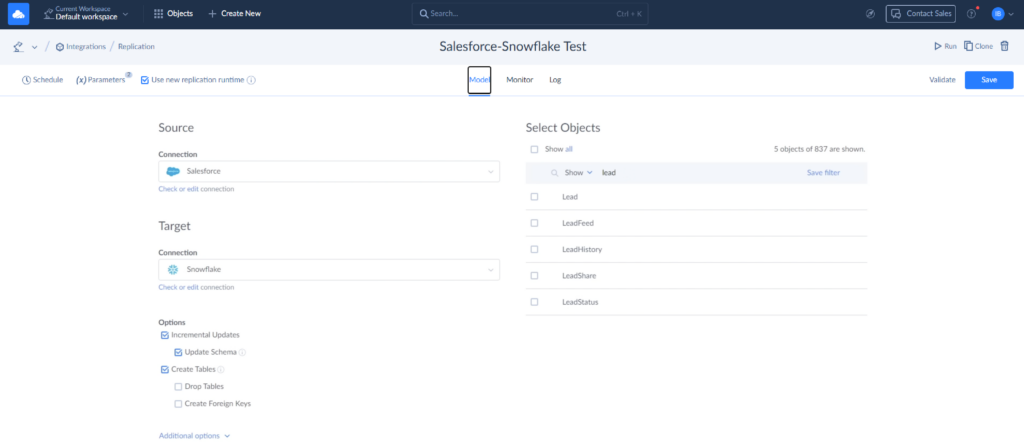
Then comes the actual Replication task. Salesforce is the source, Snowflake is the target, and Leads is the object to be sent to the DWH (all the fields within the object will be replicated by default, but you can specify if needed).
Then, I watched it land in Snowflake via the Monitor tab, scheduled it hourly, and left it alone. 20K rows arrived at their destination in roughly 40 seconds.
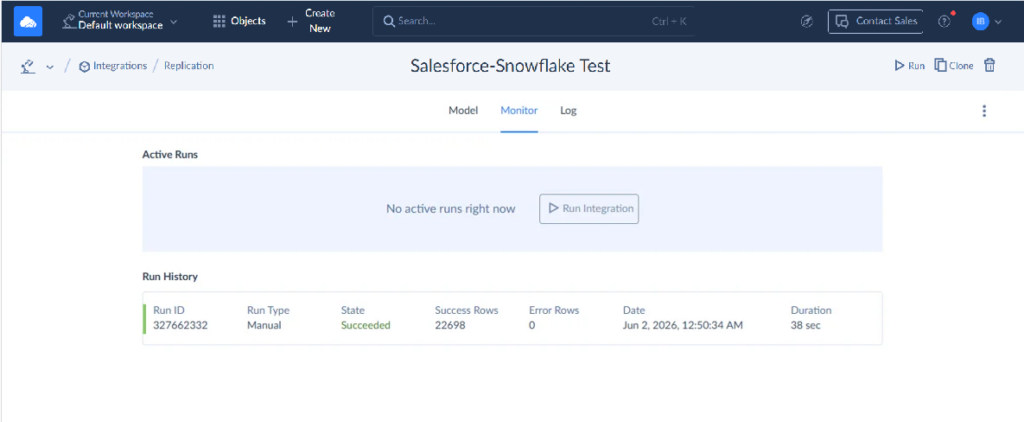
That’s really the whole story. No terminal open, no config file to write, nothing to patch afterward. Whether that counts as impressive or just expected from a no-code tool depends on what else you’ve tried, which is more or less the question this whole article is trying to answer.
Best for
Engineers who’d rather not maintain pipelines by hand, and analysts, ops, marketing, or finance teams who have no engineer to ask at all.
It’s also worth being clear about what it’s not for: if what you need is “when a new file lands, branch into three different HubSpot actions depending on its contents,” that’s an automation problem, not an integration one.
Rating
G2: 4.8/5 based on 321 reviews | Capterra: 4.8/5 based on 116 reviews
Pricing
No row-anxiety-inducing MAR model this whole article started with. Instead, Skyvia’s pricing is flat, tiered, and based on records processed.
- The free plan covers 10,000 records/month, enough to genuinely test a pipeline before paying anything.
- Basic starts at $79/month for 5 million records.
- Standard sits at $159/month with more headroom.
- Professional runs $399/month.
- Enterprise, with unlimited records, higher processing capacity, a dedicated virtual machine, etc., is custom.
Note: You can choose the record cap for every plan, so if, for example, the Basic plan suits you in everything but volume, you simply bump the record cap up without jumping to the next tier for features you don’t need.
See the Skyvia pricing page for current tiers.
Pros
- Visual, no-code setup gets a first pipeline running in minutes – nothing to write, barely anything to configure.
- 200+ connectors, deep enough that most teams never touch a raw API.
- When a source schema changes, Skyvia adapts on its own where it can and flags it when it genuinely needs a human to look.
- One tool for the whole warehouse workflow. Ingest, model with hosted dbt Core, push data back out to operational systems with Reverse ETL, and orchestrate the whole chain.
- A live monitoring view, logs down to the row count and error detail per object, and a failure email before a bad sync quietly shows up in someone’s report.
- Flat, predictable pricing instead of a meter that climbs with every sync.
- SOC 2, GDPR compliance, encryption both in transit and at rest, audit logs. Nothing flashy, all of it expected, and exactly what a team should demand before customer or deal data goes anywhere near a third-party pipeline.
Cons
- Skyvia’s fastest sync interval is one minute, and it’s polling-based – log-based CDC currently covers MS SQL Server only. For true sub-second streaming, Estuary is the better fit.
- Skyvia is cloud-only, so if your data can’t leave your premises, this is not your best shot.

Airbyte: Best Open-Source Fivetran Competitor for Connector Flexibility
If your team lives in a terminal more than in a browser, “no-code” isn’t a convenience, but rather a constraint. This is where open-source Fivetran alternatives earn their keep.
Airbyte
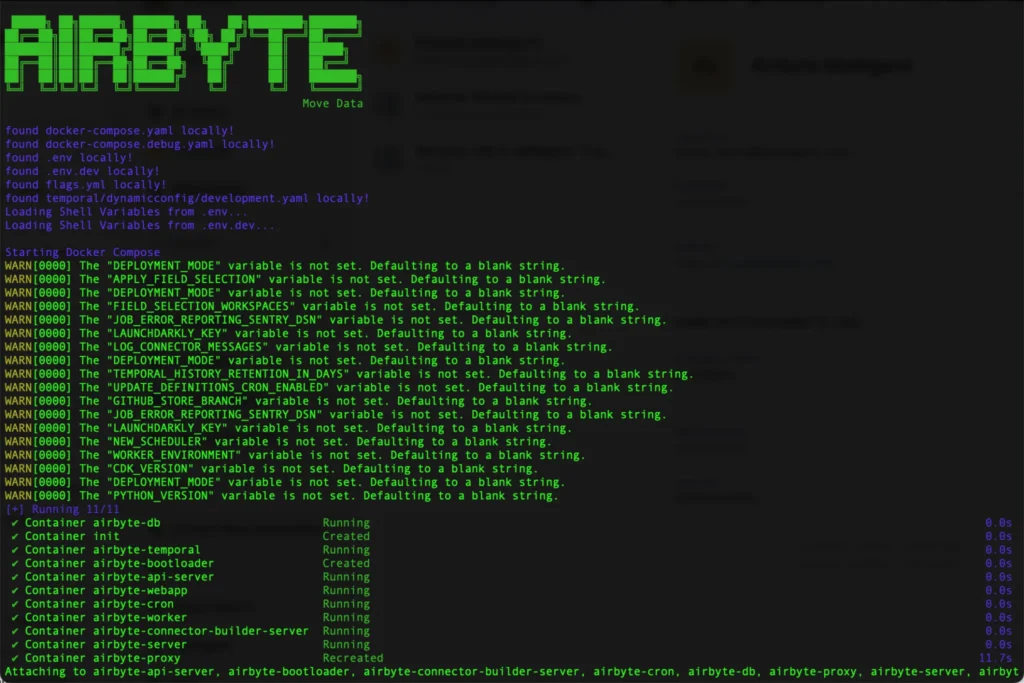
During our test, Airbyte’s open-source version impressed us in several ways. We did not use Docker Compose: the current local self-hosted installation uses abctl, which deploys Airbyte into a local Kubernetes environment.
On our first attempt, the installer remained on “waiting for Airbyte to become ready” for almost nine minutes. We checked the Kubernetes status with kubectl get pods and found two pods repeatedly restarting. Docker Desktop had only 4 GB allocated. After inspecting the pod events and logs, we attributed the failure to insufficient resources.
We increased Docker Desktop’s allocation to 10 GB and reran the abctl local install. On the same machine, the cluster became ready in under three minutes.
The next issue appeared when connecting a Salesforce sandbox. The Salesforce Connected App needed API access and the permission commonly shown as “Perform requests at any time (refresh_token, offline_access)” so the integration could maintain access after the initial login.
The connection returned a generic invalid_grant error. That error can indicate an OAuth permission or policy problem, a sandbox URL mismatch, refresh-token rotation or revocation, or another token-lifecycle issue. We identified the problem by comparing Airbyte’s Salesforce requirements with the Connected App configuration and Salesforce audit information. Once those issues were resolved, the sync ran normally.
Best for
A team already running Kubernetes for something else can usually bolt Airbyte on for close to nothing – there’s headroom, so why not use it? Start that cluster from scratch just for this, though, and the “free” open-source version quietly stops being free once you tally the setup week.
The other clean case: your source system is something like an internal billing API or a legacy on-prem database that no vendor bothered building a connector for. That’s not a pricing decision anymore – Fivetran can’t do it, and Airbyte’s CDK is the only door left open.
Rating
G2: 4.4/5 based on 78 reviews | Capterra: n/a
Pricing
Self-hosted Airbyte has no license fee. That doesn’t mean it’s free – you’re paying for the VPS or Kubernetes cluster, the database, monitoring, backups, and the engineering hours to keep all of it patched and running. At high volume, this usually beats Fivetran on raw cost. At low volume, the engineering time alone can eat the savings.
You can swap that operational burden for usage-based credit pricing with Airbyte Cloud. Entry plans start around $10/month for light usage, according to public estimates, with team plans closer to $150 – though what you pay hinges on how many connectors you’re running and whether your syncs are full refreshes or incremental. See Airbyte’s pricing page for current tiers.
Pros
- Fully open-source and self-hostable – you’re the king or queen of this castle.
- Connector catalog past 300, plus a CDK for anything missing.
- Self-hosting can undercut Fivetran meaningfully at real scale.
- Engineers can directly touch transformations, orchestration, and connector behavior.
Cons
- Self-hosting means someone owns deployment, upgrades, monitoring, and incident response.
- Connector maturity is inconsistent – official ones are solid, community ones can be hit or miss.
- Airbyte Cloud’s credit-based pricing is harder to forecast than a flat subscription.
- Full-refresh syncs on large tables can quietly spike usage-based costs.
Estuary: Best Real-Time Streaming & CDC Alternative to Fivetran
Fivetran isn’t strictly batch-only – some connectors and plans support shorter intervals or even CDC, but 15-minute syncs are still the common default. Fine for most dashboards, but less fine once a workload needs data to move continuously instead of on a timer.
Estuary
Same Salesforce-to-Snowflake test here, but worth being precise: this isn’t the WAL-based CDC people picture when they hear “Estuary.”
The pipeline runs in three stages – a Salesforce capture reads objects through Salesforce’s APIs, feeds a durable Estuary collection, and a materialization writes that into Snowflake. Setup meant creating a scoped Salesforce connected app, pointing it at our sandbox, picking objects (Account, Contact, Opportunity), and running an initial backfill before incremental updates kicked in.
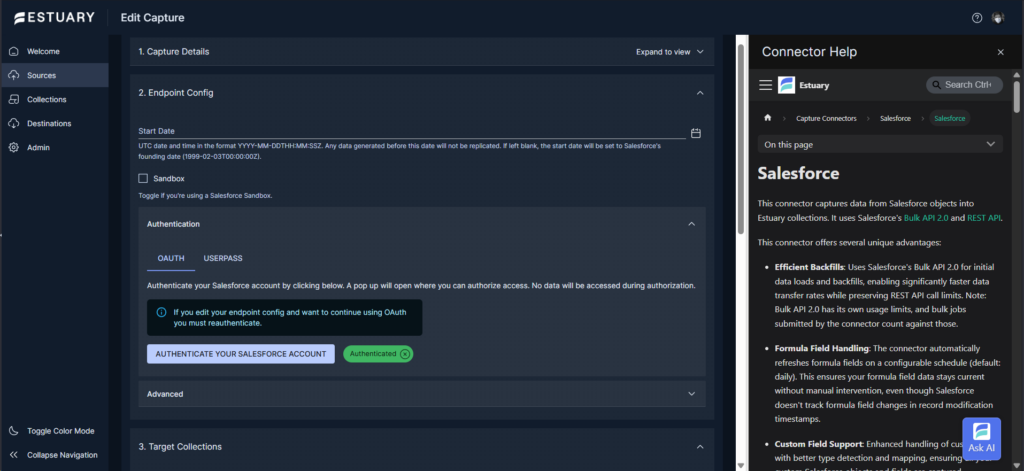
No WAL means the connector runs on Salesforce’s own incremental mechanisms, sharing API quota with everything else hitting that org. Expect latency in seconds or low minutes, not Estuary’s advertised sub-100ms. Standard objects behaved predictably; formula fields, custom objects, and deletes needed separate checking.
What does carry over: the collection itself, durable and replayable, capable of feeding more than one destination from a single capture. We landed raw data first (RAW_SALESFORCE.ACCOUNT, .CONTACT, .OPPORTUNITY), then built staging and mart layers in Snowflake afterward – keep raw dumb and complete, normalize and dedup in staging, save business logic for the mart.
One cost catch: every materialization write can trigger a Snowflake warehouse resume, so a tight sync interval built for freshness can keep a warehouse from ever fully sleeping. Save near-real-time settings for genuinely operational needs; let anything purely analytical run longer.
Best for
Teams where “the dashboard is five minutes stale” is an actual business problem, not a shrug – live financial dashboards, real-time inventory, fraud checks that need to fire before a transaction clears. It’s also the right call for teams that want streaming without standing up and babysitting their own Kafka cluster, since Estuary’s managed layer absorbs a lot of what would otherwise be a full-time infrastructure job.
Rating
G2: 4.7/5 based on 35 reviews | Not listed on Capterra so far
Pricing
Estuary’s pricing breaks into two meters: roughly $0.50 per GB moved, and $100 per month per connector (for the first six). Say you’re pushing 200GB a month through two connectors that never sleep – that’s about $100 for the data itself, and $200 for those two connectors. Roughly $300 total before any free-tier allowance.
Pros
- Genuine streaming architecture, not batch polling in disguise.
- Exactly-once delivery on supported destinations, which cuts down on duplicate-record cleanup.
- Durable, replayable collections mean a broken downstream system doesn’t force a full re-extraction from source.
- Handles both streaming and scheduled batch in the same platform, so non-CDC sources aren’t a second tool.
Cons
- Connector-hour billing means always-on pipelines cost money even when nothing’s changing.
- CDC health depends on source configuration; a stalled replication slot on Postgres can cause WAL growth and real operational pain, not just a delayed sync.
- Genuinely overkill for something like a daily Google Ads pull – you’d be paying for streaming infrastructure to move data that was never time-sensitive.
- A steeper learning curve for teams used to thinking in scheduled jobs rather than collections, captures, and materializations.
BladePipe: Best Fivetran Alternative for Database Migration & CDC
For teams comparing Fivetran alternatives beyond managed warehouse ingestion, BladePipe provides database-focused data integration. It combines full migration, CDC, and continuous delivery, while allowing sensitive data to remain in a controlled environment.
Key features include log-based CDC for inserts, updates, and deletes; 60+ connectors for databases, warehouses, queues, caches, and lakehouses; schema migration, data-type conversion, DDL sync, and visual transformations; verification, correction, monitoring, alerts, and checkpoint recovery; plus cloud, BYOC, and on-premise deployment.
Best for
Organizations moving data between heterogeneous databases, real-time warehouses, queues, or search systems. It fits teams that need low-latency replication, zero-downtime migration, or control over infrastructure and data location.
Rating
G2: no reviews | Capterra: no reviews
Pricing
The Community edition is free. Cloud pricing starts at $0.01 per million ETL rows, while CDC replication is charged at $10 per million rows, including rows added, edited, or deleted. Enterprise pricing is quote-based.
Pros
⦁ More deployment flexibility than cloud-only services.
⦁ Combines database migration and ongoing replication.
⦁ Low-latency delivery with latency below five seconds.
⦁ Keeps data within the organization’s network when self-hosted.
⦁ Free Community edition for evaluating core capabilities.
Cons
⦁ Smaller ecosystem than long-established incumbents
⦁ Less focused on marketing/SaaS connectors
⦁ Narrower brand recognition than older vendors
Talend (Qlik): Best Enterprise Fivetran Competitor for Hybrid & On-Prem Workloads
At some point, “just sync it to the cloud” stops being an option because the data isn’t allowed to leave the building, or because there’s a mainframe involved that predates half your engineering team. That’s a different problem than anything Airbyte or Estuary was built to solve.
Talend
Try moving petabytes out of an on-premises Oracle instance with a lightweight cloud-native connector, and you’ll find out fairly quickly where its limits are. That’s why there are tools like Talend that handle moving records from A to B while proving to an auditor exactly what happened to it along the way.
Talend can run execution on-premises or through remote engines, close to the legacy systems that can’t move, while management and governance stay centralized in Qlik’s cloud layer.
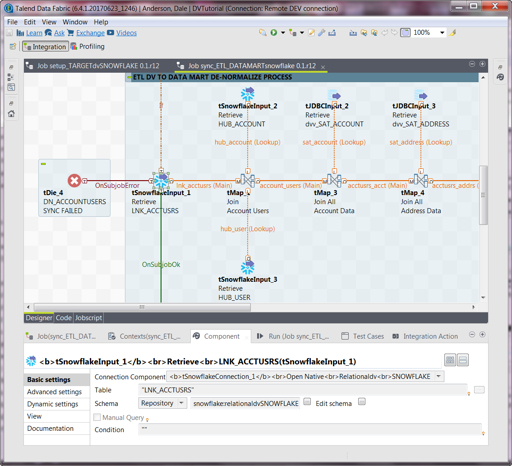
The canvas above is a fairly ordinary reconciliation pipeline: 14 components, three subjobs, Salesforce leads flowing in, getting mapped, run through data-quality checks, schema-compared, normalized, selectively masked, logged, and only then landed in Snowflake.
Worth flagging too: Talend’s now marketed under Qlik’s data-integration portfolio, and reviews split noticeably between the legacy Talend product and the newer Qlik Talend Cloud packaging. Anyone evaluating it seriously should get clarity on which edition, roadmap, and support policy applies before signing anything.
Best for
Fortune 500s running legacy mainframes alongside modern cloud infrastructure, industries where compliance teams have veto power over where data physically sits, and architectures complex enough that a single pipeline touches half a dozen internal systems before it’s done.
Rating
G2: 4.3/5 (105 reviews) | Capterra: 4.3/5 (24 reviews)
Pricing
Custom enterprise quotes, not self-checkout. See their pricing page to find out the theme of your conversation with the Talend sales team. What matters for a real budget isn’t the license quote – it’s total cost of ownership, since Talend can be economically sound when it replaces several separate ETL, quality, and governance tools at once, but expensive overkill for one lightweight pipeline.
Pros
- Genuinely built for on-premises and hybrid execution, keeping sensitive or legacy data close to home.
- Handles multi-step transformations, cleansing, enrichment, and orchestration that would strain a lightweight ELT connector.
- Built-in profiling, standardization, validation, lineage, and cataloging – governance isn’t an add-on; it’s core.
- Connects cloud apps, databases, files, APIs, warehouses, and legacy platforms in one environment.
- Supports pre-load masking and filtering, useful anywhere customer data needs to be minimized before it reaches a destination.
- Mature enough for role-based administration, deployment controls, and dedicated support contracts.
Cons
- Total cost of ownership climbs fast once infrastructure and implementation are priced in – not a fit for a $99/month budget.
- Needs experienced, often certified engineers to build and maintain – not something a business user sets up in an afternoon.
- Implementation is a project, not a signup: architecture design, security review, environment setup, and testing all take real time.
- Not built around sub-second streaming CDC – that’s Estuary’s strength, not Talend’s.
- Ongoing operation typically needs dedicated administrators for deployments, upgrades, and troubleshooting.
- The interface reflects two decades of history more than its recent Qlik rebrand.
How to Choose the Right Fivetran Alternative for Your Data Stack
Though I don’t have a universal Fivetran alternative to satisfy every team, the evaluation pattern I am about to offer is quite universal.
Start with where the data’s even allowed to live. If a source system can’t touch the public internet, that knocks most of this list out before latency or budget ever come up. Talend’s whole hybrid model exists for exactly that situation. Everyone else here is assuming SaaS is fine.
Now, get specific about the speed you want to move at. An hourly CRM refresh and a fraud check that has to start before a transaction clears aren’t the same job. Mixing those two up costs either way: overpay for streaming nobody needed, or ship something technically “working” that’s still too slow to matter.
Then look honestly at what actually has to happen to the data before it lands. Renaming a column is not the same category of problem as joining three tables, deduplicating, masking PII, and validating against a schema before anything moves downstream. A visual mapper handles the first fine. The second needs a real transformation layer – in-stream with Estuary, or a dedicated engine with Talend.
Now, something people usually think about only after the decision has been made, sealed, and paid for – who’s going to save the day when something breaks? If nobody on your team can debug a stalled container or a stuck replication slot, it’s better to leave self-hosting for others. It’s safer to choose a no-code or at least low-code tool that does the job without you hiring a data engineer.
And only after all that, run the cost math – at three times your current volume, not this month’s. Plenty of platforms look cheap today and ugly at scale.
Here’s how those five questions map to a pick, roughly:
| Ask yourself | Points toward |
|---|---|
| Data can’t leave the building/legacy on-prem systems involved | Talend |
| Source is a database, and minutes of staleness costs real money | Estuary |
| Team already lives in Docker/Kubernetes, wants full control | Airbyte |
| Just want predictable pricing and no infrastructure to maintain | Skyvia |
You’ve read a bit more than 3,000 words of me comparing Fivetran alternatives. At some point, that has to become a pipeline, actually running in front of you. Try Skyvia now – just open a second tab, connect one real source, and see if you hit “synced” before your coffee’s still hot.

FAQ for the Best Fivetran Competitors & Alternatives in 2026

Is Airbyte a direct drop-in replacement for Fivetran?
No. Fivetran hands you a managed service; Airbyte hands you a platform to run. Same destination, different job description – one you maintain yourself.
Can Fivetran handle real-time data streaming?
Not really. Most connectors sync every 5-15 minutes. Some support faster intervals, but true sub-second CDC isn’t Fivetran’s game – that’s Estuary’s territory.
Does Fivetran support bi-directional syncing (Reverse ETL)?
That’s a separate product line for Fivetran, not the core sync engine. If Reverse ETL matters, check whether it’s bundled or billed on top before assuming it’s included.
What if my company requires strict on-premise data integration?
Then most of this list is off the table. Talend, self-hosted Airbyte, or something like Informatica handles that – cloud-only SaaS tools simply aren’t built for it.