Summary
- Hightouch fits marketing teams that need warehouse-native audiences and real-time syncs, with a free tier of 2 active syncs. Skyvia – cloud-native, no-code data platform providing visual integrations, scheduling, and automated backups.
- Fivetran Activations, the former Census, suits teams that already load their warehouse with Fivetran and want one bill.
- Skyvia covers no-code CRM updates together with ingestion, sync and backup, from $79 a month billed annually.
- Airbyte is the open source choice, with data activation on its self-hosted Core edition.
- Twilio Segment and RudderStack include reverse ETL in their customer data plans.
Picture a list of accounts that look ready to churn, sitting quietly in your warehouse. Each night the scores in that Snowflake table get refreshed. The account manager, meanwhile, pulls up Salesforce, sees no warning at all, and learns the truth at renewal time. Sure, somebody exports a CSV once in a while. By Thursday the file is out of date again.
Reverse ETL tools take that chore off the table: warehouse data goes straight into the CRM, marketing and support apps your people keep open all day. The market has also changed fast: Census now lives inside Fivetran, Grouparoo is archived, and Hevo Activate takes no new users. A list written in 2024 points you to products you can’t buy.
In October 2026, we checked seven tools that still do the job against their own pricing pages and docs. Below you’ll find a quick answer by situation, a comparison table with each tool’s pricing unit and fastest sync, and a tested SQL model for your first sync.
Reverse ETL tools at a glance
Our advice is to start from the tools already on your invoice. Connector counts almost never decide it. Ownership of the sync decides it, along with how old the data can be before anyone minds.
| If you need… | Look at | Why |
|---|---|---|
| Warehouse-native audiences and syncs for marketing, in real time | Hightouch | Syncs to 300+ destinations, real-time through your warehouse’s change data capture, free tier with 2 active syncs |
| Reverse ETL from the vendor that already loads your warehouse | Fivetran Activations (formerly Census) | Same contract and MAR billing as Fivetran connections, 200+ activation destinations |
| No-code CRM updates plus ingestion, sync and backup in one tool, with a low entry price | Skyvia | Import writes warehouse query results into apps with upsert; plans from $79 a month billed annually |
| Open source you can self-host | Airbyte | Data activation runs on every edition, including Airbyte Core |
| Warehouse data in a CDP you already use | Twilio Segment, RudderStack | Reverse ETL records or events included in their customer data plans |
| Two-way syncs between apps, databases and APIs, with a self-hosted option | Polytomic | ETL, CDC streaming and reverse ETL in one platform, pricing from $500 a month |
One test comes before any comparison. Check the destination object for a field you can match on, whether that’s a record ID, an external ID or an email. Every tool here needs it to know which record to update, and no connector can make up for a missing one.
What is a reverse ETL tool?
A reverse ETL tool copies modeled data out of your warehouse (Snowflake, BigQuery, Redshift, Databricks) and into the operational systems where work gets done, usually CRMs, marketing platforms, ad networks and help desks. Inbound is a separate job: traditional ETL and ELT extract data from apps and load it into data warehouses for analytics. This goes back out. So when you compute a churn score in SQL, it ends up on the Salesforce account page (where an account manager actually looks).

The gap it closes is real. IDC ran a survey of 1,500 enterprise leaders for Seagate, and companies were putting only 32% of their available data to work; making collected data usable was the barrier respondents named first. Got a lead score that never leaves a dashboard? It belongs to the other 68%.
Not every vendor calls it the same thing, which can confuse a search. For Fivetran it’s Activations and for Airbyte it’s data activation, though Segment and Hightouch still say reverse ETL.
Reverse ETL use cases
Teams put it to work in their own ways, yet each use case begins as one column of a warehouse table:
- Sales: reps open the Salesforce or HubSpot account and find the lead score, product usage and open invoices right there, so they know who to call first without a trip to the BI tool.
- Marketing: SQL audiences travel on to email and ad platforms, and that’s how you personalize messages and stop paying to advertise to existing customers.
- Customer support: plan tier and health score appear on the Zendesk or Intercom profile, which gives an agent the chance to spot an at-risk customer before hitting reply.
- Finance and operations: usage totals flow into billing or ERP records on their own, and nobody spends an afternoon retyping a CSV export each month.
Real example: GOintegro used Skyvia to move MySQL data into Salesforce, enrich customer records there, and automate exports to Google Drive. That replaced part of the manual data-handling work around those systems.
Reverse ETL and AI agents
AI agents can find an answer in warehouse data, but the next step still has to happen somewhere. Reverse ETL can push a score, recommendation, or status into Salesforce, HubSpot, or another operational app. Skyvia also offers MCP endpoints when an AI assistant needs direct access to connected app or database data.
How a reverse ETL sync works
Every tool here goes through six steps, and the only real split is clicks versus code:
- Model the data in the warehouse with SQL or dbt (whichever your team already writes), one row for each CRM record you’ll update.
- Pick the source: a table, a view or a SQL query, in most tools.
- Map fields so each warehouse column knows which destination field it fills.
- Choose the match key and behavior: the usual options are update existing records, upsert (update or insert), insert only, and delete.
- Schedule or trigger it, and since destination APIs reject rows, somebody should read those rejections.
- Check the rows that failed. A few records may be rejected even when the job itself runs. In Skyvia, you can open the run details, see the error for each rejected record, and set up email notifications for failed executions.
A few common failure points:
| Problem | What to check |
|---|---|
| Duplicate CRM records | Use update/upsert with a stable match key |
| Several warehouse rows match one account | Deduplicate before the sync |
| Null overwrites a value entered by sales | Exclude that field or define which system owns it |
| Old data gets sent again | Use incremental logic based on a timestamp/version |
| Destination rejects some records | Check row-level errors before rerunning |
Latency is where the tools differ most. Hightouch can listen for changes through the warehouse’s own change data capture and push them in real time. Fivetran Activations runs every 15 minutes on Standard and every minute on Enterprise. Skyvia runs every minute on Professional, hourly on Standard and daily on Basic. Over at Airbyte Cloud, Standard syncs hourly, and Plus gets you down to every 15 minutes.
For lead routing, minutes matter. A weekly audience refresh, on the other hand, is fine with a daily run.
Reverse ETL changes since 2025
Plenty of reverse ETL roundups haven’t caught up, so they still list tools that shut down or got absorbed by bigger platforms. Here’s the current state.
- Census is now Fivetran Activations. Fivetran signed an agreement to acquire Census on May 1, 2025. Census now runs inside Fivetran and bills on monthly active rows (MAR), and Fivetran says month-to-month Census plans ended in March 2026. Fivetran’s merger with dbt Labs closed on June 1, 2026, so ingestion, dbt transformations and activation now come from one vendor.
- Grouparoo is no longer a product. The Grouparoo acquisition was announced by Airbyte on April 7, 2022, and by April 12, 2022 its GitHub repository had been archived. It’s read-only.
- Airbyte added data activation. Its docs list reverse ETL on every edition: Core (open source), Standard, Plus, Pro and Enterprise Flex.
- Hevo Activate is closed to new users. Hevo’s docs say Activate is available only to users with existing Activations, and since July 18, 2023 only for HubSpot and Salesforce targets.
- Hightouch moved upmarket. It now sells a composable CDP and an agentic marketing platform. A free Basic Reverse ETL tier remains, and paid plans are quote-only.
- Stitch and Astera were never reverse ETL tools. Stitch is part of Qlik now, and what it does is load data into a warehouse. Astera’s pages describe data integration and warehousing, not syncs back to apps.
We dropped Grouparoo, Hevo Activate, Stitch, Astera and a standalone Census entry from this list for those reasons.
Three kinds of reverse ETL tools
The tools below fall into three groups, and the group tells you more than any feature list.
- Dedicated reverse ETL and composable CDP platforms (Hightouch, Polytomic). Reverse ETL is the core product, with the most destination options, sync controls and debugging tools.
- ELT platforms that also send data back (Fivetran, Airbyte, Skyvia). One vendor moves data in and out, with one bill and one set of connections.
- CDPs with reverse ETL (Twilio Segment, RudderStack). They collect events first and add warehouse syncs as part of a customer data plan.
The category also changes who usually owns the workflow. Dedicated reverse ETL tools tend to give marketers or data teams more control over audiences and activation, while ELT platforms focus more on moving modeled rows back into operational systems. That distinction often matters more than the raw connector count.
You can also build reverse ETL pipelines yourself with scripts against each third-party API. That works for one destination. Past one destination, each SaaS API becomes your problem, from authentication and batching to rate limits, retries and error handling, and a change on the vendor’s end can break the pipeline overnight.

How we compared the tools
For every tool we recorded the same fields from the vendor’s own pages:
- what the product is (reverse ETL core, ELT add-on or CDP feature);
- the pricing unit (MAR, events, reverse ETL records, credits, records written, active syncs);
- the free plan and its limit;
- the cheapest published paid plan, with its billing basis;
- the fastest sync the vendor documents;
- open source or self-hosting options.
Where a vendor doesn’t publish a price, the table says so.
Reverse ETL tools compared
| Tool | Type | Pricing unit | Free plan | Cheapest published paid plan | Fastest sync |
|---|---|---|---|---|---|
| Hightouch | Reverse ETL, composable CDP | Usage-based, quote | Basic Reverse ETL: 2 active syncs | Not published | Real time (warehouse CDC) |
| Polytomic | Bidirectional sync platform | Not published | No (trial) | From $500 a month | Not published |
| Skyvia | No-code data platform | Records written per month | 10k records a month, daily runs | $79 a month billed annually, $99 billed monthly | Every minute (Professional) |
| Fivetran Activations | ELT platform with activations | MAR | 3,500 activation MAR a month | Usage-based (pricing estimator) | Every minute (Enterprise) |
| Airbyte | ELT platform with data activation | Credits (Cloud) | Core: open source, self-hosted | Standard $20 a month with 5 credits | Every 15 minutes (Plus) |
| Twilio Segment | CDP with reverse ETL | Visitors, reverse ETL records | 500,000 reverse ETL records a month | Team from $120 a month (1M reverse ETL records) | Not stated on pricing page |
| RudderStack | Customer data infrastructure | Events | 250K events a month, reverse ETL included | Growth $265 a month billed monthly, $225 billed annually | 30-minute warehouse sync (Growth) |
Dedicated reverse ETL platforms
Hightouch

Hightouch built its name on reverse ETL and now wraps it in a composable CDP for marketing teams. You define records with a table or SQL, map fields, and sync to more than 300 destinations on a schedule or in real time. The real-time mode listens for changes through the warehouse’s native change data capture.
It’s built for engineers who live in Git and dbt. You can keep pipelines as YAML files in a repo. Import dbt models straight in, fire syncs as soon as dbt jobs wrap up, and step through each API call in the row-level debugger. Customer data isn’t stored by Hightouch, according to the company, and its compliance list covers ISO 27001, SOC 2, HIPAA and GDPR.
Pricing: there’s a free Basic Reverse ETL tier, good for 2 active syncs, and destinations and seats are unlimited on it. Paid plans (Composable CDP, Agentic Marketing Platform) are usage-based and quoted after a demo.
Watch for: no public paid price. Budget a sales cycle before you scale past two syncs.
Polytomic
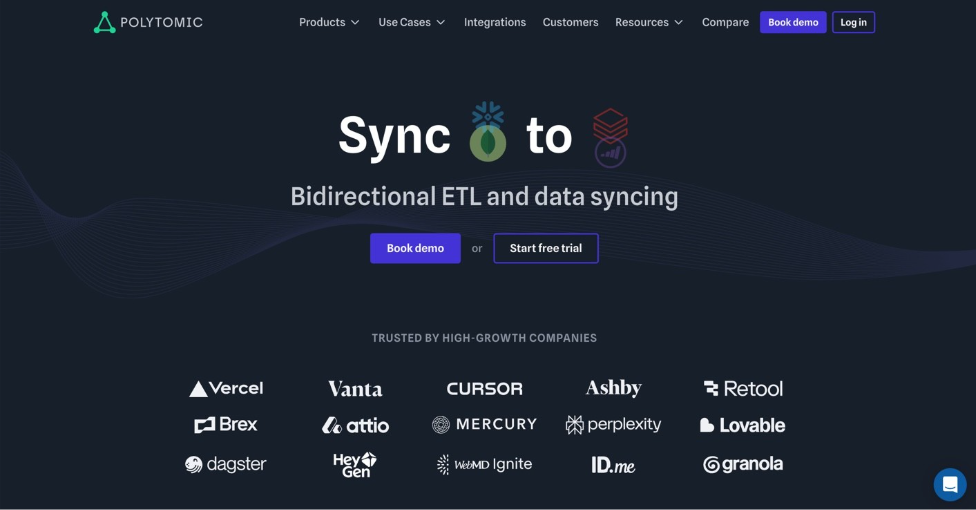
Polytomic sells one platform for ETL, ELT, CDC streaming, reverse ETL and general syncs between warehouses, databases, apps, spreadsheets and HTTP APIs. It’s a good match when the “reverse” sync is only half of a two-way flow, like product database to warehouse to HubSpot and back again.
Self-hosting is on the table, setup works through Terraform or code, and there are role-based permissions and audit logs too. SOC 2, GDPR, CCPA and HIPAA all appear on Polytomic’s compliance list.
Pricing: “Pricing begins at $500/month” on its pricing page, with Standard and Enterprise plans quoted on a call. The page doesn’t say whether that figure is monthly or annual billing.
Watch for: no free plan or published per-unit price, so small teams pay a high entry fee for a single sync.
ELT platforms with reverse ETL built in
Skyvia
Skyvia runs in the cloud without code and comes with 200+ connectors. Reverse ETL happens in Import. Hand it a warehouse table, a view or a SQL query, map the result onto a target object, and choose insert, update, upsert or delete. With Salesforce as the target there are External ID upserts and Bulk API v1 and v2, plus a Returning option that copies new record IDs back into the source.
In a recent Skyvia test, mapping Snowflake columns to Salesforce fields in the visual UI took just a few minutes. More importantly, reverse ETL doesn’t have to sit in a separate tool: the same platform can load data into Snowflake, run dbt Core, and push the modeled result back into Salesforce or HubSpot.
The same Data Integration product also replicates app data into BigQuery, Snowflake, Redshift or a database, handles two-way synchronization and runs your dbt Core project from Git. So a single tool can load HubSpot into Snowflake, run the dbt models and push scores back into HubSpot, scheduled in sequence with Control Flow on Professional. A separate Backup product covers daily backups of 36 cloud apps. Skyvia lists SOC 2, GDPR and HIPAA (with a BAA).
Pricing: Data Integration is priced by records written per month. Basic costs $79 a month billed annually or $99 billed monthly for 5M records, with daily runs. Standard starts at the same price with fewer records (500K) but adds hourly runs and Data Flow. Professional begins at $399 a month billed annually ($499 monthly), includes 10M records, and runs as often as every minute. Free gives you 10k records a month on daily runs. Signing up kicks off a 14-day trial, no credit card needed.
Watch for: syncs aren’t real-time (once a minute is the floor, and only on Professional), marketers get no audience or segment builder, and log-based change capture works for SQL Server sources alone.

Fivetran Activations (formerly Census)
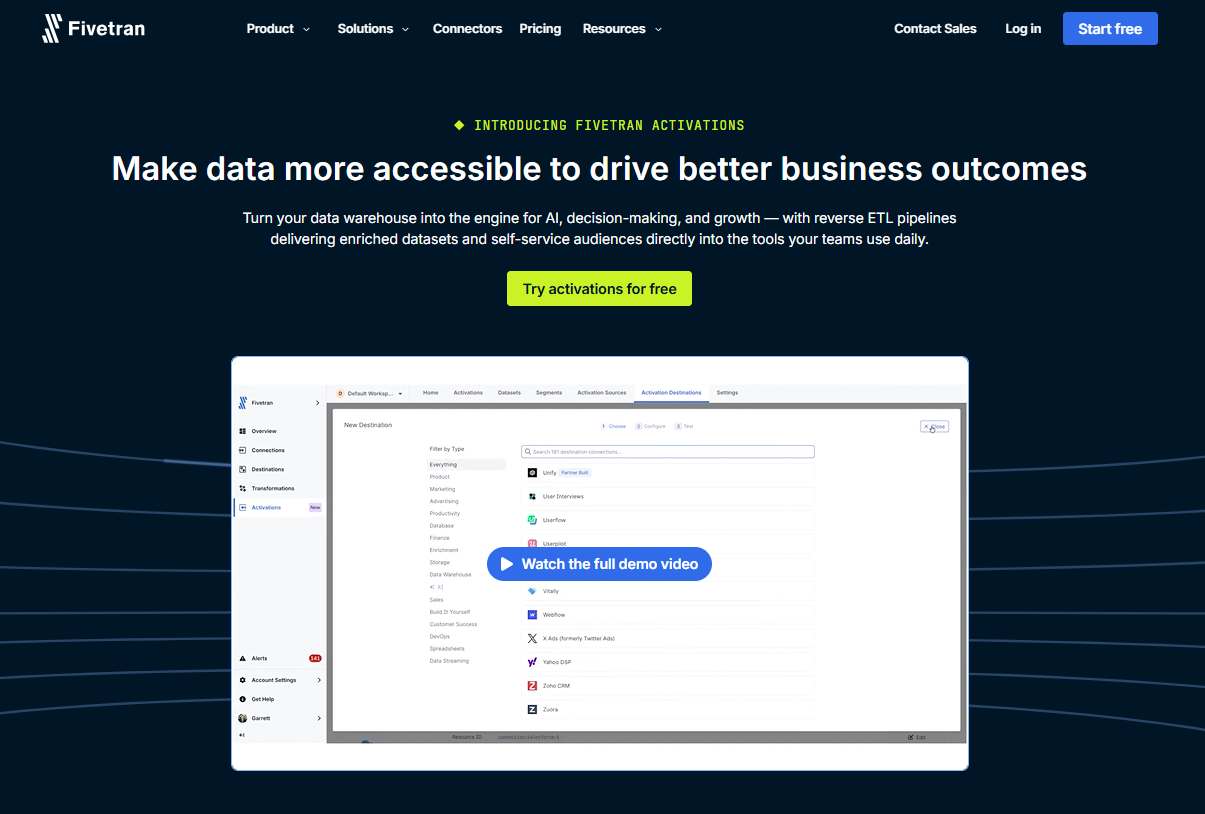
Fivetran’s docs describe Activations as managed, automated reverse ETL pipelines you set up without code. It’s the former Census product. Audience Hub, a visual segment builder that needs no SQL, comes with the Enterprise plan. Pair it with Fivetran’s 700+ngestion connectors and you get both directions in one account.
Audience Syncs go a step beyond standard row updates. They can create the destination audience, add missing profiles when needed, and remove people when they no longer match the source segment.
Pricing: each activation is billed on MAR, the unique rows synced to a destination in a month, counted once by the sync key no matter how often a row changes. On the Free plan you get 3,500 activation MAR every month, along with 500,000 MAR for connections. On Standard you get 15-minute syncs and 200+ activation destinations; Enterprise goes further, listing 1-minute syncs as well as Audience Hub. New activations come with a 14-day free trial, while an annual contract cuts the bill by up to 22%.
Watch for: a pilot fits inside 3,500 free MAR easily, though a CRM with 50,000 accounts won’t come close. Run the pricing estimator with your real row counts before you commit.
Airbyte
Airbyte is the open source pick. Its data activation feature syncs warehouse models to destinations such as HubSpot, Customer.io, Marketo and Zendesk with declarative field mapping, and the docs mark it available on every edition, including the self-hosted Core.
That makes it the free, self-hosted option on this list. The trade-off is the work: you host, upgrade and monitor it yourself.
Pricing: Airbyte Core is free and self-hosted. Airbyte Cloud Standard costs $20 a month with 5 credits, plus $5 per extra credit. Plus starts at $189 a month for 40 credits with 15-minute syncs. Pro and Enterprise Flex are custom. Cloud trials give you 14 days and 400 credits to play with.
Watch for: the 700+ connector figure includes ingestion, so check that your exact destination handles data activation before you build a plan on it.
CDPs with reverse ETL
Twilio Segment
Segment’s Reverse ETL pulls from your warehouse and sends results to Segment destinations, right beside the event collection Segment is known for. If your customer profiles already live in Segment, putting warehouse-computed traits into that same flow is the obvious next move.
Pricing: without paying anything you get 1,000 visitors and 500,000 reverse ETL records a month, plus 2 sources and 1 warehouse destination. Team, from $120 a month, covers 10,000 visitors and 1,000,000 reverse ETL records. Business pricing is custom, and the plan turns HIPAA-eligible once a BAA is signed.
Watch for: billing counts visitors too, not only records. A large audience with only a few syncs can still bump you up a tier.
RudderStack
RudderStack calls itself customer data infrastructure, covering event collection SDKs, warehouse destinations, transformations and reverse ETL. Reverse ETL is included even on Free, which lets you try a warehouse-to-app sync inside a CDP without paying a cent.
Pricing: the Free plan comes with 250K events a month. At $265 a month billed monthly, or $225 billed annually, Growth gives you 1M events along with 25 reverse ETL connections, a 30-minute warehouse sync and a 30-day free trial. Enterprise is quoted separately and brings 5-minute syncs, HIPAA and SSO.
Watch for: it suits engineers who already think in events and SDKs. A RevOps admin hoping for a point-and-click CRM update will struggle.
Prepare the warehouse model before the first sync
A clean model saves more trouble than any tool feature. Aim for one destination record per row, no more and no less, and then throw bad data at the model to see what breaks. Here, a health score and a churn risk value go to Salesforce Accounts. Only the newest score per account survives. Accounts without a Salesforce ID get dropped, and if churn risk isn’t a valid picklist value, that row waits.
The connector is often not the part that causes trouble. If two warehouse rows point to the same CRM record, or a match key is missing, the sync has no way to know which row should win. Clean that up in the model first.
WITH ranked AS (

 SELECT

   a.sf_account_id,

   s.health_score,

   s.churn_risk,

   s.scored_at,

   ROW_NUMBER() OVER (PARTITION BY a.sf_account_id ORDER BY s.scored_at DESC) AS rn
FROM accounts a

 JOIN account_scores s ON s.account_id = a.account_id

 WHERE a.sf_account_id IS NOT NULL

)

SELECT sf_account_id, health_score, churn_risk, scored_at

FROM ranked

WHERE rn = 1

 AND churn_risk IN ('low', 'medium', 'high');
We ran it on a four-account test sample and got two rows back. The account with two scores kept the newer one, the one missing a Salesforce ID disappeared, and “unknown” churn risk kept the last account out. Every so often, drop the final filter and rerun the query, just to see what you’re leaving behind.
Then map the columns. The custom field names below are examples:
| Warehouse column | Salesforce Account field | Sync behavior |
| sf_account_id | Account ID | Match key (update only) |
| health_score | Health_Score__c (number) | Overwrite |
| churn_risk | Churn_Risk__c (picklist: low, medium, high) | Overwrite |
| scored_at | Score_Updated__c (date/time) | Overwrite |
Before you turn on the schedule, check:
- One row per destination record, with no duplicate match keys.
- Every value fits the destination field type and picklist.
- The sync uses update or upsert as intended; an insert-only sync on a re-run creates duplicates.
- Fields that sales reps edit by hand aren’t in the mapping, or the team agrees the warehouse wins.
- Someone gets the rejected-row alerts.
- The first run goes to a sandbox or to a small filtered batch.
Our guide to reverse ETL in Salesforce walks through the Salesforce side in more detail.
How to choose a reverse ETL tool
Skip the feature checklist and answer these instead:
- Who runs the syncs? Marketers building audiences point to Hightouch or Fivetran Activations with Audience Hub. A RevOps admin pushing a few fields into the CRM is better served by a no-code tool like Skyvia.
- How fresh does the data have to be? Routing leads in real time takes Hightouch’s CDC mode, or at least a 1-minute schedule. A nightly score update works on any plan.
- What loads your warehouse today? Fivetran, Airbyte and Skyvia customers can add reverse ETL without a new vendor. Segment and RudderStack customers already have it in their CDP plan.
- How will the bill grow? Take your monthly row count and price it in each vendor’s own unit, whether that’s MAR (Fivetran), records written (Skyvia), reverse ETL records (Segment), events (RudderStack) or credits (Airbyte).
- Do you need to self-host? Airbyte Core and Polytomic offer it; the others are cloud services.
- Who can change a mapping? The more teams that add destinations, the harder governance gets. You want role-based access and audit logs, plus approval flows or Git versioning; Hightouch lists approval flows and Git version control.
- What compliance do you need? Look for SOC 2, HIPAA with a BAA and GDPR on each vendor’s own security page. A roundup isn’t proof.
Before you buy, run one real sync
Take a workflow you actually need, such as pushing churn-risk accounts into Salesforce, and test it end to end. Check what happens when a row is rejected, the same job runs twice, a match key is missing, or a destination field already contains a value someone entered manually.
- Can you identify failed rows individually?
- Can you rerun the same batch without creating duplicates?
- Can you keep manually edited CRM fields out of the mapping?
- Can you see who changed the sync?
Already running scheduled pipelines, and the destination is a CRM? Try the Skyvia Import flow on the free plan: aim it at a warehouse query, map the fields, and test an upsert against a sandbox before anything goes on a schedule.

FAQ for Reverse ETL Tools

Does Fivetran do reverse ETL?
Yes. Fivetran agreed to acquire Census in May 2025. Census now lives inside Fivetran, renamed Fivetran Activations and billed on monthly active rows. Free comes with 3,500 activation MAR a month, and each new activation opens with a 14-day trial.
Which reverse ETL tools are open source?
Airbyte is the main open source option: its data activation feature runs on Airbyte Core, which you host yourself. Grouparoo, an open source reverse ETL project, was acquired by Airbyte, and its repository has been read-only since April 2022. Polytomic offers self-hosting too, but it’s a paid product.
Reverse ETL vs a CDP: how do they differ?
Reverse ETL syncs data your team has already modeled in the warehouse into business apps. CDPs such as Twilio Segment or RudderStack begin somewhere else, by collecting customer events and building profiles, and reverse ETL is only one feature among many. Is the warehouse your source of truth? Start with reverse ETL. Need event collection as well? A CDP handles both.
Do I still need reverse ETL if I use dbt?
Most of the time, yes. dbt will build and test models in the warehouse, but writing them into Salesforce or HubSpot isn’t its job. You’ll need a sync step regardless, though some tools cover both: Fivetran merged with dbt Labs, and Skyvia can run your dbt Core project from Git and then send the results back to your apps.
Why does my reverse ETL sync create duplicate records?
Usually it’s one of two things: an insert-only sync that ran twice, or a model handing back several rows for one match key. Move to update or upsert on a stable key, a record ID or external ID for instance, and deduplicate the model until every destination record shows up once.
How much do reverse ETL tools cost?
You can start for free with several of them, since Hightouch allows 2 active syncs, Fivetran includes 3,500 activation MAR a month, Segment includes 500,000 reverse ETL records, and Skyvia covers 10k records a month. Paid plans each use their own unit, so translate your monthly row count into every one before you compare. Published entry prices include Skyvia at $79 a month billed annually, Segment Team from $120 a month and RudderStack Growth at $265 a month billed monthly.
Why not put those warehouse scores into your CRM? Create a free Skyvia account, connect the warehouse to Salesforce or HubSpot, and schedule an upsert, so account fields stay current and the CSV exports can stop.