Summary
- A data steward is the person who keeps one domain's data defined, correct and properly shared, day to day; the data owner is accountable, the steward does the work.
- Most of the job happens where data moves: new fields, failed records, field mapping in syncs, and access requests.
- On a small team the steward is usually a part-time role held by an analyst or an ops person who knows the domain.
- Start with one domain, one named steward and the five definitions people argue about most.
Marketing will tell you a lead is “anyone who fills out a form.” Sales? To them it’s “someone we’ve actually talked to.” Every night both definitions sync into the same warehouse table, and the pipeline report shows whichever got written last. Somebody has to choose one, write it down and make the sync follow it. Usually that’s a data steward (whether or not the title ever made it onto a business card).
So what is a data steward?
Picture one slice of data, customer data or revenue, and someone who tends to it every day: that’s a data steward. They keep the definitions clear and the values right, and they make sure the people who should see the data can. Accountability is different. That belongs to the data owner. The steward is the one who spots a field that means two things, settles with the owner what it should mean, and then chases the systems until they agree.
IBM describes stewardship as “the operational aspect” of data governance, borrowing the phrase from David Plotkin’s book on stewardship. Fair enough. Governance is where policies and standards get written. The steward applies them, the moment a real field, a real record or a real request shows up in a domain’s data assets, compliance rules included.
A data steward’s week
The responsibilities vary from company to company, but the daily problems are often similar. Here’s an example from a ten-person data team that uses HubSpot, a billing system and a warehouse, with scheduled integrations moving customer data between them.
Monday: a field nobody defined. Sometime over the weekend, someone added a HubSpot property called lead_source_detail to the CRM, but nobody documented what it means or whether it belongs in the warehouse. No one asked for it. Free text that sales types into? Or a picklist? The steward looks, writes a one-line definition plus the allowed values, and tells the analysts whether grouping by it makes sense. Free text? Then no.
Tuesday: twelve rejected records. The overnight import into the billing system ended with “Record errors”.
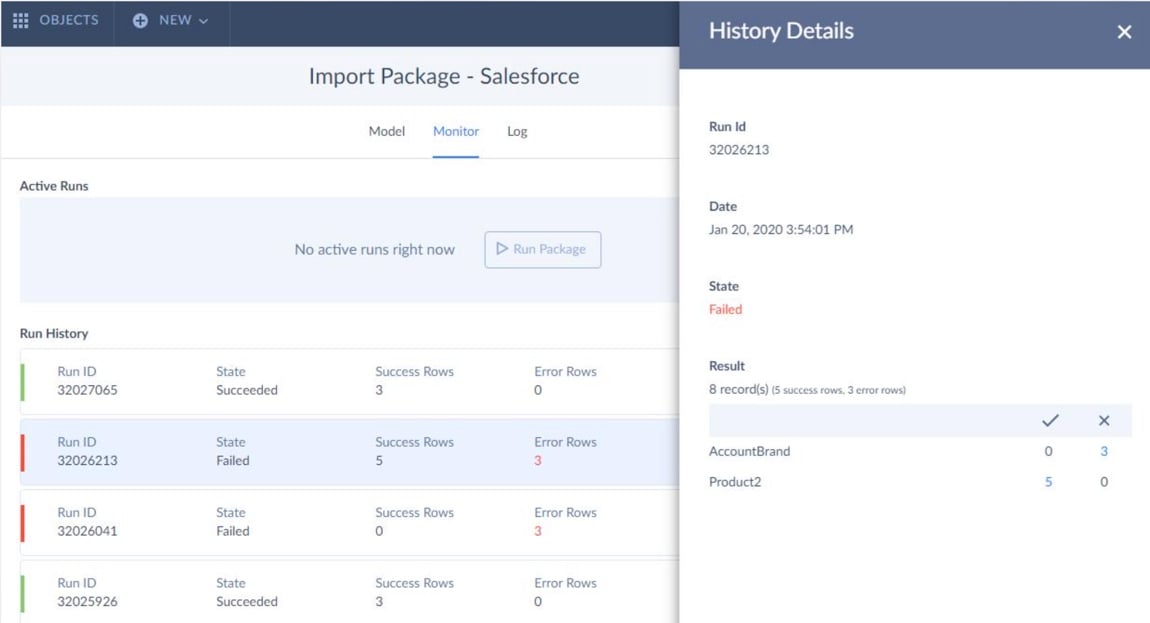
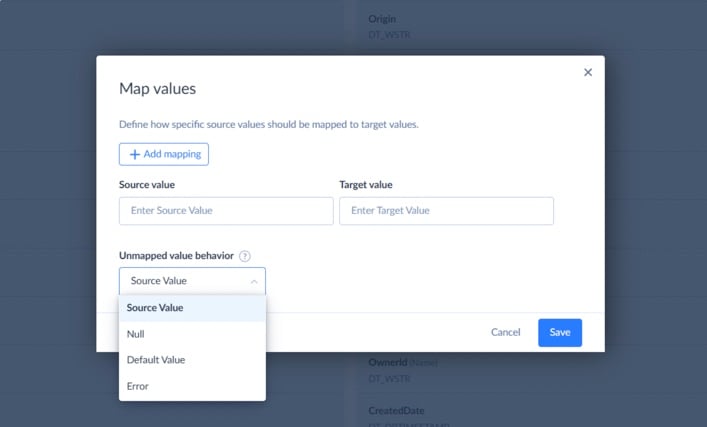
Open the run’s failed-records file and you find twelve contacts turned away because the country field said “UK” while the target wants “GB”. A pipeline bug it isn’t; this is a reference data problem. So the steward adds “UK” and two other variants to the country mapping, and the next run takes them.
Wednesday: an access request. Then someone asks to plug an AI assistant into the CRM, so it can field questions about accounts. The steward asks one narrow thing: which objects and fields will it see? An endpoint typically exposes whatever its connection can read, which is why a separate connection, with a user who can’t see payment details, is the safer route. The data owner signs off, and an engineer does the setup. NIST’s glossary defines least privilege as restricting each user’s access privileges to the minimum necessary to accomplish assigned tasks.
Thursday: the sync that wanted 80 fields. Somebody configured a new replication from the CRM into the warehouse with every Contact field, “in case we need it later”. Home addresses and phone numbers would then sit in a table that every analyst and half of finance can query. The steward trims the mapping down to the eight fields the reports use. If anyone needs personal fields for matching, they get hashed on the way in. Article 5 of the UK GDPR requires personal data to be limited to what is necessary for the purposes it is processed for. There’s also a reason to check how often records are updated. In Skyvia, UPDATE and UPSERT operations count updated records even when their values haven’t changed, so unnecessary updates can increase the number of records counted toward plan limits.
Friday: write it down. The definitions page gets its update: what lead_source_detail means, the country code rule, who approved the AI assistant’s access. Ten minutes of typing spares the next person a week of asking around.
Notice what’s missing? A governance platform. Every one of those tasks needed somebody who knew the domain, could decide the small stuff alone, and knew whom to ask about the big stuff.
Data steward vs data owner vs data engineer
Small teams blur the three roles, partly because one person often wears two of the hats. Charlotte Ledoux, who consults on data governance, put the steward-engineer line clearly in a 2025 post about finding stewards. The steward’s job, in her words, is to
“Define the meaning, functional quality, and usage of data in a specific domain, not the servers or ETL jobs.” Charlotte Ledoux, freelance data and AI governance consultant
A role card for a single domain keeps all three apart.
Who does what? A practical division of responsibilities between the data owner, data steward, and data engineer.
| Decision or task | Data owner | Data steward | Data engineer |
|---|---|---|---|
| What “active customer” means | Decides | Drafts the definition, checks it against the data | Implements it in the model |
| Who gets access to customer PII | Approves | Reviews the request, says which fields | Grants it in the systems |
| A new source connected to the warehouse | Is told | Approves the field mapping | Builds the sync |
| A run fails with record errors | Is told if it affects reports | Triages: data problem or pipeline problem | Fixes pipeline problems |
| Reference values (country codes, plan names) | Maintains the list | Applies it in transformations | |
| Definitions and documentation | Signs off | Writes and updates | Links them in code and models |
Here’s how you know the card works. A number looks wrong, and nobody has to ask whose job it is to look.
Types of data stewards
Big organizations carve the role up. IBM lists business data stewards, who watch data inside one function such as marketing; technical data stewards, who know the systems (ETL processes, warehouses); and enterprise data stewards, who lead the others and talk to business leaders. Snowflake’s version throws in operational stewards, who sit closer to daily processes, and metadata stewards.
Under 20 people? Forget the taxonomy. You need one steward for each domain that matters, which for most companies comes to three or four: customers, revenue, product usage and possibly employees. It’s a part-time hat. Usually it lands on the analyst or ops person who already gets asked “what does this column mean?”
What a data steward is responsible for
Peel off the job-ad language and the duties settle into a few places:
- Definitions. The business meaning of each important field and metric, kept wherever people actually go looking.
- Reference data. The lists other data leans on: country codes, currencies, plan names, product codes. They’re small lists, and they do big damage when two systems disagree.
- Quality at the point of entry. That means required fields, valid values and duplicate rules, both in the source apps and in each sync’s mapping, so bad records stop before they ever hit the warehouse.
- Access. Who can see which fields (personal and payment data above all), and what each integration or AI tool is able to read.
- Issue triage. Going through failed runs and data quality alerts, then deciding if the culprit is the data, the definition or the pipeline.
- Metadata and data lineage. Owners, descriptions and tags on datasets, so a catalog (if you run one) doesn’t sit empty, plus a rough picture of where each important field comes from. Our list of data lineage tools covers the software side.
Skills a data steward needs
Domain knowledge comes first. A data steward for customer data who doesn’t understand how the sales team works will write definitions that nobody follows. Then comes the rest: enough SQL to test a claim against the data, ease with a sync’s field mapping and a run log, the patience to write things down, and the standing to tell a team lead “not like that”. A certification looks nice on a CV. It replaces none of the above.
Where Skyvia fits
Skyvia isn’t a data stewardship or catalog tool, but much of a steward’s daily work happens around the integrations it runs. Each execution is logged with its Run ID, status, run type, and successful and failed record counts. For Import, users can download a CSV with individual record results and error descriptions, which helps investigate problems like Tuesday’s rejected contacts.
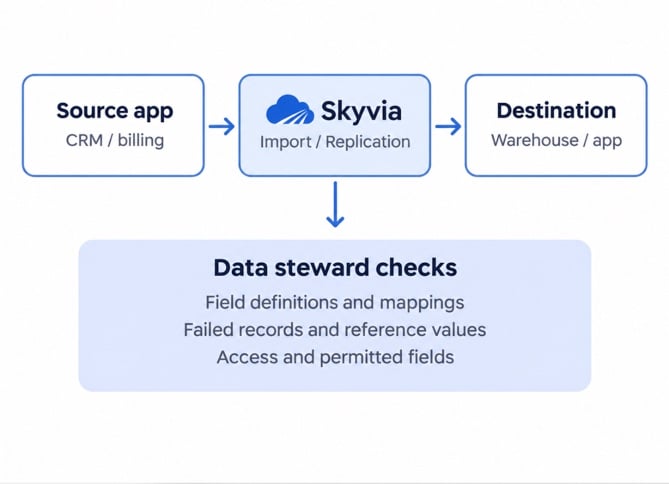
Skyvia’s support knowledge base covers integration errors such as field mapping, lookups, duplicate records, missing metadata, unsupported INSERT or UPDATE operations, and API limits. Mapping and duplicate issues may require a data steward’s attention, while API restrictions and unsupported operations typically need technical investigation.
On Standard and Professional plans, Import supports expressions and source lookups for correcting inconsistent source values. Replication can hash personal fields using SHA-256, and Skyvia provides role-based access control, audit logs, and IP allowlists. Because execution logs may contain portions of the processed data, users can also clear execution history and associated logs for a selected period using Clear History.

How to appoint your first data steward
- Pick one domain where people argue about numbers. Customer data is the usual first pick.
- Name a data owner (senior, accountable) and a steward, the person who’s close to the data every day. On a tiny team they can be the same person. Write both names down anyway.
- Find the five definitions people argue about most, and put them in one place.
- Open the integration run logs to the steward and let them weigh in on any new field mapping in their domain.
- After a month, look back. Which questions still had no one to answer them? What did the steward have to push up the chain?
FAQ for data stewards

Is a data steward a full-time role?
In large, regulated companies it often is, and there can be several of them. Smaller and mid-size teams usually fold it into another role, a few hours a week per domain. That works fine, as long as somebody has actually been named for it and nobody just assumes.
Should you set up a data catalog before you name data stewards?
No. Early on you’ll be fine with a shared definitions page, read access to the run logs and a voice in field mapping. A catalog starts to earn its keep once nobody can remember all your datasets, and even then only if stewards fill in owners and descriptions.
Who should a data steward report to?
For decisions, normally the data owner of their domain. Day to day, they work for the head of data or analytics. What you can’t skip is a quick yes or no from the owner when a definition or access request is waiting on one.
A data steward’s best evidence? It’s the run log, which shows the records that failed, the reasons, and what changed after the fix. Try Skyvia free to run your syncs with every run, failed record and field mapping kept together, so your steward knows what Tuesday morning’s import did.