Summary
- Fivetran prices each connection separately by monthly active rows, and the rate per row drops as that connection grows.
- The same 10M rows cost $1,358 a month in one Standard connection and $5,000 across ten.
- Enterprise lists about a third higher than Standard, and Business Critical a little over twice as high.
- Transformations, activations, and a $5 base charge on small connections add to the bill.
- Annual contracts start at $12,000 and come with discounts of 5%.
You get a quote or a first invoice, and the number doesn’t match the rows you thought you were syncing. It would be suspicious, but that’s common with Fivetran pricing. The bill depends less on how much data you have than on how it’s spread across connections and how often it changes.
Fivetran does publish its list prices on a legal page called the Service Consumption Table, plus it has an estimator where you can evaluate how much a connection might cost. And on top of that, there is a classical pricing page (though no numbers there). This amount of input data can confuse anyone.
So, we went through those pages to price a single connection on every plan and three example stacks, from a startup with three sources to a 15-connection Enterprise setup. You’ll also see what pushes monthly active rows up, how annual discounts work, and where the bill can shrink. Here’s the math.
How Much Does Fivetran Cost? The Short Answer
Fivetran’s pricing model has no flat monthly price. You pay for each connection separately, based on its monthly active rows (MAR), and the rate per row falls as that one connection grows. Your plan sets the rate, and an annual contract takes a discount off the total.
So the first thing to check is MAR per connection, not the total for your account. Two teams that sync the same 10M rows can see bills that differ by a factor of three or more.
Here’s what a single connection costs on the Standard plan at list price, paid monthly. We calculated these from the price list Fivetran publishes, effective February 1, 2026.
| MAR in one connection | Monthly price (Standard) | Effective price per million MAR |
|---|---|---|
| 100,000 | $54.50 | $545.00 |
| 500,000 | $252.50 | $505.00 |
| 1,000,000 | $500.00 | $500.00 |
| 4,000,000 | $1,010.00 | $252.50 |
| 10,000,000 | $1,358.00 | $135.80 |
| 50,000,000 | $2,375.80 | $47.52 |
| 100,000,000 | $2,893.52 | $28.94 |
Add the other connections, any transformation runs, and any reverse ETL on top. The worked examples below show what that looks like for a real stack.
How Fivetran Pricing Works
Fivetran calls its model usage-based pricing, and it bills three meters:
- Connections (ELT pipelines): most of the money goes here, and they are priced by MAR.
- Transformations.
- Activations (reverse ETL).
What counts as a monthly active row
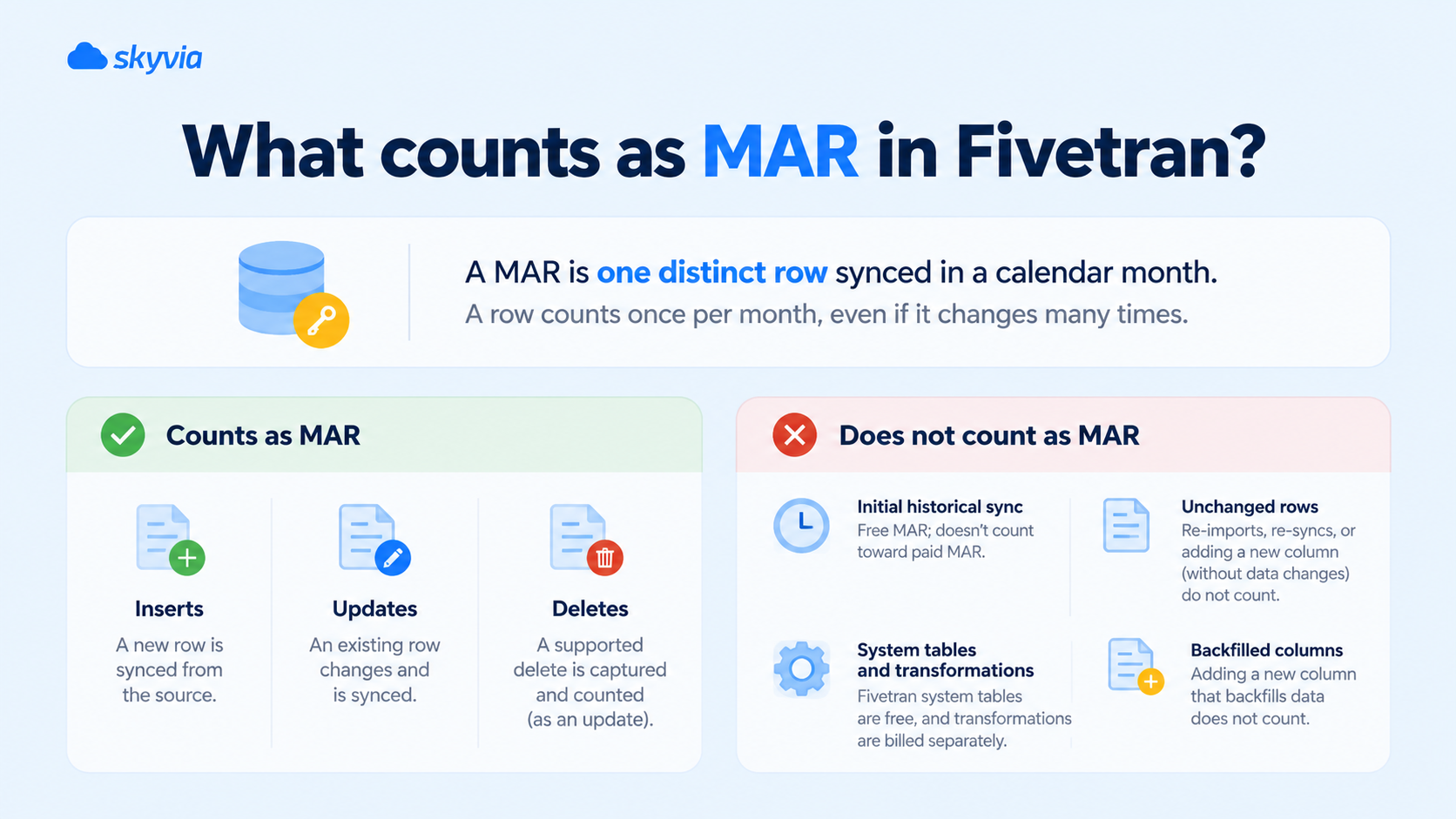
A monthly active row is a distinct primary key that was inserted, updated, or deleted and synced during a calendar month. A row counts once a month, however many times it changes. Fivetran’s own example: a key synced 30 times in a month is one MAR.
Keys are counted separately for each connection and each table. The counter resets on the first of the month, so a row that changes in October and again in November is billed in both months.
Some rows are free. The initial sync of a new connection, the first load of a new table, and unchanged rows in a scheduled re-sync don’t count. Every new account gets a 14-day free trial, and after that, every new connection gets 14 days of free use once incremental syncs start.
Even deleting data comes with a price tag in this economy. Fivetran started billing pay-as-you-go accounts for deleted source rows on January 1, 2026. Inserts and updates are already counted, and deletions now join them. Annual contracts signed after March 1, 2025 follow the same rule once renewed.
Each connection is priced on its own curve
Since March 2025, volume discount doesn’t cover a whole account; it stops at each connection. No pooling MAR for a better deal. That’s the rule in Fivetran’s Service Consumption Table, and it also rules out counting activations or other accounts toward the same discount.
A connection is one instance of a connector, from one source to one destination. Syncing the same Salesforce org to a staging warehouse and a production warehouse makes two of them, and both pay full freight.
The formula Fivetran bills with
Every connection’s monthly cost follows the same formula:
Monthly cost = base spend for the tier + (MAR above the tier’s threshold, in millions) × incremental price per million
On the Standard plan, the tiers look like this:
| MAR threshold | Base spend per month | Incremental price per million MAR |
|---|---|---|
| 1 MAR | $5.00 | $495.00 |
| 1M | $500.00 | $170.00 |
| 4M | $1,010.00 | $58.00 |
| 16M | $1,706.00 | $19.70 |
| 64M | $2,651.60 | $6.72 |
| 250M | $3,901.52 | $2.29 |
| 1,000M | $5,619.02 | $1.18 |
A worked example: a PostgreSQL connection with 2.5M MAR falls in the 1M tier, so it costs $500 + 1.5 × $170 = $755 a month. Partial millions are prorated, so the math holds for whatever MAR figure you plug in.
Free, Standard, Enterprise, or Business Critical: Fivetran Plans Side by Side
You think you’re picking a plan, but you’re picking two things at once: the feature set and how steep your price curve gets. The MAR rules don’t change between plans.
| Plan | Fits | Sync frequency | Notable features | 100K MAR connection | 1M MAR connection | 10M MAR connection |
|---|---|---|---|---|---|---|
| Free | Trials and small stacks | Every 15 minutes (Standard features) | 500,000 connection MAR, 3,500 activation MAR, 5,000 model runs a month | $0 | Over the limit | Over the limit |
| Standard | Most teams | Every 15 minutes | Unlimited users, 700+ connectors, REST API, role-based access, SSH tunnels | $54.50 | $500.00 | $1,358.00 |
| Enterprise | High-volume and governed setups | Every minute | Enterprise database connectors, custom roles, SCIM, hybrid deployment, VPN tunnels on annual contracts | $71.17 | $666.67 | $1,810.65 |
| Business Critical | Strict compliance needs | Every minute | Customer-managed encryption keys, PCI DSS Level 1, private networking | $111.17 | $1,066.67 | $2,897.05 |
Monthly prices are list prices for one connection, from Fivetran’s Service Consumption Table. The same connection costs about a third more on Enterprise than on Standard, and a little over twice as much on Business Critical.
Some sources decide the plan for you. Fivetran’s Oracle connectors and its High-Volume Agent connectors need Enterprise or Business Critical, and so does Hybrid Deployment.
Why the Number of Connections Matters More Than Data Volume
Every connection starts at the steep end of its own curve. Spread the same rows across more connections, and you pay the high early rate many times over.
Here’s 10M MAR a month on the Standard plan, split different ways:
| How 10M MAR is split | Monthly list price |
|---|---|
| 1 connection × 10M | $1,358.00 |
| 2 connections × 5M | $2,136.00 |
| 5 connections × 2M | $3,350.00 |
| 10 connections × 1M | $5,000.00 |
| 20 connections × 500K | $5,049.99 |
| 40 connections × 250K | $5,149.98 |
Push it through 40 connections instead of one, and the identical data costs almost four times as much. Fivetran’s pricing guide tells customers much the same thing (group related tables into fewer connections where possible).
Some splits are there to stay, though. Separate Salesforce and HubSpot accounts need separate connections. But duplicate connections for staging and production, or several connections to one database that could share one, are worth a second look.
What Fivetran Costs: Three Worked Examples
These are our own example stacks, priced at Standard or Enterprise list rates, paid monthly. Swap in your own MAR per connection and the math works the same way.
A startup with three sources
Picture a seed-stage team running its app on PostgreSQL. That database produces 150,000 MAR, but it isn’t the only source feeding the pipeline. Another 40,000 comes from HubSpot. Stripe brings the monthly total to 220,000 MAR with its 30,000.
It fits inside the Free plan’s 500,000 connection MAR, so it costs $0 while you don’t cross the line. Move those three connections to Standard and the bill reads $24.80 + $19.85 + $79.25, or $123.90 a month.
Free forever sounds great. And Fivetran means it, although the headline 500,000 MAR allowance doesn’t tell the whole story. That limit covers connections; activations have a much smaller budget of 3,500 MAR. Run dbt transformations? You get 5,000 model runs a month before hitting another ceiling.
Fivetran sends warnings when connection usage reaches 350,000 MAR and again at 500,000. Your first month over a limit comes with some breathing room, but you can’t add new connections. Cross a limit again within 12 months, and Fivetran may suspend your Free plan at month’s end. Creating another free account to spread the load isn’t allowed either. Still, there’s plenty to like: Standard-plan features, including 15-minute syncs, with no credit card or expiration date attached.
A growing SaaS team on Standard
This team runs eight connections and 20,000 dbt model runs a month on Standard:
| Connection | MAR per month | Monthly list price |
|---|---|---|
| Salesforce | 600,000 | $302.00 |
| HubSpot | 400,000 | $203.00 |
| PostgreSQL (app database) | 2,500,000 | $755.00 |
| Stripe | 120,000 | $64.40 |
| Zendesk | 250,000 | $128.75 |
| Google Ads | 900,000 | $450.50 |
| Facebook Ads | 700,000 | $351.50 |
| Jira | 80,000 | $44.60 |
| Connections total | 5,550,000 | $2,299.75 |
| Transformations (20,000 runs) | $150.00 | |
| Monthly total | $2,449.75 |
That’s $29,397 a year at list price. On an annual contract, it falls in Standard’s 5% discount band, so it comes to about $27,930 a year.
Notice the curve at work. If all 5.55M MAR came through one connection, the connection cost would be $1,099.90 instead of $2,299.75. Eight sources can’t share one connection, but this is why each new source adds more than its rows suggest.
A mid-market company on Enterprise
A company that syncs an Oracle ERP needs Enterprise. Spread over 15 connections, that’s 32.6M MAR a month, led by Oracle (12M), PostgreSQL (8M) and Salesforce (3M), then Google Ads (2M), NetSuite (1.5M), Facebook Ads (1.2M), Marketo (1.1M), HubSpot (900K), Shopify (700K), Zendesk (600K), S3 files (500K), Stripe (400K), LinkedIn Ads (300K), Workday (250K) and Jira (150K). Transformations add 60,000 model runs a month.
| Cost line | Monthly list price |
|---|---|
| 15 connections on Enterprise | $10,370.34 |
| Transformations (60,000 runs) | $460.00 |
| Monthly total | $10,830.34 |
| Annual list price | $129,964 |
That annual list price sits in Enterprise’s 5% to 22.6% discount band, and the exact rate appears on the order form. For comparison, the same workload, transformations included, would list at $8,243.00 a month on Standard and $17,039.93 on Business Critical.
Costs Beyond Connections
Connections are the main line, but three other charges can move a Fivetran bill.
Transformations
Fivetran bills transformations per successful monthly model run, across the whole account. Every model that materializes a table or view counts, including staging and intermediate models.
| Monthly model runs | Price per run |
|---|---|
| 0 to 5,000 | Free |
| 5,001 to 30,000 | $0.01 |
| 30,001 to 100,000 | $0.007 |
| More than 100,000 | $0.002 |
Fivetran’s own example: 120,000 runs in a month cost $780. Cutting intermediate models is the direct way to lower this line.
Activations (reverse ETL)
Since February 1, 2026, Fivetran sells Census as Fivetran Activations, on the same contract and invoice. An activation is every sync from one source to one destination, such as Snowflake to one Salesforce org, and each activation gets its own MAR curve.
That curve starts steep. Fivetran’s price list gives two examples: 1.5M activation MAR on Standard costs $1,017.66 a month, and 15,000 activation MAR on Enterprise costs $479.01. If reverse ETL is a big part of your plan, compare it on its own; our roundup of reverse ETL tools covers the options.

The $5 base charge on small connections
That $5 charge isn’t quite the safety net the word “minimum” suggests. On paid plans, every connection with 1 to 1 million monthly MAR pays it on top of the per-row cost. Fivetran also calls it a base charge, which better explains why 2,000 MAR produces a $5.99 bill rather than $5.
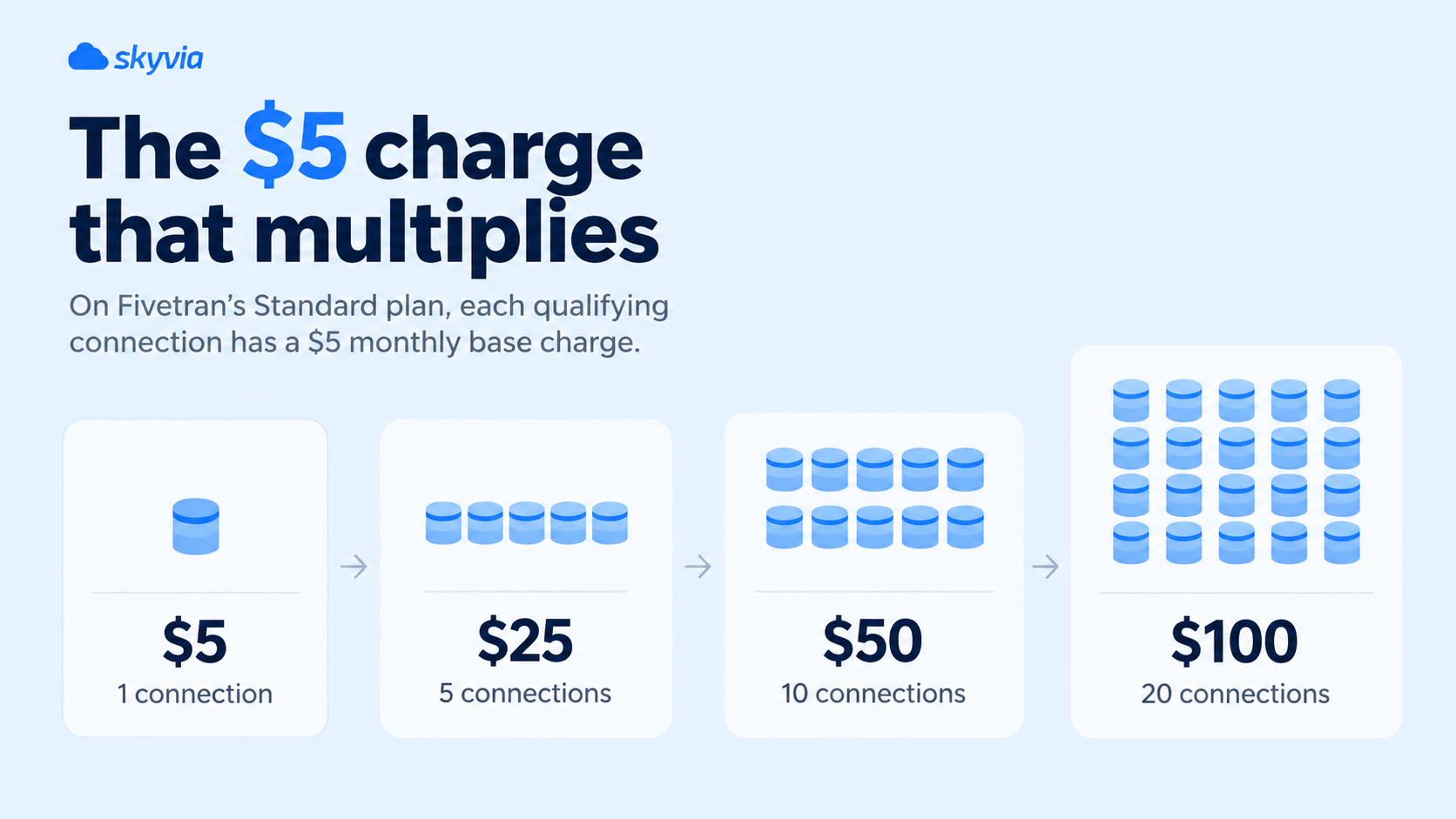
It adds up on wide, thin stacks. Twenty connections at 2,000 MAR each cost $119.79 a month, while the per-row part alone is $19.79. Connections with zero paid MAR and accounts on the Free plan don’t pay it.
What Pushes Your MAR Up
Business growth usually has a little to do with the most of bill surprises. Blame the sync behavior. These are the drivers Fivetran’s docs list:
- History mode. Since January 2026, every repeated update to a row in a month counts. A 200,000-row table where each row changes three times a month costs $104.00 without history mode and $302.00 with it, on Standard.
- Deletes. Hard deletes in the source count as changed rows.
- Unpausing. A paused table syncs all the changes it missed when you turn it back on.
- Rollback syncs. Records fetched again from the previous month count as new rows this month.
- Ad reporting connectors. Adding a new ad account to a running connection brings its incremental data into the bill.
- Tables without a primary key. For these tables, Fivetran builds a hashed key from column values, so a changed value can look like a brand-new row.
- Destination deletes. Delete data in the warehouse, sync it again from the source, and it counts again.
- One source, two destinations. Each connection counts its own MAR.
Estimate MAR before you use the estimator
Fivetran’s pricing estimator, its version of a pricing calculator, needs MAR per connection. You can approximate that from the source. Count the rows changed in the last full month, table by table, on any table with an updated_at column:
-- Rows inserted or changed in September 2026, by table
SELECT 'orders' AS table_name, COUNT(*) AS changed_rows
FROM orders
WHERE updated_at >= '2026-09-01' AND updated_at < '2026-10-01'
UNION ALL
SELECT 'customers', COUNT(*)
FROM customers
WHERE updated_at >= '2026-09-01' AND updated_at < '2026-10-01';
One row gets one spot in the count, just as MAR counts each key once per month. This sounds perfectly logical and fair. Now look at this little use case. You updated a record in September, then again in October. On November 1, you need to run a query, but the record’s September activity is nowhere to be found. It only carries October’s timestamp. Your database has a short memory.
Hard deletes are even better at disappearing. Unless the source keeps a deletion log, they’re gone from the calculation.
Then fill in this checklist for each planned connection:
- ☐ Source and destination (one connection each)
- ☐ Changed rows per month, summed across the tables you’ll sync
- ☐ Deletes per month
- ☐ Tables that need history mode, and how often their rows change
- ☐ Tables without a primary key
- ☐ Monthly dbt model runs, intermediate models included
- ☐ Reverse ETL destinations and rows sent per month
- ☐ Plan needed (Oracle, High-Volume Agent, or hybrid deployment means Enterprise)
Annual Contracts, Discounts and the Free Plan
Fivetran sells in two ways. Monthly pay-as-you-go bills last month’s usage at list price, with no commitment, though small connections still carry the $5 base charge. An annual contract needs at least $12,000 of committed spend and comes with a built-in discount.
The discount depends on the annual list price and the plan:
| Plan | Annual list price | Discount |
|---|---|---|
| Standard | Up to $37,900 | 5% |
| Standard | $37,900 to $145,340 | 5% to 22.6% |
| Standard | Above $145,340 | 22.6% and up |
| Enterprise | Up to $50,526 | 5% |
| Enterprise | $50,526 to $193,787 | 5% to 22.6% |
| Enterprise | Above $193,787 | 22.6% and up |
| Business Critical | Up to $80,842 | 5% |
| Business Critical | $80,842 to $310,060 | 5% to 36.42% |
| Business Critical | Above $310,060 | 36.42% and up |
That’s also why Fivetran’s own pages give different figures: the pricing page says you can save up to 22%, and its pricing guide says up to 36%, which is where Business Critical’s top band starts.
A few other terms matter at renewal:
- Rollover. Unused contracted spend carries over in full if the new contract is at least as large and is signed in the month the old one expires.
- Other discounts. Fivetran lists discounts for Powered by Fivetran customers, non-profits, and sharded databases, plus $50,000 of free Fivetran for Y Combinator companies.
- Cloud marketplaces. Buying through AWS, GCP, or Azure is monthly pay-as-you-go, on Standard or Enterprise only. Fivetran’s AWS Marketplace listing adds that Census reverse ETL (now Fivetran Activations) can currently be purchased there only through private marketplace offers.
- Enterprise License Agreements. A fixed yearly price with no consumption limit, offered to companies moving their whole workload to Fivetran or paying a premium for predictability.
How to Lower Your Fivetran Bill
Before you start shopping for Fivetran alternatives, find out what you’re actually paying for. You might discover a forgotten connection quietly adding to the bill every month. Or a table that nobody has queried since last Christmas.
Head to Account Settings → Billing & Usage → Usage. You’ll see how much MAR each connection generates. For the real detective work, open a connection’s own Usage tab and look at the table-level breakdown.
Here’s where I’d start.
- Stop paying for tables that only collect dust. No, that abandoned project doesn’t need a lifetime data subscription just in case. Block its tables and check whether new ones can sneak in automatically. Excluding columns usually saves storage, not MAR, except in some tables without primary keys.
- Take only the rows you need. Why import ten years of inactive customers when your reports only cover active ones? Row filters help, although changing a filter triggers a re-sync. You may see a temporary MAR bump before the savings begin.
- Retire connections past their usefulness. Even a barely used connection can incur the $5 base charge. Pause the ones you no longer need, but watch out for database CDC. If source logs expire during the break, you could be looking at a full re-sync.
- Let file datasets share the discount. Three small connections don’t get the same volume pricing as one large connection. Where supported, group related file datasets together. Same MAR, potentially friendlier math.
- Save history mode for actual history. Need every previous version of a record? Keep it. Only care about the latest state? Soft delete mode may spare you the cost of repeated updates. No point paying to remember what your reports will never ask about.
- Give your dbt models fewer unnecessary workouts. Fivetran includes 5,000 model runs monthly before additional charges apply. Check for unused Quickstart outputs and transformations running far more often than anyone needs. That hourly job feeding a weekly report isn’t doing your budget any favors.
- Revisit the plan you originally chose. Perhaps those one-minute syncs aren’t essential anymore. A lower tier might do the job for less. Annual commitments can bring discounts, but with a $12,000 minimum spend, buying more than you need won’t suddenly become a bargain.
One thing you can probably leave alone is sync frequency. Running a connection more often doesn’t, by itself, increase MAR for the same changed rows. A faster schedule may require a pricier plan, but that’s a different issue.
The biggest savings often come from asking a less glamorous question: Does anyone still need this data? If the answer is no, there’s probably little reason to keep paying to move it.
How Fivetran Pricing Changed in 2025 and 2026
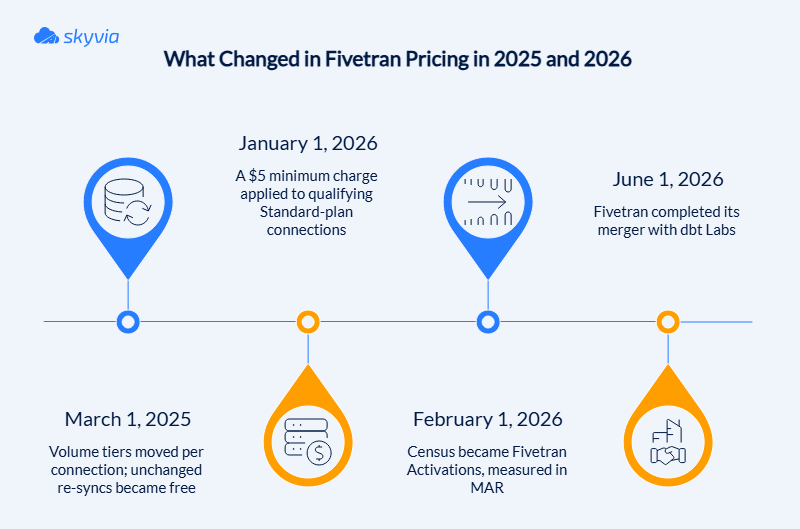
So much happened with Fivetran pricing during the last two years that many older articles on this topic still describe plans that no longer exist. The changes, chronologically.
The first changes were introduced on March 1, 2025:
- Volume discounts are now for connections; accounts no longer have this privilege.
- Annual discounts became automatic; no need to negotiate them anymore.
- Fivetran said goodbye to the Starter and Private Deployment plans.
- Also, starting from this point, users can re-sync unchanged rows for free.
Next, on January 1, 2026:
- Pay-as-you-go accounts were the first to see Fivetran’s updated pricing.
- A $5 base charge now applies to connections with 1 to 1 million MAR, while deletions count toward paid usage.
- History mode also bills repeated updates to the same row.
- Annual customers see the base charge at renewal.
- For contracts signed after March 1, 2025, that’s also when the updated delete and history-mode rules take effect.
- Older contracts already had those charges.
The last change (so far) happened on February 1, 2026.
- Activations (formerly Census) joined the price list.
- The current Service Consumption Table (V.10) took effect.
For a wider view of how these changes push teams to shop around, see our guide to Fivetran alternatives.
When a Different Pricing Model Fits Better
MAR pricing works well for a few large connections that are stable. But it isn’t particularly fond of small connections in large numbers. Give it constantly changing tables, and the bill gets less friendly. Frequent deletes make matters worse, while history mode adds another reason to check your invoice. And it’s hard to budget when volumes swing month to month.
A fixed monthly price for a set record allowance is the other common model. We build Skyvia, so here’s how ours works.
Data Integration plans are priced by records written per month, with unlimited users and connections on every plan. Standard costs $159 a month billed annually ($199 billed monthly) for 5M records and runs integrations hourly. Professional costs $399 a month billed annually ($499 billed monthly) for 10M records, with schedules down to every minute.
A row that shows up in every sync can tell two different billing stories. Fivetran counts it once per month if it changes, while Skyvia charges for each time the record is written. One more thing worth knowing: Skyvia won’t automatically charge for extra records. Unless you enable overage, new runs wait until the next period once you’ve used up your allowance.
If a predictable bill matters more than per-row efficiency, check what your sources would need on Skyvia’s pricing page, or see our Fivetran and Skyvia comparison. You can try replication into your warehouse free for 14 days, no credit card needed.

FAQ for Fivetran Pricing

Is there a free version of Fivetran?
Yes. The Free plan includes Standard plan features for up to 500,000 monthly active rows on connections, 3,500 on activations, and 5,000 model runs a month. Cross the limit again in another month within those 12 months, and the Free plan is no longer yours (Fivetran may pause your connections as well).
What counts as a monthly active row in Fivetran?
One MAR is any distinct primary key that gets inserted, updated, or deleted, then synced, inside a single calendar month. It doesn’t matter if that row changes once or dozens of times: it’s counted a single time, and each connection and table keeps its own tally. On the first of the month, the count starts over.
Are initial syncs and deletes billed in Fivetran?
New connections get a free initial sync, followed by 14 free days of incremental syncing. Deletes aren’t so lucky. They’ve counted toward paid MAR since January 1, 2026, for pay-as-you-go accounts. Annual contracts signed after March 1, 2025 pick up that rule at renewal.
How can I estimate what Fivetran will cost me before I sign up?
Start with your sources: count how many rows each table changed last month, and total them for every connection you plan to set up. From there, either run each connection through the plan’s rate table on its own or type the totals into Fivetran’s pricing estimator. Model runs from dbt and any reverse ETL volume go on top as lines of their own.
Does a Fivetran annual contract cost less than monthly billing?
Usually, yes. Annual contracts start at $12,000 of committed spend and come with a discount of at least 5%. The top bands start at 22.6% on Standard and Enterprise and at 36.42% on Business Critical, for the largest contracts. Monthly pay-as-you-go is billed at list price, with no commitment.
Why did my Fivetran bill jump this month?
Look for a one-off MAR spike. Resumed a table? Added an ad account? History mode on a busy table can drive costs up too. To find the culprit, open Billing & Usage → Usage, then check each connection’s Usage tab for the table-level breakdown.
What if Fivetran’s MAR pricing doesn’t fit my budget?
Try a fixed monthly record allowance instead. Skyvia offers one without limiting users or connections. But watch the math: Skyvia counts every record written, even repeatedly. Fivetran counts a changed row once per month.