

Summary
- MuleSoft fits API-led programs in Salesforce estates, with packages from $2,000 a month billed annually.
- Workato suits business-led automation, and Celigo suits NetSuite and ecommerce back offices.
- Skyvia fits data loading and two-way sync on a records-based price, with a free plan.
- Jitterbit covers EDI, SnapLogic offers flat packages, and Informatica leads on data governance.
- Boomi itself now publishes a Pay-as-You-Go price, so use it as the baseline for every quote.
The Boomi renewal quote lands, and it’s bigger than last year. Or the two people who built your Boomi processes have moved on, and nobody else can open them without breaking something. Either way, you’re looking at Boomi alternatives and finding lists that still call it “Dell Boomi” and quote prices nobody can trace.
Those lists are stale. Boomi isn’t the product it was back then, and neither are its competitors. Take MuleSoft: it sells shared credits these days, and Salesforce owns it along with Informatica.
So we went to the source. Nine platforms, each read against its own pricing pages and docs, then lined up on workload fit, pricing unit, free plan or trial, on-premise reach and AI support. Here’s what we found.
Which Boomi competitors deserve your shortlist?
The short list depends on what Boomi does for you today. For API programs, look at MuleSoft. For business-led automation, Workato. For NetSuite and ecommerce back offices, Celigo. For data loading into a warehouse or two-way sync between apps on a small team’s budget, Skyvia. Jitterbit, SnapLogic, Informatica, TIBCO and Oracle Integration? Good tools, but each one earns its spot in a narrower kind of enterprise shop.
Be clear about what pushed you here. A renewal quote points somewhere other than a shrinking integration team does, and a move from app-to-app flows toward warehouse loading changes the picture again. Then check the pricing unit. Every platform here bills on something different (messages, credits, endpoints, records), and the unit decides how your bill grows. Only three of the nine publish an entry price.
| Boomi alternative | Best for | Pricing unit | Published entry price | Free plan or trial | On-premise reach |
|---|---|---|---|---|---|
| Skyvia | Data integration, warehouse loading and sync for small and mid-size teams | Records written per month | Data Integration Basic from $79/month billed annually ($99 monthly) | Free plan; 14-day trial | On-premise agent (Windows) |
| MuleSoft | API-led enterprise integration, Salesforce estates | Mule Credits | From $2,000/month billed annually | 30-day trial | Ask sales |
| Workato | Business-led workflow automation | Edition plus consumption | Not published | Free account signup | On-premise agents |
| Celigo | NetSuite, ecommerce and finance back-office flows | Endpoints and flows | Not published | 30-day trial, then a free plan | On-premise agent on paid plans |
| Jitterbit | Application integration with EDI | Connections per edition | Not published | None published | Private agents |
| SnapLogic | Pipelines plus app integration at a flat package price | Package | Not published | Demo | Self-hosted Groundplex |
| Informatica | Data management, governance and data quality | IPUs (Informatica Processing Units) | Not published | 30-day trials | Ask sales |
| TIBCO | Event-driven and messaging-heavy integration | Not published | Not published | Contact sales | Ask sales |
| Oracle Integration | Oracle Fusion and E-Business Suite estates | Messages per hour | Standard $0.6452 per hour per 5,000 messages | Oracle Cloud Free Tier and 30-day trial | On-premises apps through adapters |
For a broader look at the category, see our guide to the best iPaaS solutions.
What changed at Boomi since Dell?
“Dell Boomi” is an old name. Back in May 2021, Dell signed a deal to sell Boomi to Francisco Partners and TPG for $4 billion in cash. Boomi has been on its own ever since. Quotes, contracts and search results that still say “Dell Boomi” are using the pre-sale name.
The product has grown too. Boomi announced in December 2024 that it was buying Rivery, a tool built for ELT, ETL and change data capture (CDC). Boomi’s site now leads with AI agent management (Agentstudio and an agent control plane) next to integration, API management and Data Hub.
Pricing is where the old lists go wrong. Boomi itself lists exactly one price. It’s called Pay-as-You-Go and costs $99 a month plus $0.05 per Boomi Message, which you pay monthly without signing a contract. Boomi counts every document that passes through as one message, so receiving a file and sending another out costs you two. Anything bigger, whether Professional, Professional Plus, Enterprise or Enterprise Plus, goes through sales. The free trial runs 30 days.
So compare your options against today’s Boomi. If your renewal quote is the problem, price the same message volume on Pay-as-You-Go before you leave.
How we compared the Boomi alternatives
We compared every tool on five criteria:
- Workload type. That covers app-to-app integration and API management, though also workflow automation, loading data into a warehouse, and B2B/EDI.
- Pricing unit and published price. What you pay for, and whether the vendor publishes a number.
- Free plan or trial. How long you can test before talking to sales.
- Deployment. Cloud only, or agents that reach databases behind a firewall.
- AI and MCP support. Whether the platform exposes data or actions to AI assistants through the Model Context Protocol (MCP) or ships agent tooling.
Connector counts appear only where the vendor publishes one, and we name the vendor as the source.
The 9 best Boomi alternatives in detail
1. Skyvia
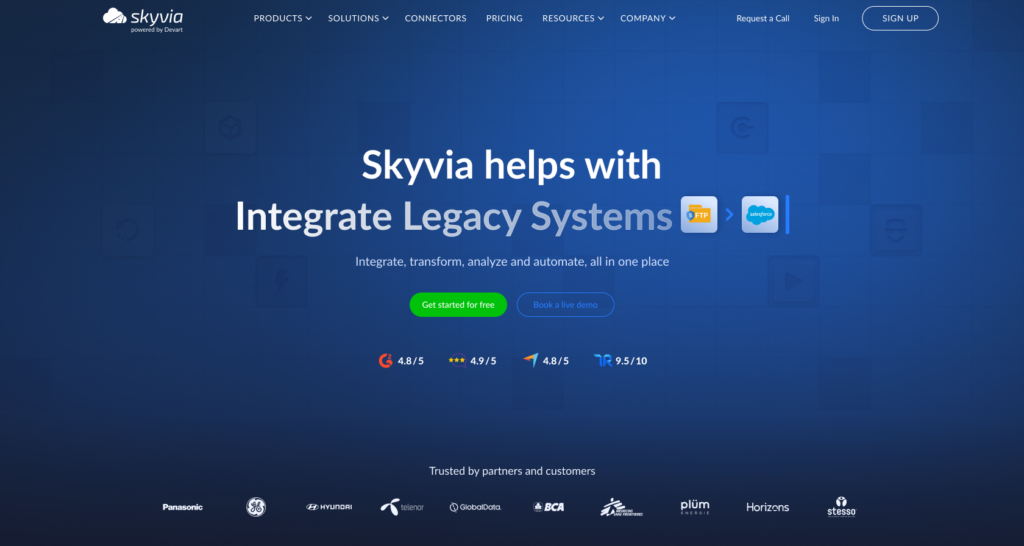
Skyvia is a no-code cloud data platform. Its Data Integration product handles import, export, ELT replication into a warehouse and two-way sync, plus visual multi-step pipelines in Data Flow (Control Flow orchestrates them). There are connectors for 200+ cloud apps, databases, warehouses and file storages.
Best for
It suits teams that use Boomi mainly for moving data around. That might mean replicating Salesforce, HubSpot or NetSuite into BigQuery, Snowflake or Redshift, though syncing two apps or loading CSV files on a schedule count too. On Professional, replication can run every minute.
There’s an AI angle too: any connection can become an MCP endpoint, letting an assistant read data and create or update records. Databases behind a firewall? The on-premise agent gets to them over outbound HTTPS. Security teams will want the paperwork, and Skyvia lists SOC 2, GDPR and HIPAA (a BAA is available).
Pricing
Data Integration is priced by records written per month. The Basic plan gives you 5M records from $79 a month billed annually, or $99 billed monthly, with one run per day. Step up to Standard for hourly runs and Data Flow. Professional goes down to every minute and brings Control Flow.
You don’t need a credit card to start. Sign up and you’re on a 14-day trial (there’s a free plan for each product too). The Data Integration free tier covers 10,000 records a month with one daily run, and you get two scheduled integrations, though those expire after 30 days. Paid plans include unlimited users, and Skyvia pricing has the full matrix.
Trade-offs
Skyvia moves and manages data. It doesn’t do API lifecycle management or B2B/EDI. Only SQL Server gets log-based change capture. Every other source picks up new and changed records by timestamp. Record triggers in Automation poll on a schedule, and only webhook triggers fire immediately. Schema changes in a source aren’t picked up automatically.

2. MuleSoft
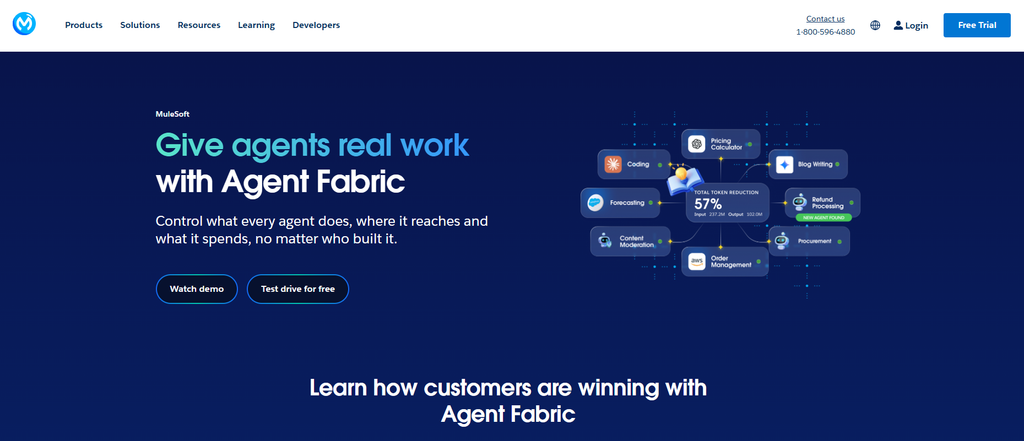
Anypoint Platform is MuleSoft’s product for integration, API management, automation and AI agents, and MuleSoft is a Salesforce company. Salesforce closed its Informatica acquisition in November 2025, so both products now share one portfolio (and Salesforce has said it means to combine them).
Best for
Large organizations running a formal API program, especially when Salesforce is the system of record. Our Boomi vs MuleSoft comparison goes deeper on the two.
Pricing
Everything runs on Mule Credits now. You spend that one unit on integrations, APIs, automation and agents alike. The cheapest package is $2,000 a month, billed annually. There’s more than one way to buy: pre-purchase credits, pre-commit with a $50,000 minimum annual commitment billed monthly, or agree a custom fixed price for unlimited credits. The free trial lasts 30 days and covers the full portfolio.
Trade-offs
The entry price rules MuleSoft out for small teams. Credit rates differ by usage type, so ask sales to model your workloads before you sign.
3. Workato
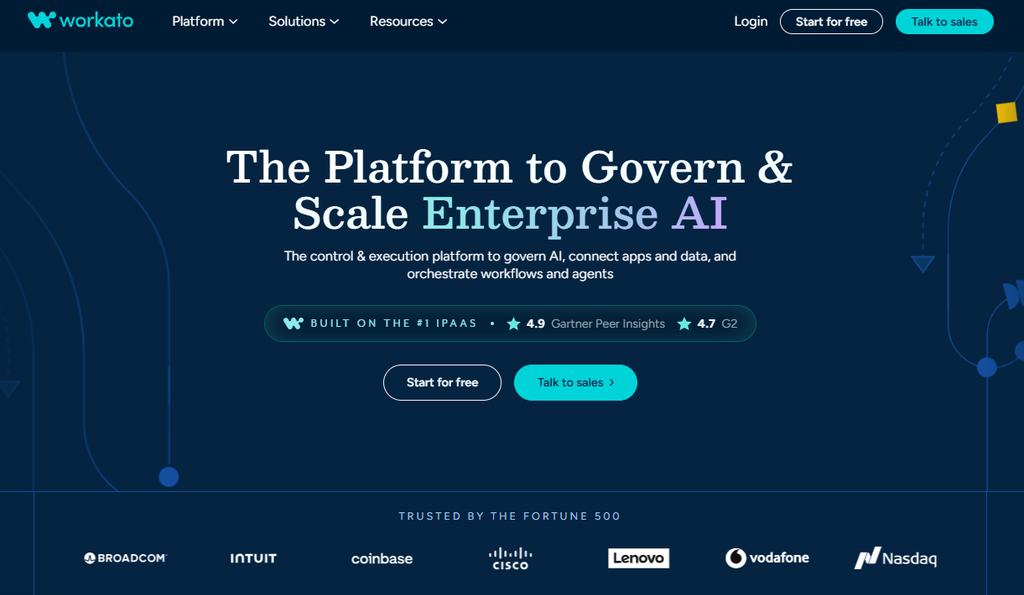
Workato is a workflow automation and integration platform where business and IT teams build “recipes” together. Workato reports 1,200+ pre-built connectors, and it includes unlimited workspaces and users.
Best for
Cloud-based process automation owned by operations teams with IT oversight. The Business MCP edition and above add data integration (ETL, ELT and reverse ETL), an API platform, pre-built MCP servers and an AI/MCP gateway.
Pricing
Four editions (Standard, Business MCP, Enterprise MCP and Workato ONE), with prices on request. Usage is tracked by capability in a dashboard. On-premise connectivity runs through on-premise agents: three in Business MCP, 10 in Enterprise MCP and 30 in Workato ONE. A free account is available at signup.
Trade-offs
No published price. Warehouse loading needs at least the Business MCP edition, and the Standard edition includes one concurrency.
4. Celigo
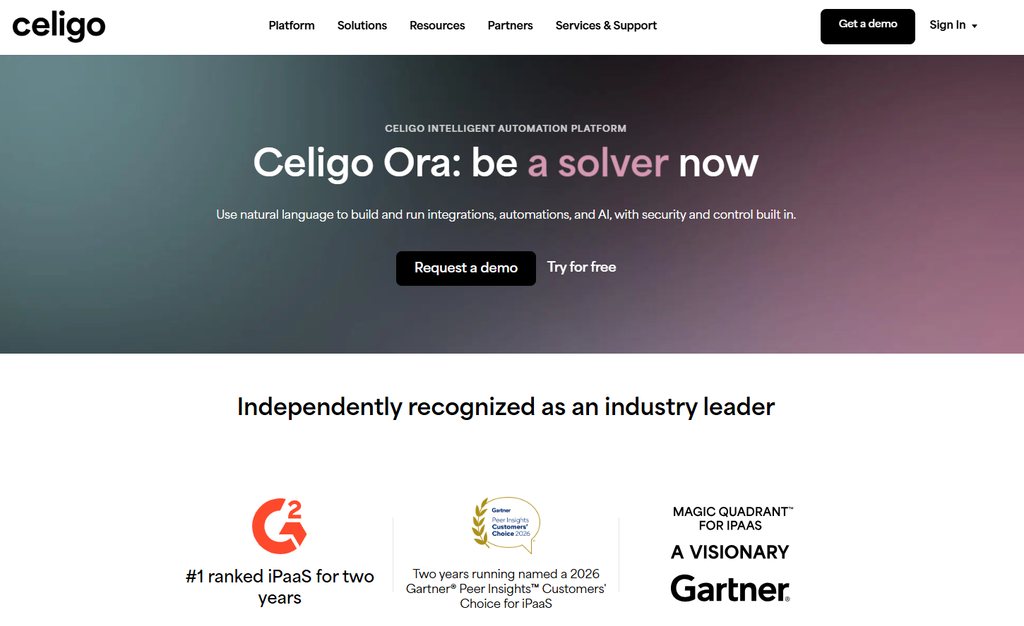
Most of Celigo’s iPaaS is built on business-process templates, and those templates lean toward back-office work in NetSuite, Shopify and Salesforce. If an app isn’t covered, its universal connectors speak HTTP, FTP, JDBC, AS2, GraphQL and webhooks. Agent Builder and an MCP server come with every edition.
Best for
Mid-market finance, ecommerce and supply chain teams that want packaged flows they can adjust. Our Boomi vs Celigo comparison covers the head-to-head.
Pricing
Celigo charges by endpoints and flows at a flat rate, with no task or volume charges and no overage fees. You’ll have to ask sales what the Standard, Professional and Enterprise editions cost. New accounts open with a 30-day trial where endpoints and flows are unlimited. Once it ends, you’re moved to a free plan that allows two endpoints and one flow.
Trade-offs
Add an endpoint and the bill goes up. With a sprawling app estate, that adds up fast. And on the free plan you won’t get the on-premise agent, SSO or API tokens.
5. Jitterbit
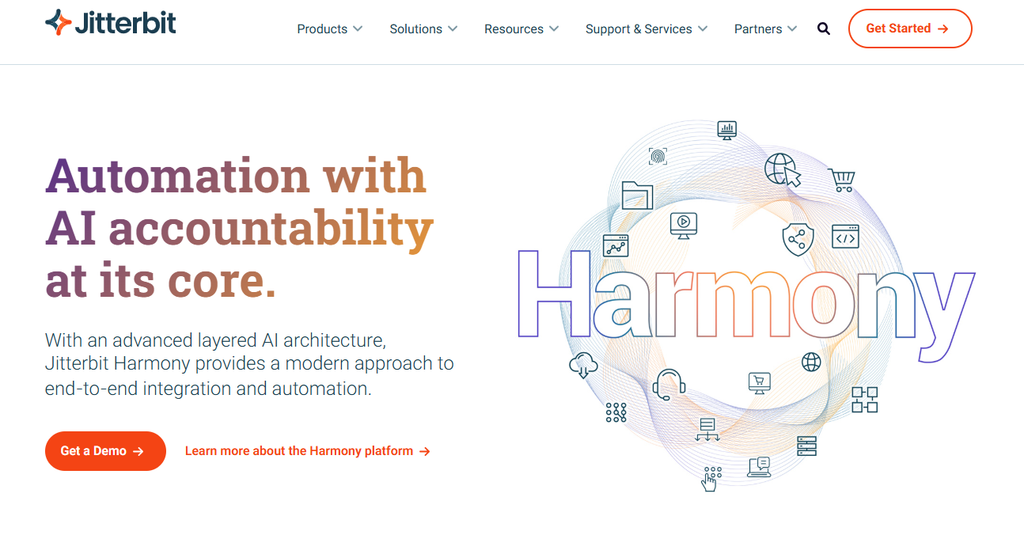
At the center sits Jitterbit Harmony, the iPaaS, while API Manager is sold as an add-on and Jitterbit EDI takes care of trading partners. Custom endpoints get built with the Studio visual designer, Connector Builder or Connector SDK. AskJB, an assistant, sits inside the editor.
Best for
Anyone moving B2B and EDI work off Boomi. It also suits on-premises databases that need private agents.
Pricing
There are three editions, sized by connections: two or three on Standard, five on Professional, and eight or more on Enterprise. Prices come by quote.
Trade-offs
Connection caps per edition mean you plan your endpoint count up front. Pricing isn’t public, and there’s no trial you can start on your own either.
6. SnapLogic

SnapLogic pipelines, for data or for applications, are assembled from pre-built connectors that the company calls Snaps. You choose between three packages (Essential, Professional and Enterprise One), and every one of them includes unlimited pipelines and data movement at a fixed price.
Best for
Organizations that run many pipelines and want the bill to stay flat as volume grows. The price is the same whether you run on SnapLogic’s cloud runtime (Cloudplex) or a self-hosted one (Groundplex).
Pricing
Package prices are on request. AgentCreator, API Management, ELT and AutoSync are add-ons.
Trade-offs
API management and ELT? Those cost extra, even if you expected them in the base price. Price the add-ons in before you put quotes side by side.
7. Informatica
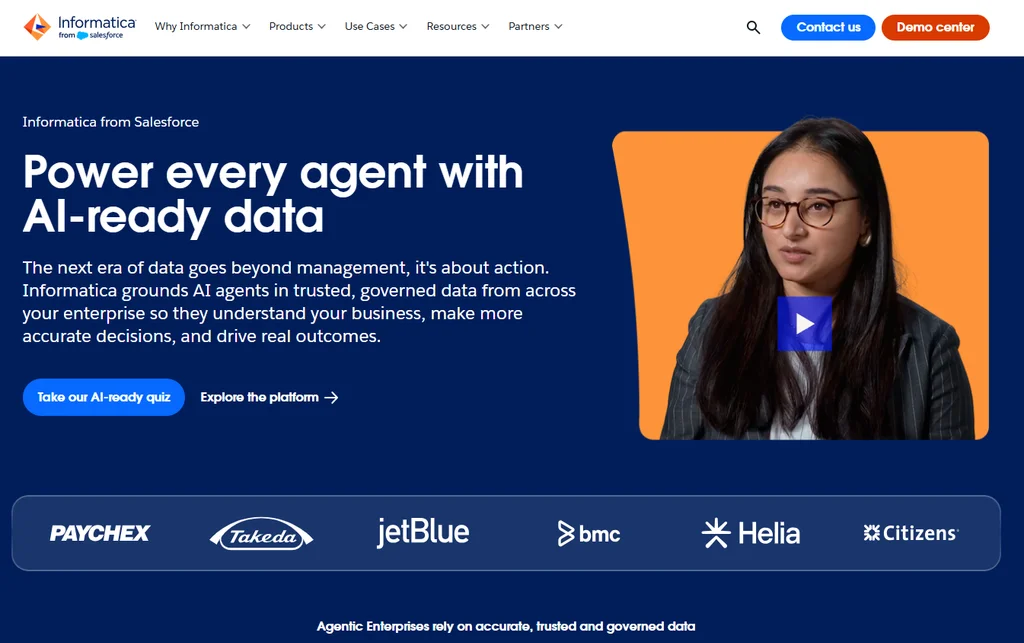
The Intelligent Data Management Cloud is Informatica’s suite: data integration, data quality, catalog, governance and master data management. It’s owned by Salesforce now; that acquisition closed on November 18, 2025.
Best for
Enterprises whose project is mostly about governance, quality and master data, with app-to-app flows a side concern.
Pricing
Consumption-based in IPUs (Informatica Processing Units), with quotes from sales. Want to try first? Informatica has free 30-day cloud trials, data integration among them.
Trade-offs
IPU budgeting takes work, and you need sales for any price. Expect packaging changes as Salesforce brings Informatica and MuleSoft together.
8. TIBCO
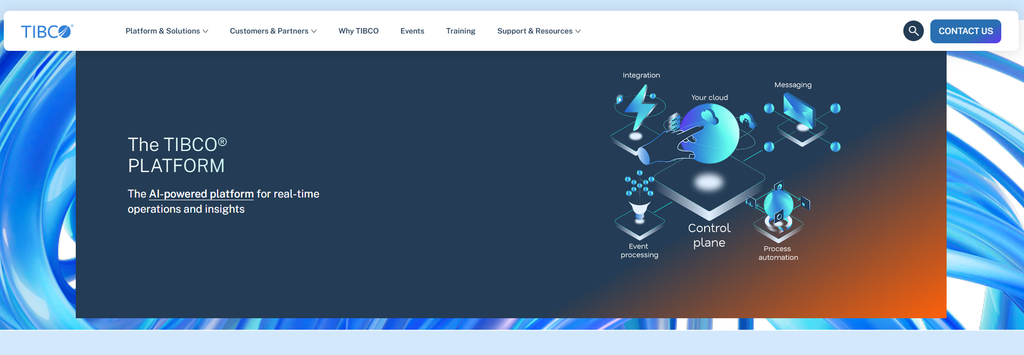
TIBCO sells integration as one capability of the TIBCO Platform, next to messaging, data grid, event processing and process automation. TIBCO reports over 300 pre-built connectors, with low-code and no-code tooling and MCP servers for AI use.
Best for
Architectures built on events and messaging, where integration has to live beside real-time event processing.
Pricing
Not published. The older TIBCO Cloud Integration product pages, with their public plans, no longer exist, so talk to sales.
Trade-offs
There’s no self-service way in. And since the platform covers a lot, ask for a quote on just the integration piece you’ll use.
9. Oracle Integration
Prebuilt adapters, low-code customization and process automation templates are how Oracle Integration links SaaS and on-premises applications. It lives inside Oracle Cloud Infrastructure.
Best for
Oracle shops, mostly. If Oracle Fusion, E-Business Suite or other Oracle apps sit next to Salesforce, SAP, Workday or ServiceNow, this one’s built for you.
Pricing
Oracle bills by the hour in blocks of message throughput. On Oracle Integration Cloud Service Standard, each 5,000 messages per hour of capacity costs $0.6452 an hour; Enterprise is $1.2903. Bring your own license and the rate drops to $0.3226 per 20,000 messages per hour. To test it, Oracle Cloud Free Tier comes with a 30-day trial and $300 in credits.
Trade-offs
Steady workloads do well on hourly billing. Capacity that sits idle just burns money. The fit is strongest inside an Oracle estate.
How do Boomi alternatives price their platforms?
Use Boomi’s per-message price as your yardstick. Before any sales call, get your own numbers: documents your flows move each month, the endpoints they touch, and the records that land in each target.
| Platform | You pay for | What to count before you ask for a quote |
|---|---|---|
| Boomi Pay-as-You-Go | $99/month plus $0.05 per message | Documents in and out of every flow per month |
| Skyvia | Records written per month, by plan | Records loaded per month and how often each job must run |
| MuleSoft | Mule Credits, from $2,000/month billed annually | APIs, integrations and agents you plan to run |
| Workato | Edition plus consumption by capability | Recipes, jobs and on-premise agents needed |
| Celigo | Endpoints and flows | Apps connected and flows between them |
| Jitterbit | Connections per edition | Endpoints, including any EDI partners |
| SnapLogic | Package, unlimited pipelines | Add-ons you need (API management, ELT, agents) |
| Informatica | IPUs | Services used (integration, quality, catalog) and volume |
| Oracle Integration | Hourly blocks of 5,000 messages | Peak messages per hour |
Is one workload eating most of the Boomi bill? Then that’s the one to price on every tool you shortlisted. High volume through a few endpoints favors a flat endpoint price. Lots of small flows tip it the other way, toward per-message billing.
Which Boomi alternative fits your workload?
| If your Boomi workload is… | Shortlist | Why | Validate in the trial |
|---|---|---|---|
| Loading app data into BigQuery, Snowflake or Redshift | Skyvia, SnapLogic | Replication with incremental loads; flat or record-based pricing | Run a full load and an incremental run on your largest object |
| Two-way sync between a CRM and an ERP | Skyvia, Celigo | Sync without extra external-ID fields (Skyvia); NetSuite templates (Celigo) | Edit one record on each side and check both directions |
| A formal API program | MuleSoft, Jitterbit | API management (an add-on in Jitterbit) | Publish one API with a rate-limit policy |
| Business-led automation across SaaS apps | Workato | Recipes owned by ops teams | Build one approval flow end to end |
| B2B and EDI with trading partners | Jitterbit | EDI in the platform | Exchange a test document with one partner |
| Governance, data quality, master data | Informatica | Data management suite | Profile one dataset and apply a quality rule |
| Oracle applications at the center | Oracle Integration | Prebuilt Oracle adapters | Connect Fusion or E-Business Suite and one SaaS app |
| Event streams and messaging | TIBCO | Integration beside event processing | Route one event stream to a target |
| AI assistants that read and update business data | Skyvia, Workato (Business MCP and up), Celigo, TIBCO | MCP endpoints or servers | Ask the assistant to read and update one record |
Still torn between an integration platform and a data pipeline tool? Our explainer on what an iPaaS is helps with that call.
Checklist before you move off Boomi
Copy this into your migration ticket:
- Write down each Boomi process, plus its source, target, schedule and documents per month.
- Tag every process as app-to-app, API, warehouse load, EDI or event.
- Flag the ones that touch on-premise systems, along with the runtime they go through.
- Use last quarter’s message usage to work out a Boomi Pay-as-You-Go baseline.
- Rebuild your two busiest processes in every trial on the shortlist.
- After one full run, check that record counts in Boomi and the new tool match.
- Find out where a failed record ends up and who hears about it.
- Regulated data in the mix? Then get SOC 2, HIPAA and GDPR reports out of each vendor before you sign.
- See whether the new tool can run as often as your most frequent Boomi schedule does today.
- Plan a parallel run, then switch off Boomi processes one at a time.
If your Boomi work is mostly moving data between apps, databases and a warehouse, try the same processes in Skyvia’s free plan before you renew. You’ll see what the job costs on a records-based price.

FAQ for Boomi Alternatives

How much does Boomi cost in 2026?
Boomi publishes one price: Pay-as-You-Go at $99 a month plus $0.05 per Boomi Message, billed monthly with no contract. The Professional, Professional Plus, Enterprise and Enterprise Plus subscription plans are quote-only. A 30-day free trial is available.
Is there a free alternative to Boomi?
Skyvia and Celigo both have free plans. Skyvia’s Data Integration free plan includes 10,000 records a month, runs once a day, and allows two scheduled integrations that expire after 30 days. Celigo’s free plan starts after its 30-day trial and covers two endpoints and one flow.
Which is better for API management, MuleSoft or Boomi?
For a formal API program inside a Salesforce estate, MuleSoft is the stronger fit, but it costs more to start. And it’s not a small difference. MuleSoft starts at $2,000 a month billed annually, while Boomi’s Pay-as-You-Go is $99 a month plus usage. So take one real workload of yours and price it on both before deciding.
Is Boomi any good for ETL into a data warehouse?
Yes. Boomi said in December 2024 that it was acquiring Rivery, a deal that adds ELT, ETL and change data capture to what the platform can do. When loading a warehouse is most of the work, put a record-priced tool like Skyvia next to it, since you pay for the records you actually load.
Why would a team replace Boomi with a cheaper tool?
Plenty of jobs don’t need a full enterprise iPaaS (nightly replication of CRM data into Snowflake is a good example), and a data integration tool priced by records can come in under a message-based or quote-only platform for those. You’ll only know for sure once your largest flow has run in a trial.
Can Boomi alternatives reach databases that sit on-premise?
Skyvia, Workato, Celigo and Jitterbit all use agents for systems behind a firewall. Celigo’s on-premise agent is on paid plans only, and SnapLogic can run its whole runtime self-hosted on Groundplex.
Curious how a Boomi replacement handles your own data? Create a free Skyvia account, plug in your source and warehouse, and see how your heaviest replication or sync job does over the 14-day trial.