Summary
- The Google Data Analytics Professional Certificate is the usual starting point for beginners and now teaches Python instead of R.
- The IBM Data Analyst Professional Certificate suits beginners who want more Python and dashboards in IBM Cognos Analytics.
- CompTIA Data+ and CAP-Essentials are vendor-neutral exams for early-career analysts.
- PL-300, the Salesforce Certified Tableau Data Analyst exam and the SAS Viya credential prove skills in one BI tool.
- CAP-Pro and CAP-Expert from INFORMS fit analysts who own or lead analytics projects.
You’ve decided a credential will help, and now you’re staring at dozens of options that all promise a better job. Some are courses you pay for by the month. Others are a single proctored test. A few changed so much in the past year that guides written in 2025 now describe programs that no longer exist in that form.
Picking the wrong data analytics certification costs more than the fee. It costs the months you spend on a curriculum your target employers don’t ask for. Google’s beginner certificate, for example, swapped R for Python, and the Certified Analytics Professional program split into three levels with different entry rules.
We checked every price, exam format and renewal rule below on each provider’s own page in October 2026, using US prices. So below you’ll see which one suits your level and the job you’re after, what it costs once everything’s added up, and which to take first.
Which Data Analytics Certification Fits You Best? The Short Answer
Forget the famous badge for a second and think about your next job. Do the postings you like mention Power BI or Tableau? Then a tool exam wins over a general one. No tool in the post at all? Then a broad program or a vendor-neutral exam makes more sense.
| Your situation | Pick | Type | Cost (US) |
|---|---|---|---|
| No experience, switching careers | Google Data Analytics Professional Certificate | Certificate | $49 a month on Coursera |
| Beginner who wants deeper Python | IBM Data Analyst Professional Certificate | Certificate | Included with Coursera Plus ($59 a month) |
| 18 to 24 months in, want a vendor-neutral exam | CompTIA Data+ | Certification | $255 voucher |
| Early-career, want a framework-based exam with no prerequisites | CAP-Essentials (INFORMS) | Certification | $195 members, $275 nonmembers |
| Your company runs on Power BI | Microsoft Certified: Power BI Data Analyst Associate (PL-300) | Certification | $165 |
| Your company runs on Tableau | Salesforce Certified Tableau Data Analyst | Certification | $200 |
| Your company runs on SAS Viya | SAS Certified Specialist: Visual Business Analytics Using SAS Viya | Certification | $180 |
| You own analytics projects end to end | CAP-Pro (INFORMS) | Certification | $325 members, $460 nonmembers |
| You set analytics strategy | CAP-Expert (INFORMS) | Certification (application first) | $440 or $640 exam fee, plus a $55 application |
Try this before spending a dollar. Pull up 10 job postings for the role you’re after, then list each credential and tool you see mentioned. That count settles most of the choices in this table.
How Data Analytics Certifications Changed in 2025 and 2026
Quite a few big-name credentials got reworked over the last 18 months, yet plenty of top-ranking guides haven’t caught up. Here’s what’s different now.
| Credential | What changed | What it means for you |
|---|---|---|
| Google Data Analytics Professional Certificate | The program now teaches Python. Google’s FAQ says R is no longer in the curriculum. It runs nine courses and over 180 hours, with a course on job hunting with AI | Google and IBM no longer split along “R vs Python”. Both teach Python, so compare depth and tools instead |
| CompTIA Data+ | Version V2 (exam DA0-002) launched on October 14, 2025, with new domain weights and new topics: AI concepts, cloud, on-premise and containerized infrastructure | Study materials written for V1 cover the wrong blueprint. Buy V2 prep |
| Certified Analytics Professional (CAP) | INFORMS split CAP into three levels: CAP-Essentials, CAP-Pro and CAP-Expert. CAP-Essentials and CAP-Pro replaced the old aCAP, which stopped enrolling new candidates in June 2025 | CAP is no longer only for veterans. Two levels have no eligibility requirements |
| SAS Certified Advanced Analytics Professional | Retired on June 30, 2025. Credentials earned before then stay valid | For a current SAS analytics credential, look at Visual Business Analytics Using SAS Viya |
| Tableau Certified Data Analyst | Now sold as Salesforce Certified Tableau Data Analyst through Trailhead Academy, at $200 | Older guides quote a higher fee. Check the current exam page before you budget |
Certificate or Certification: Which One Do You Need?
People mix these two words up constantly. That matters more than it sounds, since one is a monthly subscription with no renewal listed, while the other is billed per attempt and can lapse.
A certificate means you completed a training program, nothing more. That’s how the Google, IBM and SAS programs on Coursera work: a monthly subscription, courses and projects, and a certificate when you finish. There’s no proctored exam at the end.
A certification proves you passed a proctored exam. CompTIA Data+, PL-300, the Tableau exam, the SAS Viya exam and every CAP level work this way. Each attempt has its own fee, and most of these credentials run out or need renewing.
Recruiters don’t weigh them the same way. A professional certificate tells them you put in the training hours. A data analyst certification from an exam body tells them you passed a test somebody else wrote. In the end a lot of analysts hold one of each (a certificate for learning and building projects, then an exam that matches the tools their target job asks for).
Data Analytics Certifications for Complete Beginners
You don’t need a degree or any experience for either program, because both are designed around entry-level data analyst roles. You start from scratch with hands-on labs, and by the end you’ve got portfolio projects to show. Not ready to pay yet? Our roundup of free data analytics courses has options that don’t cost a thing.
Google Data Analytics Professional Certificate, via Coursera
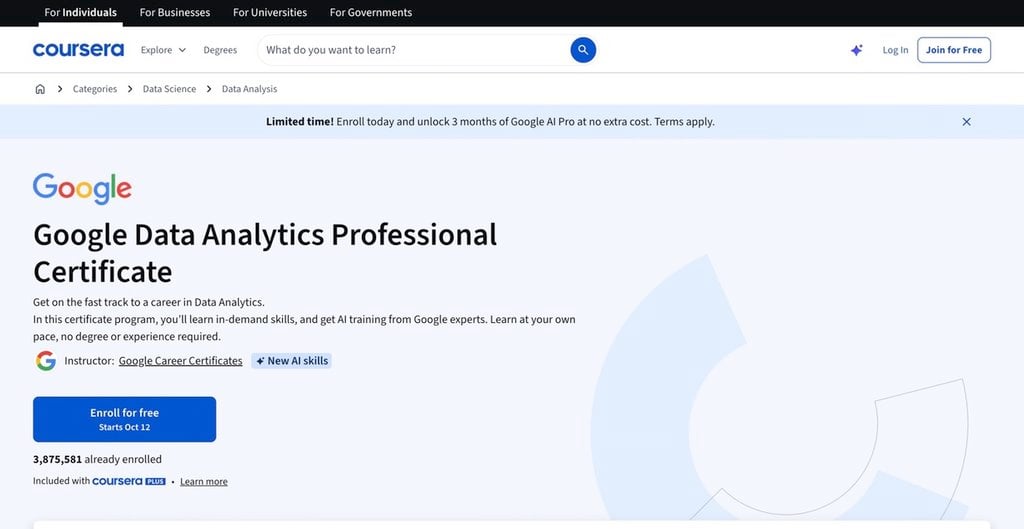
Career changers often start here. Coursera shows over 3.8 million people enrolled.
What you learn: cleaning, charting and presenting data. The tools are spreadsheets, SQL, Python and Tableau. Python gets its own course (number 7), an intro to analyzing data with it. Course 8 is the capstone, a case study you can hand to employers. Course 9 covers job hunting with AI.
Cost: $49 a month in the US, and Coursera doesn’t bill you until the 7-day free trial is over. The program is also included with Coursera Plus.
Time: Google estimates less than six months at under 10 hours a week, with over 180 hours of instruction across nine courses.
What happens after: graduates can apply directly to Google itself and over 150 US employers, Deloitte, Target and Verizon included. Google’s 2022 graduate survey says 75% of US respondents saw a positive career outcome inside six months, whether that was a new job, a promotion or a raise.
Best for: total beginners. You get a route someone else has planned, and a name recruiters already know sits on your resume.
IBM Data Analyst Professional Certificate (Coursera)
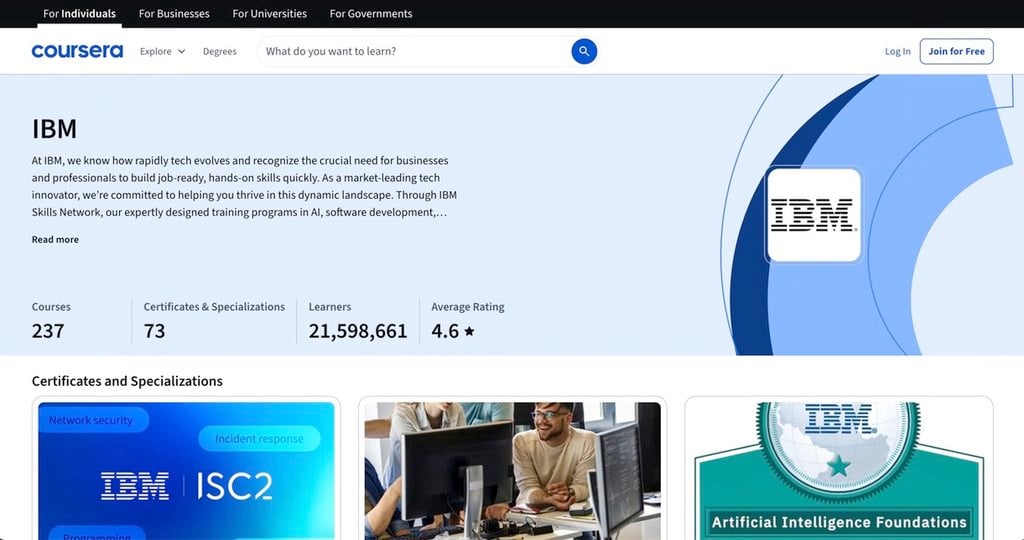
IBM’s program goes further into code. Five of the 11 course titles include the word Python, and they go from the basics to analysis and charts with Python libraries.
What you learn: Excel and SQL come first. After that it’s Python (Pandas, NumPy, Jupyter Notebooks), dashboards in IBM Cognos Analytics and Tableau, and a little API work and web scraping. The projects are practical ones, such as regression models for housing prices and a Python dashboard on US flight reliability. Course 10 covers generative AI for analysts.
Cost: included with Coursera Plus, which costs $59 a month in the US (with a 7-day free trial on monthly billing). IBM’s program page doesn’t list a separate price.
Time: at 10 hours a week, figure on roughly four months. That works out to around 180 hours if you total the course list.
Extras: you also get an IBM Digital badge and career resources, and the ACE and FIBAA recommendation can count for up to 12 college credits.
Best for: beginners already set on a technical analyst job, or eyeing data science or data engineering a bit later.
Google or IBM? Both now teach Python. Google has the bigger learner base and eases you in through spreadsheets. IBM gives you more hours of Python, and you learn Cognos as well as Tableau.

Picks for Early-Career Analysts
Got some analyst work under your belt and want a credential no single vendor owns? These two exams fit.
CompTIA Data+
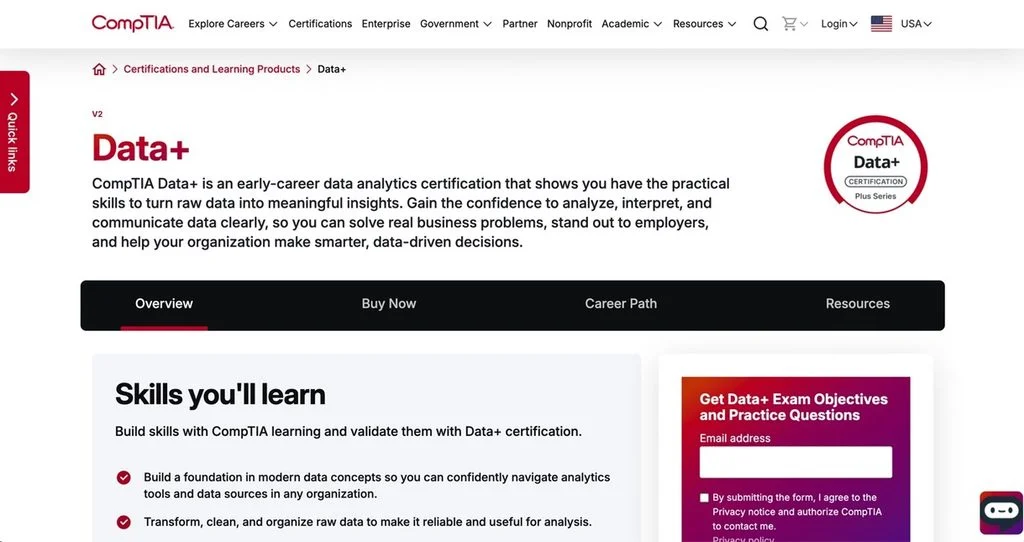
CompTIA calls Data+ an early-career certification, and it’s an exam, not a course. You pass it or you don’t.
Format: version V2, code DA0-002. You’ll have 90 minutes for at most 90 questions, some multiple-choice and some performance-based. The pass mark is 675, scored on a 100 to 900 scale. English and Japanese are the two exam languages.
What it covers in V2:
| Domain | Weight |
|---|---|
| Data concepts and environments (including cloud, containerization and AI concepts) | 20% |
| Data acquisition and preparation | 22% |
| Data analysis | 24% |
| Visualization and reporting | 20% |
| Data governance | 14% |
Cost: $255 for the exam voucher, or $304 with retake assurance. If you want study material, CompTIA sells CertMaster products that it estimates at 10 to 60 hours, depending on which one you buy.
Renewal: every three years. You’ll need 20 continuing education units by then.
Recommended experience: CompTIA’s guideline is 18 to 24 months in an analyst seat or near it, and time spent with databases, analytical tools, basic statistics and data visualization helps.
Why it counts: it’s ISO-accredited by the ANSI National Accreditation Board. CompTIA also maps it to the NICE Framework’s Data Analyst work role.
Best for: anyone who’ll probably change tools or jobs, since this one goes wherever you go.
CAP-Essentials (INFORMS)
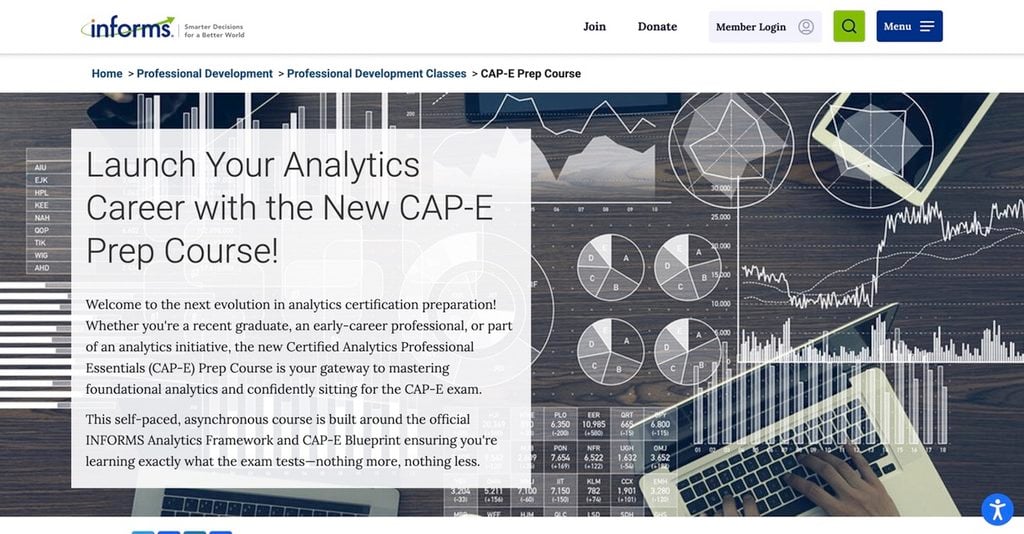
CAP-Essentials is the entry level of the Certified Analytics Professional program, and one of the two exams (with CAP-Pro) that replaced the old aCAP. It’s about the analytics process, whatever the tool.
Format: three hours, closed book, with 100 scored questions and some unscored pilot ones mixed in. You won’t have to write any code.
Requirements: you only have to agree to the INFORMS Code of Ethics. There’s no application.
Cost: INFORMS members pay $195, while nonmembers pay $275. Retakes run $150 if you’re a member and $200 if you aren’t. Candidates in qualifying developing countries pay less.
Validity: you’re covered for five years. Then you retest, or you move up a level to CAP-Pro or CAP-Expert.
Best for: early-career analysts out to show they can do more than SQL. Think framing the problem and seeing a project through its full lifecycle.
Tool Certifications for BI Analysts
Some employers have already settled on one BI platform. In that case the job post usually names that platform’s credential, since it proves you know the tool the team works in all day. The three below are all intermediate-level.
Power BI Data Analyst Associate (PL-300, Microsoft Certified)
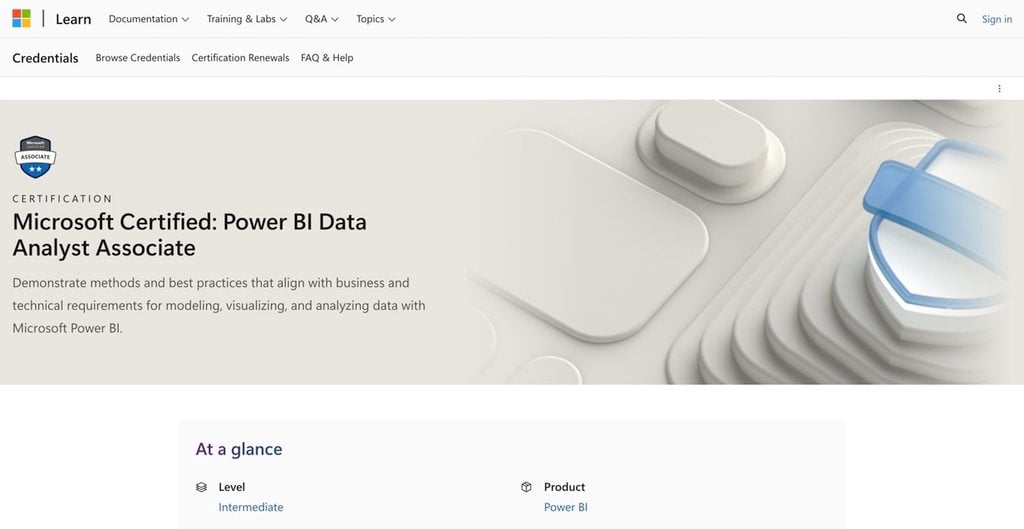
Can you build Power BI reports that business users actually trust? That’s what PL-300 checks. Microsoft takes it for granted that you know Power Query and DAX (Data Analysis Expressions) before you show up.
What it covers: data preparation and modeling come first, then visualizing and analyzing, and finally managing and securing Power BI.
Format: it’s proctored and runs 100 minutes. Pick from 10 languages. Fail it? You can try again 24 hours after that first attempt.
Cost: in the US, it’s $165. Outside the US, the price depends on the country where you take the exam.
Renewal: no fee. Every 12 months you pass an online assessment on Microsoft Learn.
Prep: there’s a free Microsoft Learn course (six learning paths). Then do the practice assessment and click through the exam sandbox to get a feel for the question types. Use your personal Microsoft account to register. According to Microsoft, exam records on a work or school account disappear once you leave that organization.
Best for: analysts in Microsoft shops. If you’re weighing where Power BI should pull data from, our guide to ETL in Power BI covers the options.
Salesforce Certified Tableau Data Analyst
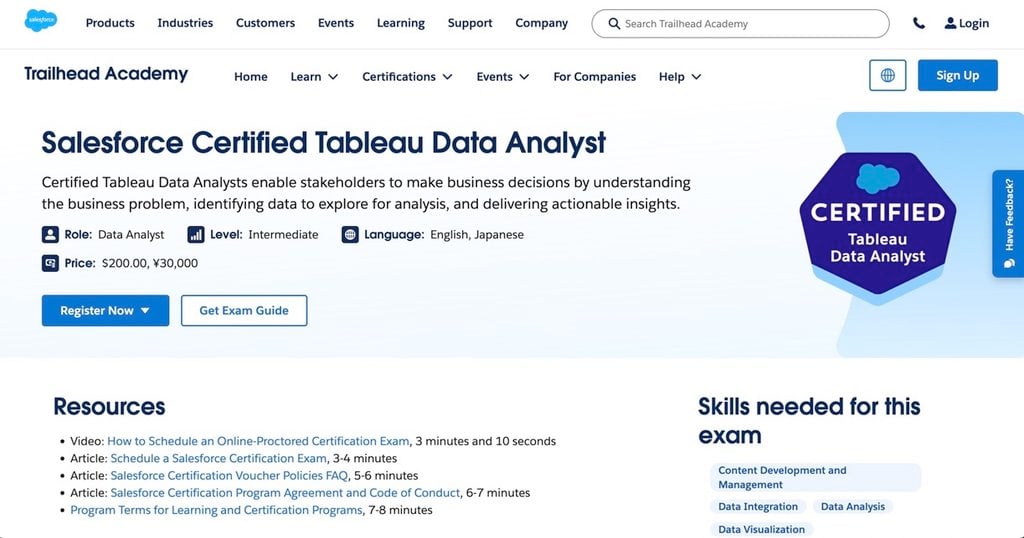
Tableau’s analyst exam now carries the Salesforce name and is booked through Trailhead Academy. Tableau Desktop and Tableau Prep are both on it, along with Tableau Server or Tableau Cloud.
Format: 60 multiple-choice and multiple-select questions, plus five that aren’t scored. Offered in English and Japanese.
Cost: $200 to register, plus taxes. There’s no prerequisite.
Renewal: the credential is valid for one year, and you keep it active by completing a maintenance module on Trailhead once a year.
Best for: analysts whose teams publish dashboards in Tableau. Our list of ETL tools for Tableau helps with the data side.
SAS Certified Specialist: Visual Business Analytics Using SAS Viya
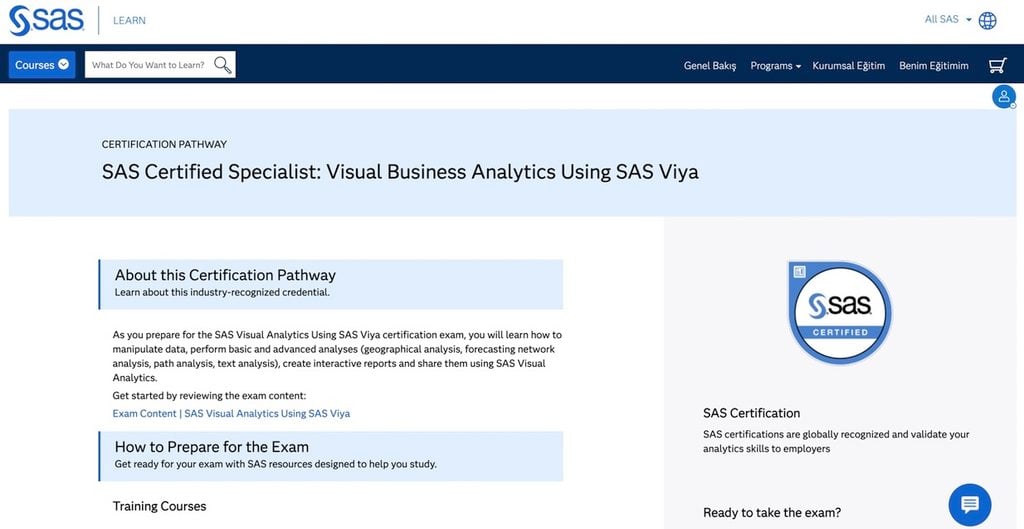
This is SAS’s credential for building reports and dashboards in SAS Visual Analytics. It’s the current option now that SAS retired the SAS Certified Advanced Analytics Professional credential.
What it covers: adding and manipulating data items, analyzing data and designing reports in SAS Visual Analytics.
Format: exam ID A00-470. There are 50 to 55 questions, multiple-choice and short-answer, with 100 minutes on the clock and 67% needed to pass. SAS and Pearson VUE run it.
Cost: $180, charged in USD in every country. Students and educators get academic discounts.
Validity: good for five years.
Prep: time spent in SAS Visual Analytics, on SAS Viya or SAS 9.4, helps. There’s also a SAS Visual Business Analytics Professional Certificate on Coursera, six beginner-level courses that take about 34 hours.
Best for: analysts whose teams already build their reports in SAS Visual Analytics.
Picks for Senior Analysts and Analytics Leads
INFORMS CAP-Pro and CAP-Expert
The Certified Analytics Professional program doesn’t belong to any vendor, because INFORMS built it on its own Analytics Framework. Every level uses the same exam setup, which is three hours, closed book, 100 scored questions and no programming. Who it’s for and what you need to get in are what change from one level to the next.
| Factors | CAP-Essentials | CAP-Pro | CAP-Expert |
|---|---|---|---|
| Signals | “I do the work” | “I own the work” | “I lead the work” |
| Requirements | Code of Ethics, pass the exam | Code of Ethics, pass the exam | Master’s or doctorate plus 2 years of analytics work, a bachelor’s plus 4 years, or no degree plus 8 years; soft skills confirmed by an employer or colleague; $55 application |
| Exam fee (member / nonmember) | $195 / $275 | $325 / $460 | $440 / $640 |
| Retake (member / nonmember) | $150 / $200 | $250 / $350 | $300 / $400 |
| Valid for | 5 years | 5 years | 3 years |
| Renewal | Retest or upgrade | Retest or upgrade | 30 professional development units across at least 3 of 5 categories |
CAP-Expert also carries ANAB accreditation under ISO/IEC 17024.
All in all there are seven domains. For CAP-Expert, the weighting is business problem framing 16%, analytics problem framing 17%, data 21%, methodology framing 13%, model development 16%, deployment 10%, and lifecycle management 7%.
Which level? Take CAP-Pro if you run analytics projects from the first question to deployment. Save CAP-Expert for when you set direction for a team and your education and years of experience meet the bar.
Data Analytics Certifications Compared
| Credential | Type | Level | Format | Cost (US) | Time or prep | Renewal |
|---|---|---|---|---|---|---|
| Google Data Analytics Professional Certificate | Certificate | Beginner | 9 online courses | $49 a month | Under 6 months at under 10 hours a week | No renewal listed |
| IBM Data Analyst Professional Certificate | Certificate | Beginner | 11 online courses | Coursera Plus, $59 a month | About 4 months at 10 hours a week | No renewal listed |
| CompTIA Data+ (V2) | Certification | Early-career | Up to 90 questions, 90 minutes | $255 ($304 with retake) | 18 to 24 months of experience recommended | Every 3 years with 20 continuing education units |
| CAP-Essentials | Certification | Early-career | 100 questions, 3 hours | $195 / $275 | No prerequisites | 5 years |
| PL-300 | Certification | Intermediate | 100 minutes | $165 | Six free learning paths | Every 12 months, free online |
| Salesforce Certified Tableau Data Analyst | Certification | Intermediate | 60 questions plus 5 unscored | $200 | No prerequisite | Yearly maintenance module on Trailhead |
| SAS Visual Business Analytics (A00-470) | Certification | Intermediate | 50 to 55 questions, 100 minutes | $180 | Optional 34-hour Coursera prep | Expires after 5 years |
| CAP-Pro | Certification | Mid-career | 100 questions, 3 hours | $325 / $460 | No prerequisites | 5 years |
| CAP-Expert | Certification (application first) | Senior | 100 questions, 3 hours | $440 / $640 plus $55 | 2, 4 or 8 years of experience, by degree | 3 years, 30 professional development units |
Subscriptions cost more the longer you take. Take Google’s full six-month estimate at $49 a month and you’re looking at about $294, tops; finish in three and it’s half that. An exam fee doesn’t care how long you study, though failing means you pay it again.
Your Data Analytics Certification Path, Step by Step
A pile of badges won’t land you a job by itself. What gets you there is a sequence. First the skills, then real data to use them on, and after that the one exam your target employers keep asking for.
- Build the foundation (4 to 6 months). Take Google’s or IBM’s program at about 10 hours a week. Don’t skip the capstone.
- Build two or three projects of your own (1 to 2 months). Find data the course didn’t supply, such as a sales export from work, a public dataset or a CRM you’re allowed to connect. Write up what you asked, the cleanup it took, and the answer.
- Add one targeted exam (1 to 2 months of prep). Job posts mention Power BI? Take PL-300. Tableau means the Tableau exam, and when no tool comes up at all, Data+ or CAP-Essentials.
- Move up when your job does. CAP-Pro makes sense once you own projects end to end, CAP-Expert once you’re leading the analytics function.
Run through this list before you book a test date:
- Took the provider’s practice assessment or sample questions and passed comfortably
- Know the retake fee and the waiting rule (PL-300: 24 hours after a first fail)
- Registered with a personal account, not a work one
- Studying for the current exam version (Data+ is DA0-002)
- Put the renewal date in your calendar (PL-300 every 12 months; Data+ and CAP-Expert every 3 years)
- Checked with your manager whether the company reimburses the exam fee
Choosing Your Data Analytics Certification
Know Your Starting Skill Level
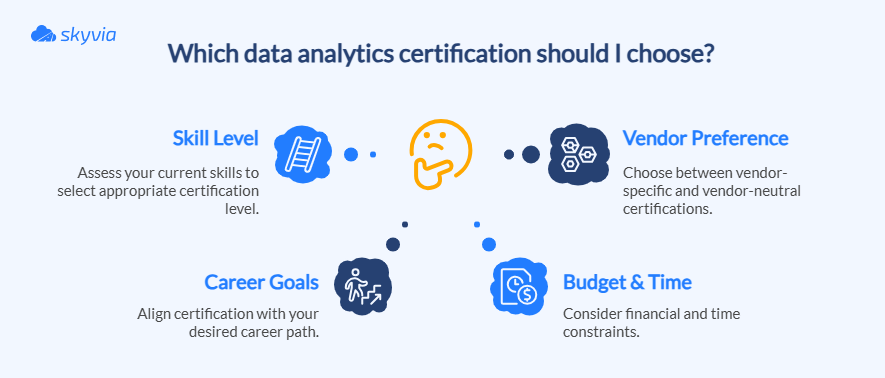
This part needs honesty. Haven’t written a SQL query yet? Then Google or IBM comes first, since an exam won’t teach you anything. Already building reports every week, on the other hand, means you can skip the beginner programs and go straight to an exam.
Let Job Posts for Your Target Role Decide
Nothing tells you more than the tool names in those job posts. A Power BI requirement repeated across postings makes PL-300 the obvious next step. Postings that only say “SQL, Excel, dashboards” point to a broad program or a vendor-neutral exam.
Count the Full Cost and Time
Add it all up: subscription months, the exam fee, a possible retake and the renewal. Fail a cheap exam twice and you’ve paid more than one pass at a pricier exam would cost. Budget for one retake up front. And before you pay, ask your manager about reimbursement. A credential tied to your job is a fair request.
Vendor Credentials or Vendor-Neutral Ones?
PL-300, Tableau and SAS exams say you can work in one tool. That’s what a team using that tool hires for. CompTIA Data+ and CAP have no vendor behind them, so they keep their value if your employer or stack changes. Still torn? Go with what your current or target company runs now, and save the neutral credential for later.
Is a Data Analytics Certification Worth It for You in 2026?
Yes, provided it fits your next job and you’ve got projects behind it. Self-taught learners get structure from a course certificate, plus a capstone to show for it. Hiring managers like exams for a simple reason: they’re quick to check. One caveat on Google’s survey above, though: it’s vendor-reported, so we’d read it as a best case, not a promise.
What it won’t do is replace a portfolio. Interviewers want to hear what you built, and exam credentials need upkeep too: PL-300 every year, and CAP-Expert and Data+ every three years. Put that in the budget from day one.
Where Skyvia Fits When You Practice on Real Data
Interviewers remember projects built on messy, real data from several sources. Pulling that data into one place is often the first snag.
Skyvia Data Integration handles that part. It replicates data from 200+ cloud apps and databases into BigQuery, Snowflake, Redshift, Azure Synapse, Databricks or a database, with no code. Skyvia Query is for quick looks: you write SQL in the browser and send results to Google Sheets or Excel. If PL-300 or the Tableau exam is next for you, practice on live data: Power BI, Tableau and Excel can read from the OData and SQL endpoints that Skyvia Connect exposes. Every product has a free plan, and signup needs no credit card.

FAQ for Data Analytics Certifications

Is R still part of the Google Data Analytics Certificate?
No. Google rebuilt the course around Python, and according to its FAQ, R programming isn’t in the curriculum anymore. The current version has nine courses, including an introduction to data analysis with Python and a course on job hunting with AI. Many older reviews still describe the R version.
What does a data analytics certification cost?
That comes down to the type you pick. Course certificates are subscriptions: Google’s program is $49 a month in the US, and IBM’s comes with Coursera Plus at $59 a month. Single exams start at $165 for Microsoft’s PL-300, CompTIA Data+ costs $255, and the top of the range is CAP-Expert at $640 for nonmembers plus a $55 application fee.
Are data analytics certificates worth it in 2026?
They are, when the one you pick matches the tools your target job posts name and you’ve got a few projects of your own to show next to it. You get structure and a capstone from a certificate, while an exam gives hiring managers something fast to check. Still, a certificate won’t stand in for a portfolio, because interviewers ask what you built.
Is 3 months enough to learn data analytics?
Three months can cover a lot if you put in well over 10 hours a week, though the main beginner programs expect you to take longer. Google’s estimate is under six months at under 10 hours a week; IBM’s is about four months at 10 hours a week. Add a month or two for projects of your own before you apply for jobs.
Do data analytics certifications expire?
Course certificates like Google’s and IBM’s list no renewal requirement. Exam-based ones usually expire or need renewal: Microsoft’s PL-300 renews every 12 months through a free online assessment, the SAS Viya credential expires after five years, CAP-Essentials and CAP-Pro last five years, and CAP-Expert lasts three years with 30 professional development units to renew. CompTIA Data+ renews every three years with 20 continuing education units.
Should I take CompTIA Data+ or the Google certificate?
They answer different needs. Google’s certificate teaches you the skills from zero, while CompTIA Data+ tests skills you should already have, with 18 to 24 months of analyst experience recommended. Many people take Google first, work for a while, and then sit Data+ for a vendor-neutral credential.
Will AI replace data analysts?
Nobody can promise how the job will change, but the programs themselves show where it’s heading. Google added a course on job hunting with AI, IBM added one on generative AI for analysts, and CompTIA Data+ V2 now tests AI concepts. The curricula are training analysts to use these tools on top of SQL and visualization.
Ready to build a portfolio project on data from your own CRM, ads or finance tools? Create a free Skyvia account and load it into a warehouse or a spreadsheet, with no credit card needed.