Summary
- Boomi, MuleSoft, Workato and WSO2 replace TIBCO's integration middleware, and Boomi and MuleSoft publish entry prices.
- Skyvia, Informatica, IBM DataStage and Qlik Talend Cloud fit teams that mainly use TIBCO to move data between apps, databases and warehouses.
- Apache Kafka is the usual replacement for TIBCO EMS messaging, and TIBCO itself offers enterprise support for it.
- TIBCO now runs BusinessWorks 5 applications in containers without a rewrite, so staying can be the right call for large BusinessWorks estates.
Renewal time comes around, and half the TIBCO line items are a mystery to everyone in the room. There’s that BusinessWorks job pushing CRM records every night. A few EMS queues feed orders, and the two people who get how it all fits are booked for months. Looking at TIBCO alternatives starts to feel less like an option and more like a risk you have to price.
The catch is that TIBCO is several products under one brand, now owned by Cloud Software Group. Integration middleware, a message broker and an in-memory data grid each need a different kind of replacement. We grouped nine TIBCO competitors by the workload they take over and checked every price on each vendor’s own US pricing page in October 2026.
Below you’ll find a quick answer by workload, what changed at TIBCO in 2026, a pricing and deployment table, and a migration plan with an inventory template.
The best TIBCO alternatives at a glance
TIBCO isn’t one product, so there’s no single replacement for it. Most estates run a mix of BusinessWorks or Flogo for integration, Enterprise Message Service (EMS) or FTL for messaging, and sometimes BusinessEvents or ActiveSpaces on top. Each of those is a separate decision.
| If you use TIBCO for… | Look at | Why |
|---|---|---|
| Application integration and ESB flows (BusinessWorks, Flogo) | Boomi, MuleSoft, Workato, WSO2 Integration Platform | Full integration platforms (iPaaS) with visual builders, API work and on-premise reach |
| Moving data between SaaS apps, databases and warehouses | Skyvia, Informatica, IBM DataStage, Qlik Talend Cloud | Built for ETL, ELT, replication and sync, priced by volume or usage |
| Messaging and event streaming (EMS, FTL) | Apache Kafka | Open-source event streaming; TIBCO itself sells enterprise support for it |
| Process automation across business teams | Workato, Boomi | Workflow builders that business users can run with IT oversight |
| People-facing workflows on a Microsoft 365 stack | Microsoft Power Automate (outside the nine) | Per-user plans from $15 a month paid yearly; a layer above integration, not a BusinessWorks replacement |
Before you shortlist anything, pull your TIBCO license list and count the applications per product. Twenty BusinessWorks jobs that copy CRM records into a database are a data integration problem. Two hundred EMS queues feeding trading systems are not, and no iPaaS on this list replaces them.
Who owns TIBCO in 2026, and what does it sell?
TIBCO is now a brand of Cloud Software Group. These days the flagship is called the TIBCO Platform. It’s a control plane, so you watch and deploy your TIBCO software from one spot, though that software might run on-premises, in a cloud or at the edge. Nothing on-premise has to move, because TIBCO Control Tower looks after those components where they sit; anything new can go to Kubernetes in the cloud you prefer.
The platform is organized into five capabilities:
| TIBCO capability | Main components | What it does |
|---|---|---|
| Integration | BusinessWorks, Flogo, BusinessConnect, Managed File Transfer | App, data, IoT and B2B integration, APIs; TIBCO lists 300+ pre-built connectors |
| Messaging | Enterprise Message Service, FTL, support for Apache Kafka and Apache Pulsar | Real-time message delivery between systems |
| Data Grid | ActiveSpaces, support for Apache Cassandra | Distributed in-memory system of record |
| Event Processing | BusinessEvents | Detects patterns in events from IoT devices, brokers and APIs and acts on them |
| Process Automation | Workflow and case management | Automates business processes and case resolution |
Does that make TIBCO an ETL tool? Partly. You can extract, transform and load data with BusinessWorks, though TIBCO sells it as general integration middleware rather than a warehouse loader. TIBCO doesn’t publish prices for any of these products; every deal goes through sales.
What changed at TIBCO in 2026
Many TIBCO comparison articles still describe “TIBCO Cloud Integration” and its trial. Try those product pages on tibco.com today and you’ll hit a “page not found” error; the offer has moved under TIBCO Platform. If leaving is on the table, three changes deserve a look:
- BusinessWorks 5 Containers. TIBCO wrote about bw5ToCE in June 2026. It takes existing BusinessWorks 5 applications and runs them on the TIBCO Platform as Kubernetes deployments, no rewrite needed. Your EAR files stay the same. Still, check a few patterns before you move anything: Fault Tolerant Groups, Wait and Notify across instances, and HTTP Basic Authentication that leans on TIBCO Administrator domain users.
- TESSA. On August 4, 2026, TIBCO introduced TESSA, an AI agent you can ask about your platform in plain language (“what’s unhealthy right now?”). Its tools are read-only by default, and it runs on MCP servers for Control Plane, BusinessWorks, Flogo and Observability.
- AI and MCP across the platform. TIBCO now advertises MCP servers (including a zero-code MCP server), AI copilots and an AI-powered mapper.
None of this changes TIBCO’s pricing or the skills it takes to run. It does change one argument: “TIBCO can’t run in containers” is no longer true for BusinessWorks 5.
When staying on TIBCO makes sense
Staying is the smart move when BusinessWorks 5 makes up most of the estate and can go into containers, when high-volume EMS messaging is the backbone of your architecture, and when a certified TIBCO team is already on payroll. Here, renewing costs less than a migration.
Flip it around, though. Maybe your integrations mostly carry SaaS data into a warehouse now, or two or three people hold every detail of the estate, or the quote is full of products nobody opens. Then start planning an exit.
Why teams look for TIBCO competitors
We hear the same reasons from companies of every size:
- Opaque pricing. You won’t find a TIBCO price list anywhere, so each renewal turns into a negotiation (and BusinessWorks, EMS and the rest often come as separate licenses).
- Specialist skills. BusinessWorks and EMS need trained developers and administrators. When one of them leaves, the knowledge goes too.
- A shifting estate. More and more integrations look like this: a cloud app such as Salesforce or HubSpot feeding a warehouse such as Snowflake or BigQuery. Jobs like that don’t need a middleware team behind them.
- Platform size. Even if you use just one TIBCO capability, somebody still runs and patches everything around it.
License fees cover only part of the bill, so compare quotes on total cost of ownership (TCO). Count the developers and admins a platform needs. Then add servers or cloud capacity, plus whatever partners charge to run the migration. A cheaper license that still needs two certified specialists can cost more than the TIBCO renewal.
How we compared the tools
We scored each tool on the facts a TIBCO buyer needs before a sales call:
- Workload covered: application integration, data integration, messaging or automation.
- Pricing unit and entry price: what each vendor charges for (credits, messages, records, compute hours) and the lowest price on its US pricing page in October 2026.
- Free plan or trial: can you try the product before signing any contract?
- Deployment: cloud service only, self-hosted, or a blend of the two through an on-premise agent.
- On-premise reach: how a tool gets to systems that live behind your firewall.
We left out review-site ratings. They shift month to month and say little about whether a tool fits your TIBCO workload.
TIBCO alternatives compared: pricing and deployment
| Tool | Replaces | Pricing unit | Entry price (published) | Free plan or trial | Deployment |
|---|---|---|---|---|---|
| Boomi | Integration (BusinessWorks) | Boomi Messages (pay-as-you-go) or subscription | $99/month + $0.05 per message, billed monthly | 30-day trial | Cloud with on-premise runtimes |
| MuleSoft | Integration, APIs | Mule Credits | From $2,000/month, billed annually | 30-day trial | Cloud and hybrid |
| Workato | Integration, automation | Edition plus usage | Not published | Free account signup | Cloud with on-premise agents |
| WSO2 Integration Platform | Integration, APIs | Integrations and transactions | Not published (Growth plan priced on request) | 30-day trial, no credit card | Open-source self-hosted or iPaaS |
| Skyvia | Data integration | Records per month | $79/month billed annually, $99 billed monthly | Free plan, 14-day trial | Cloud with On-premise Agent |
| Informatica | Data integration, MDM | IPUs (consumption) | Not published | 30-day trial | Cloud, multi-cloud and hybrid |
| IBM DataStage | Data integration (ETL, ELT) | Capacity Unit-Hours | DataStage as a Service from USD 1.75 per CUH | Free trial | Cloud, with remote engine |
| Qlik Talend Cloud | Data integration | Data volume (plus job executions and duration on Premium and Enterprise) | Not published | Free trial | Cloud |
| Apache Kafka | Messaging (EMS, FTL) | Open source | Free (you run it) | n/a | Self-hosted |
Only three vendors here publish a usable entry price for their commercial product: Boomi, MuleSoft and Skyvia. IBM publishes an indicative rate for its managed DataStage service. For the rest, plan on a sales call before you can compare totals.
Alternatives for app integration (BusinessWorks, Flogo)
Here’s the integration middleware side of TIBCO: process flows, APIs, and the connections between ERPs, CRMs and homegrown systems.
Boomi
Boomi runs as an independent iPaaS these days (back in 2021, Dell sold it to Francisco Partners and TPG). It’s the closest like-for-like replacement for BusinessWorks in estates full of ERPs and legacy systems: a visual integration builder, the full standard connector library in every subscription, and runtimes that Boomi says can run anywhere, including behind your firewall.
- Pricing: Pay-as-You-Go costs $99 a month plus $0.05 per Boomi Message, billed monthly with no contract. For a subscription (Professional, Professional Plus, Enterprise or Enterprise Plus) you’ll need a quote.
- Trial: you get 30 days.
- Also: Boomi owns Rivery, now sold as Boomi Data Integration, and markets AI agent management through Agentstudio and Agent Control Plane.
- Limits: subscription prices aren’t public, so larger estates still negotiate.
Our roundup of Boomi alternatives covers what to do if Boomi itself doesn’t fit.
MuleSoft
MuleSoft became part of Salesforce in May 2018 and has stayed there. On Anypoint Platform you get integrations and API management, plus automation and AI agents. The idea is API-led connectivity: put an API in front of every system, legacy ones too, and build processes on those APIs. MuleSoft Agent Fabric adds a registry and governance for agents, MCP servers and APIs.
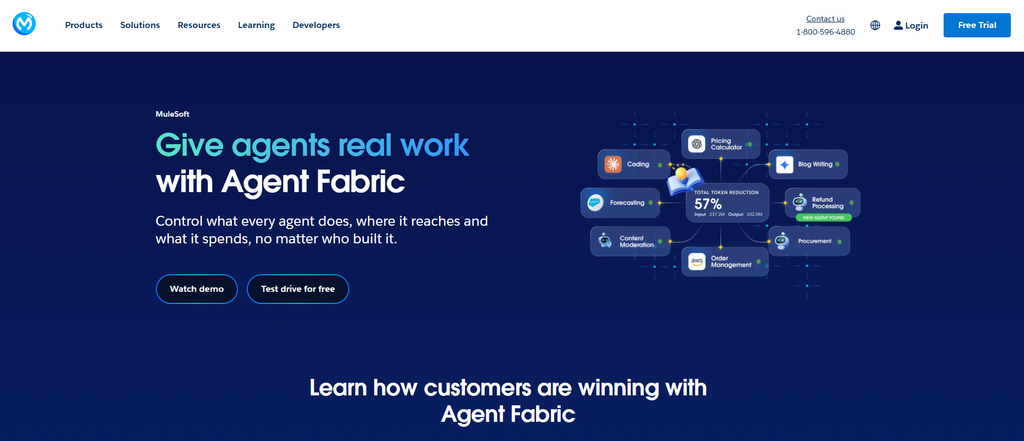
- Pricing: packages start at $2,000 a month billed annually and are paid in Mule Credits, one consumption currency for every usage type. Buying models are Pre-Purchase, Pre-Commit (with a $50K minimum annual commitment) and Unlimited.
- Trial: 30 days, with the full portfolio.
- Limits: transformations are written in DataWeave, MuleSoft’s own language, so you trade TIBCO specialists for MuleSoft specialists. Salesforce also owns Informatica, so expect the two portfolios to converge.
See our MuleSoft alternatives guide for a closer look at its pricing model.
Workato
Workato is an iPaaS for process automation that IT and business teams build together. It advertises 1,200+ pre-built connectors (vendor-reported) and unlimited workspaces and users.
- Pricing: editions are Standard, Business MCP, Enterprise MCP and Workato ONE, all priced on request. Data integration (ETL, ELT, reverse ETL) starts at Business MCP.
- On-premise reach: on-premise agents (OPAs), with three included in Business MCP and 10 in Enterprise MCP.
- Trial: free account signup.
- Limits: no messaging layer comparable to EMS, and no public price.
WSO2 Integration Platform
WSO2 is the open-source option. Its Integration Platform is 100% open source, so you can self-host it with no feature restrictions, or let WSO2 run it for you as an iPaaS (Devant). Connectors are unlimited on every plan, and the platform includes AI-assisted development and AI agents.
- Pricing: the Growth plan covers up to 100 integrations and 20M transactions a month, paid monthly by card with no contract, but the price isn’t listed. Enterprise is unlimited on custom terms.
- Trial: it lasts 30 days with full access and needs no credit card, although you’re limited to five integrations and up to 1M transactions.
- Limits: self-hosting puts runtime care, upgrades and monitoring back on your own people, which is pretty much the job TIBCO gives them today.
Alternatives for data integration and pipelines
Are most of your TIBCO jobs just copying records between apps, databases and warehouses? Then a data integration tool will cost less to run than yet another middleware platform.
Skyvia
Skyvia runs in your browser with no code to write (200+ connectors cover cloud apps, databases, data warehouses and file storage services). Hand it the data-movement chores of a TIBCO estate. Scheduled syncs, warehouse loads, record imports: none of them should need a BusinessWorks developer on call.
What it covers:
- Data Integration: replication (ELT) into BigQuery, Snowflake, Redshift, Azure Synapse, Databricks or a database, with incremental updates; import, including reverse ETL; CSV export; and two-way synchronization between apps and databases.
- Complex pipelines: Data Flow (Standard plan and up) for multi-source pipelines with lookups and conditional splits, and Control Flow (Professional and up) to run integrations in order or in parallel with error handling.
- On-premise databases: the On-premise Agent reaches databases behind a firewall over outbound HTTPS on port 443, with no inbound ports.
- Endpoints: Skyvia Connect publishes OData and SQL endpoints for BI tools, and MCP endpoints for AI assistants.
- Security: SOC 2, GDPR and HIPAA (BAA available).
- Pricing: for 5M records, Data Integration Basic is $79 a month billed annually, or $99 billed monthly. Standard also starts at $79 a month billed annually, though only for 500K records, since it adds hourly runs and Data Flow ($159 billed annually at 5M records). Professional begins at $399 a month billed annually ($499 billed monthly) for 10M records, with runs every minute and Control Flow. The free plan gives you 10K records a month, with runs once a day. You also get a 14-day trial the moment you sign up, and there’s no credit card step. Users are unlimited on every paid plan.
- Limits: Skyvia isn’t a message broker or an API management platform, and it doesn’t sync in real time: the fastest schedule is once a minute on Professional and Enterprise. Native change capture covers SQL Server only (through Change Tracking); other sources use timestamp-based incremental updates. TIBCO projects can’t be imported, so each job is rebuilt in Skyvia’s visual editors.

Informatica
Salesforce owns Informatica now (that deal closed on November 18, 2025). Its current platform goes by Intelligent Data Management Cloud (IDMC). Inside, there’s data integration, data quality and observability, and application integration too. Add a data catalog, lineage and master data management on top, with the CLAIRE AI engine wired through the lot. And CLAIRE Copilot? It turns a plain-language description into a pipeline.
- Pricing: consumption, counted in Informatica Processing Units (IPUs); expect to ask sales for a number.
- Trial: 30 days of free cloud access, straight from Informatica.
- Best fit: data programs that put governance first. Lineage, data quality and MDM win out over message volume there.
- Limits: Informatica doesn’t publish prices, and its roadmap could change as Salesforce brings it closer to MuleSoft.
Our Informatica alternatives roundup compares it with lighter tools.
IBM DataStage
IBM DataStage, formerly InfoSphere DataStage, is IBM’s ETL and ELT engine, now part of watsonx.data integration. It runs jobs on a parallel processing engine, offers a remote engine for running pipelines close to your data, and includes an AI pipeline assistant that works from natural language.
- Pricing: IBM DataStage as a Service on IBM Cloud starts at USD 1.75 per Capacity Unit-Hour (indicative). Enterprise and Enterprise Plus editions are quoted, with unlimited users.
- Trial: free.
- Best fit: high-volume batch ETL in organizations already on IBM.
- Limits: it’s a data engine, so application integration and messaging need other IBM products.
Qlik Talend Cloud
Talend sits inside Qlik these days. Its free desktop tool, Talend Open Studio, went away on January 31, 2024. So the product on sale is Qlik Talend Cloud, with four editions to choose from (Starter, Standard, Premium and Enterprise).
- Pricing: quote-based capacity subscriptions, measured by data volume on Starter and Standard, and by data volume, job executions and duration on Premium and Enterprise.
- Trial: free trial from Qlik.
- Best fit: teams that want data integration and data quality from the same vendor as their Qlik analytics.
- Limits: no open-source edition anymore, and no public prices.
See our Talend alternatives guide if you’re weighing Talend against simpler tools.
Alternatives for messaging (TIBCO EMS and FTL)
Apache Kafka
Apache Kafka is an open-source distributed event streaming platform used for high-performance data pipelines, streaming analytics and data integration. It handles the real-time, high-volume side of a TIBCO estate that batch tools can’t. It’s the usual destination when teams move publish-subscribe workloads off EMS.
There’s a twist. TIBCO’s own Messaging capability includes enterprise support for Apache Kafka and Apache Pulsar, so moving topics to Kafka doesn’t force you to drop TIBCO support on day one. Swap the broker now, pick the vendor later.
- Pricing: Kafka itself costs nothing, being open source; what you pay for is the infrastructure and the staff who run it, unless you buy a managed Kafka service instead.
- Limits: running the clusters is your job, at least until you buy a managed service. Test how your EMS queues, transactions and consumers behave on Kafka before you plan the cutover. None of the iPaaS or data integration tools above replace a message broker.
How to migrate off TIBCO, step by step
Treat this as a rebuild. Other vendors’ tools can’t run TIBCO applications, so every flow gets recreated from scratch in the new one. It’s worth asking each vendor on your shortlist what migration help comes with the deal. These steps keep the rebuild under control:
- Inventory every application. Export the list from TIBCO Administrator or the TIBCO Platform control plane and record each one in a sheet (template below).
- Classify by workload. Tag each row as application integration, data movement, messaging or event processing. This tells you which group of tools above applies.
- Flag what can’t move as-is. Note custom Java code, adapters, Fault Tolerant Groups, cross-instance Wait and Notify, and anything that depends on Rendezvous or Hawk.
- Pick one pilot. A scheduled data job with clear inputs and outputs makes the best pilot (a nightly CRM-to-database sync, say), so rebuild that one in the new tool.
- Run both in parallel. Compare record counts and a sample of field values between the TIBCO job and the new one for at least one full business cycle.
- Cut over in waves. Move data jobs first, then integration flows, and messaging last, because it touches the most applications.
- Decommission. Once a replacement has run cleanly, turn off the TIBCO application behind it, then cut that license line at the next renewal.
- Paste this inventory template into a spreadsheet to get going:
application_name,tibco_product,workload_type,source_systems,target_systems,schedule_or_trigger,custom_code,owner,target_tool,migration_wave,status
crm_to_db_nightly,BusinessWorks 5,data movement,Salesforce,SQL Server,daily 02:00,no,data-team@example.com,Skyvia,1,pilot
order_events,EMS,messaging,ERP,Warehouse system,on message,yes,integration-team@example.com,Apache Kafka,3,not started
The pilot has done its job if record counts match TIBCO’s on every run of the parallel period, if failed records appear in the new tool’s logs, and if the owner can move the schedule with no TIBCO developer involved.
Where Skyvia fits in a TIBCO migration
Most TIBCO exits keep some middleware and replace the rest. Got a block of scheduled data jobs in that inventory (CRM to warehouse, ERP to database, CSV imports)? Skyvia can pick those up in wave one, and integration flows and messaging can follow on their own timeline. For warehouse loads there’s Replication, which brings app data in with incremental updates. And when two systems have to agree both ways, Synchronization keeps them in step.

FAQ for Tibco Software Alternatives

Is TIBCO still relevant in 2026?
Yes, especially for estates built on BusinessWorks 5 and EMS messaging. For one thing, BusinessWorks 5 applications can now move into containers on TIBCO without being rewritten. August 2026 also brought TESSA, TIBCO's AI agent for the platform (read-only tools by default). It's a weaker case if your integrations mostly just haul SaaS data into a warehouse.
Can TIBCO work as an ETL tool?
Partly. BusinessWorks can extract, transform and load data. TIBCO, though, sells it as general integration middleware, and a warehouse loader isn't how they describe it. When ETL and ELT make up most of your workload, data integration tools such as Skyvia, Informatica or IBM DataStage fit the job more directly.
What is the closest alternative to TIBCO BusinessWorks?
Boomi, mostly. There's a visual builder, every subscription comes with the standard connector library, and the runtimes are happy behind your firewall. For a Salesforce-centric company chasing API-led integration, MuleSoft wins. Need open source you can host yourself? Go with WSO2.
Which tools can replace TIBCO EMS?
Apache Kafka is the usual choice for moving publish-subscribe messaging off EMS. Since TIBCO's own Messaging capability comes with enterprise support for Kafka and Pulsar, the broker can change before the vendor does. A message broker is a different animal, and integration or data tools like Boomi and Skyvia won't stand in for one.
Is there an automatic way to migrate TIBCO integrations to another platform?
Not as a rule. Other vendors' tools can't run TIBCO applications, which means rebuilding each flow in the new one. Begin with an inventory of every application. Then rebuild one scheduled data job as a pilot and keep it running next to TIBCO until you're ready to cut over.
Which TIBCO alternatives publish their prices?
Boomi, MuleSoft and Skyvia publish entry prices. Boomi Pay-as-You-Go costs $99 a month plus $0.05 per message, MuleSoft packages start at $2,000 a month billed annually, and Skyvia Data Integration starts at $79 a month billed annually. IBM lists an indicative rate for DataStage as a Service, while Informatica, Workato, WSO2 and Qlik Talend quote on request.
Does Skyvia support real-time integration like TIBCO?
No. Skyvia runs scheduled integrations, as often as once a minute on the Professional and Enterprise plans, and it isn't a message broker. It suits the scheduled syncs, warehouse loads and imports in a TIBCO estate, not real-time event streaming.