


Summary
- Boomi, Workato, Celigo, Jitterbit and SnapLogic replace MuleSoft's app and process integration, and only Boomi publishes a price.
- Skyvia, Informatica, Integrate.io and AWS Glue fit teams that mainly use MuleSoft to move and sync data.
- Apigee, WSO2 API Platform and Kong Konnect replace MuleSoft's API management layer.
- MuleSoft packages now start at $2,000 a month billed annually, paid in Mule Credits.
Then the renewal quote shows up, priced for far more platform than your team ever touches. Maybe all MuleSoft does for you is a dozen nightly data jobs, one Salesforce-to-ERP sync and two internal APIs. Changing any of them means booking a certified developer. Meanwhile the backlog keeps growing, quarter after quarter.
Here’s the catch with most MuleSoft alternatives: they cover one part of Anypoint well, rarely all of it. You’ll find iPaaS platforms built for app integration, API gateways, and tools whose only job is moving data. We sorted 12 of them by the job they take over and checked every price on the vendor’s own US pricing page in October 2026.
Below you’ll find a quick answer by use case, what changed in MuleSoft’s own pricing, a comparison table with each tool’s pricing unit, and a checklist for the switch.
The best MuleSoft alternatives at a glance
So what does MuleSoft actually do for you today? Anypoint Platform is a bundle of products, and which replacement makes sense hangs on the slice you run day to day.
| If you use MuleSoft for… | Look at | Why |
|---|---|---|
| Connecting SaaS apps and ERPs, automating business processes | Boomi, Workato, Celigo, Jitterbit, SnapLogic | Full iPaaS with visual builders; Boomi also sells a pay-as-you-go plan |
| Moving data between apps, databases and warehouses | Skyvia, Informatica, Integrate.io, AWS Glue | Built for pipelines, replication and sync; most price by volume or usage, not by integration project |
| Publishing, securing and governing APIs | Apigee, WSO2 API Platform, Kong Konnect | Gateways and API management with public usage-based prices or an open-source core |
| Desktop and cloud task automation (RPA) on a Microsoft stack | Microsoft Power Automate (outside the 12) | Per-user and per-bot plans instead of an integration contract |
| Avoiding license fees altogether | WSO2 API Platform, Apache NiFi (outside the 12) | Open source, but you run and maintain them yourself |
Sort your MuleSoft applications by type (system APIs, process flows, batch data jobs) before any tool makes the shortlist. Say you run 40 batch jobs and two APIs. That’s a job for a data integration tool plus a light gateway, and another full iPaaS would be wasted money.
What MuleSoft does, and why teams start looking elsewhere
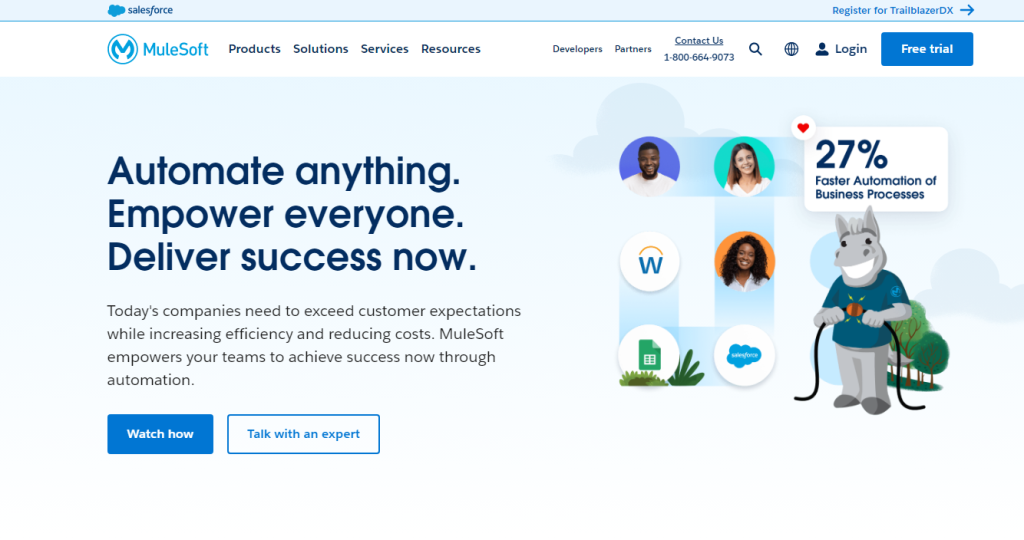
Anypoint Platform from MuleSoft handles integrations, API management, automation, AI agents and document processing. The big idea is API-led connectivity. Each system gets wrapped in an API, processes get built on top, and the next project reuses what’s already there. MuleSoft belongs to Salesforce, and it earns its price in large Salesforce-centric enterprises that keep a dedicated integration team.
Ask teams why they’re shopping for MuleSoft competitors and you hear the same few answers:
- Cost floor. Packages begin at $2,000 a month billed annually, and that’s before you pay implementation partners or certified developers.
- Specialized skills. You build flows in Anypoint Studio and write transformations in DataWeave, a language only MuleSoft uses. Without a developer background, that learning curve is steep. Certified MuleSoft engineers also cost more to hire than the people who run a low-code tool.
- Overkill for a few flows. A company that syncs Salesforce with an ERP and loads a warehouse every night pays for API lifecycle tooling it never opens.
- Salesforce lock-in. With Informatica now inside Salesforce too, some teams want an integration layer that isn’t tied to their CRM vendor.
MuleSoft pricing in 2026: what changed
Many comparison articles still describe MuleSoft pricing in vCores. MuleSoft’s current pricing page doesn’t use that model. It sells packages that include Mule Credits, a single consumption currency you spend on integrations, API management, automation and agents. Each usage type has its own credit rate, and the rate drops as usage grows.
| MuleSoft buying model | How it works |
|---|---|
| Pre-Purchase | Buy a package and a block of credits up front; add more later; no minimum credit purchase |
| Pre-Commit | Commit to a yearly baseline and pay monthly as you draw it down; $50K minimum annual commitment |
| Unlimited | Custom fixed price for uncapped credits and the full portfolio |
Packages begin at $2,000 a month, billed annually. Do the math and the entry point is $24,000 a year. There’s a 30-day free trial, and it opens the full portfolio. Comparing quotes? Ask every vendor to price the same thing MuleSoft bills you for, which is credits per workload rather than a list price per connector.
Who owns what now
Ownership changed for several tools on this list, and older roundups miss it:
- Salesforce owns MuleSoft, and Informatica joined it on November 18, 2025. Salesforce plans to combine the two.
- Boomi acquired Rivery, announced in December 2024. Rivery’s pricing now runs on Boomi Data Unit credits.
- Qlik owns Talend and Stitch. Qlik retired the free Talend Open Studio on January 31, 2024, and points new Stitch users to Qlik Talend Cloud.
How we compared the alternatives
Each tool was scored on five points you can check yourself, no sales call needed:
- The job it replaces: is it iPaaS, data integration or API management?
- Pricing unit: the thing you’re billed for, be it messages, records, events, API calls, credits or one flat fee.
- Entry price: the lowest public price on the vendor’s US pricing page in October 2026, with its billing basis. “Quote only” means the vendor publishes no figure.
- Free plan or trial: length and limits.
- Deployment: cloud only, self-hosted, or cloud plus an on-premises agent that reaches systems sitting behind a firewall.
We also note who builds on each tool. With low-code platforms, analysts and operations staff can own the flows. Developer-first tools, much like MuleSoft, need engineers around.
MuleSoft alternatives compared
| Tool | Best for | Pricing unit | Entry price | Free plan or trial | Deployment |
|---|---|---|---|---|---|
| Boomi | Enterprise iPaaS | Boomi Messages (PAYG) or subscription | $99/month + $0.05 per message (PAYG, billed monthly) | 30-day trial | Hosted cloud or your own runtime |
| Workato | Business process automation | Editions + usage | Quote only | Free account | Cloud with on-prem agents |
| Celigo | NetSuite and SaaS app flows | Endpoints and flows | Quote only | 30-day trial, then free plan (2 endpoints, 1 flow) | Cloud with on-prem agent on paid plans |
| Jitterbit | API-first app integration | Editions by connection count | Quote only | Not published | Cloud and private agents |
| SnapLogic | Enterprise pipelines and apps | Packages | Quote only | Not published | CloudPlex or self-hosted GroundPlex |
| Skyvia | No-code data integration and sync | Records per month | $79/month billed annually, $99 monthly (5M records) | Free plan + 14-day trial | Cloud with on-premises Agent |
| Informatica | Enterprise data management | IPUs | Quote only | 30-day trial | Cloud |
| Integrate.io | Flat-fee data pipelines | Flat fee | $1,999/month | 14-day trial | Cloud |
| AWS Glue | AWS-native ETL | DPU-hours | Per second, e.g. $0.44 per DPU-hour (varies by region) | Data Catalog free tier | AWS serverless |
| Apigee | Large API programs | API calls + environments | $365/month per region (Base environment) + calls | 60-day sandbox | Google Cloud, hybrid |
| WSO2 API Platform | Open-source API management | Usage-based | Not published | Free sign-up; open source | SaaS, self-hosted, hybrid |
| Kong Konnect | Lightweight gateways | Control planes + requests | From $25/month plus usage, billed monthly | 30-day trial | SaaS, hybrid, self-hosted |
iPaaS alternatives for app and process integration
For app-to-app flows, these platforms take over the job of MuleSoft’s integration engine. Plan for enterprise sales cycles, since Boomi is the only one of the five with a public price.
Boomi
Boomi is the closest like-for-like MuleSoft competitor: an iPaaS with mapping and transformation, API management, Data Hub for master data, and Data Integration editions. It runs in Boomi’s hosted cloud or on your own runtime, and the lineup now includes AI agent tooling (Agentstudio, Agent Control Plane).
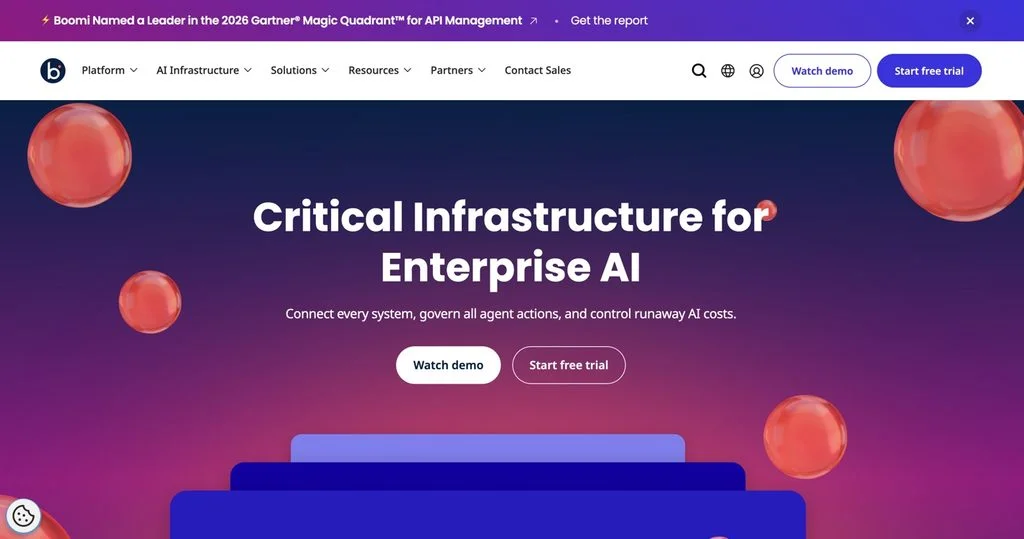
Boomi is also the easiest to try without a contract. On Pay-as-You-Go you pay $99 a month and then $0.05 per Boomi Message, billed monthly. The subscription plans (Professional, Professional Plus, Enterprise, Enterprise Plus) are all quote only. The free trial runs 30 days. Chatty, high-volume flows are where that per-message charge bites. For a deeper list, see our Boomi alternatives guide.
Workato
Workato is a workflow automation platform with 1,200+ pre-built connectors (vendor-reported). Editions are Standard, Business MCP, Enterprise MCP and Workato ONE, all priced on request, with unlimited workspaces and users.
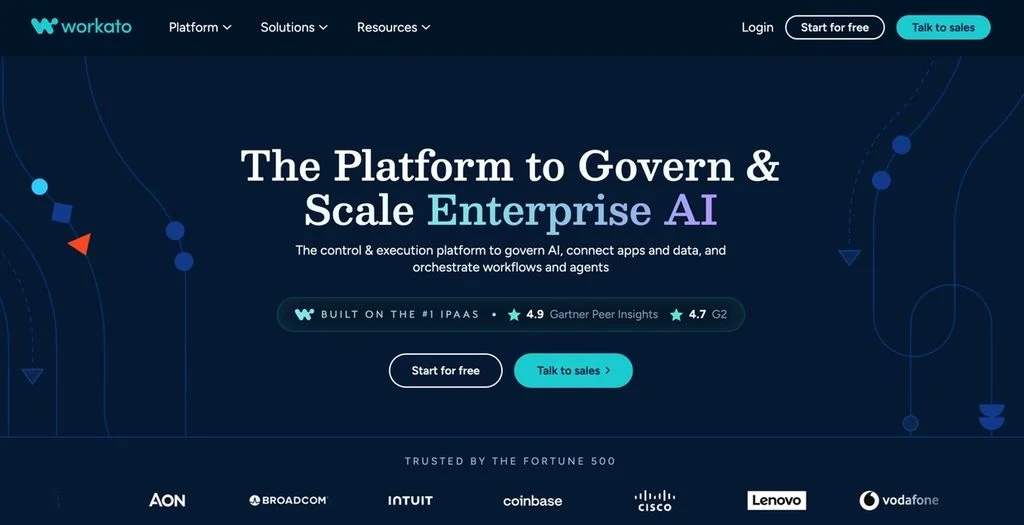
Data integration (ETL, ELT, reverse ETL) starts at the Business MCP edition. For on-premises systems you get on-prem agents, three of them in Business MCP and 10 in Enterprise MCP. A free account is available too, so you can build a test workflow before any sales conversation.
Celigo
Celigo sells integration-driven automation for SaaS apps, with Data Ingestion, API Management and B2B Manager in its lineup. Pricing is a flat rate by endpoints and flows, with no overage charges, across Standard, Professional and Enterprise editions. No figures are public.
The free path is generous for a small pilot: a 30-day trial with unlimited endpoints and flows, then a free plan with two endpoints and one flow that doesn’t expire. The free plan excludes SSO and the on-premises agent, so database flows behind a firewall need a paid plan. Our Celigo competitors roundup covers similar tools.
Jitterbit
Jitterbit Harmony combines a visual designer (Studio), API Manager and EDI. Editions are sized by connections: Standard (two to three), Professional (five) and Enterprise (eight or more), all quote only. Integrations run on Jitterbit’s cloud agents or on private agents you host, and a Connector SDK covers systems without a ready connector.
The AskJB AI assistant helps build integrations. Jitterbit suits teams that need API creation and app integration together but don’t need MuleSoft’s full API governance. See also our Jitterbit alternatives list.
SnapLogic
SnapLogic sells three packages (Essential, Professional, Enterprise One), all quote only, with unlimited pipelines and data movement. Its pre-built connectors are called Snaps: core Snap Packs come with the base packages, and premium packs cost extra.
You pay the same price whether pipelines run in SnapLogic’s cloud (CloudPlex) or on your own servers (GroundPlex). Add-ons include AgentCreator, API Management, ELT and AutoSync.
Outside the ranking: Microsoft Power Automate
Microsoft-centric teams have one more option outside this ranking. Microsoft Power Automate prices per user or per bot instead of per integration: Premium costs $15 per user a month and Process $150 per bot a month, both paid yearly, after a 30-day free trial. Its plans center on cloud flows and desktop flows (RPA), so it’s better suited to task automation than to replacing a MuleSoft-style integration layer.
Data integration alternatives for pipelines and sync
Is most of your MuleSoft workload batch jobs, warehouse replication or record sync between apps? Then a data integration tool will cost less and need fewer specialists.
Skyvia
Skyvia is a no-code cloud data platform. Its 200+ connectors reach cloud apps, databases, data warehouses and file storage. Data Integration handles import (reverse ETL included), export, two-way synchronization between apps and databases, and replication into BigQuery, Snowflake, Redshift, Azure Synapse or Databricks. For multi-step ETL there’s the visual Data Flow (Standard plan and up), while Control Flow (Professional and up) chains integrations in order or in parallel using If and Try Catch blocks.
Skyvia also covers jobs MuleSoft customers often script by hand. Automation covers the workflows between apps, kicked off by an event or a schedule. Connect publishes OData and SQL endpoints for BI tools, plus MCP endpoints that AI assistants can query. On-premises databases connect through the Skyvia Agent over outbound HTTPS, with no inbound ports.
Pricing is by records written per month. Data Integration Basic costs $79 a month billed annually, or $99 billed monthly, for 5M records. Professional begins at $399 a month billed annually ($499 monthly) for 10M. You get a free plan on every product (Data Integration Free allows 10k records a month), plus a 14-day trial at signup with no credit card.
The limits are real. One clear gap: Skyvia isn’t an API gateway or an API management product, so that part of Anypoint needs another tool. Free and Basic run once a day. You need Standard for hourly schedules and Professional for per-minute ones. Log-based change capture is SQL Server only, and every other source relies on timestamp-based incremental updates.

Informatica
For enterprise data management, Informatica Cloud Data Integration is the heavyweight: ETL and ELT, data quality and governance all live in one suite. Its CLAIRE Copilot turns natural-language prompts into pipelines.
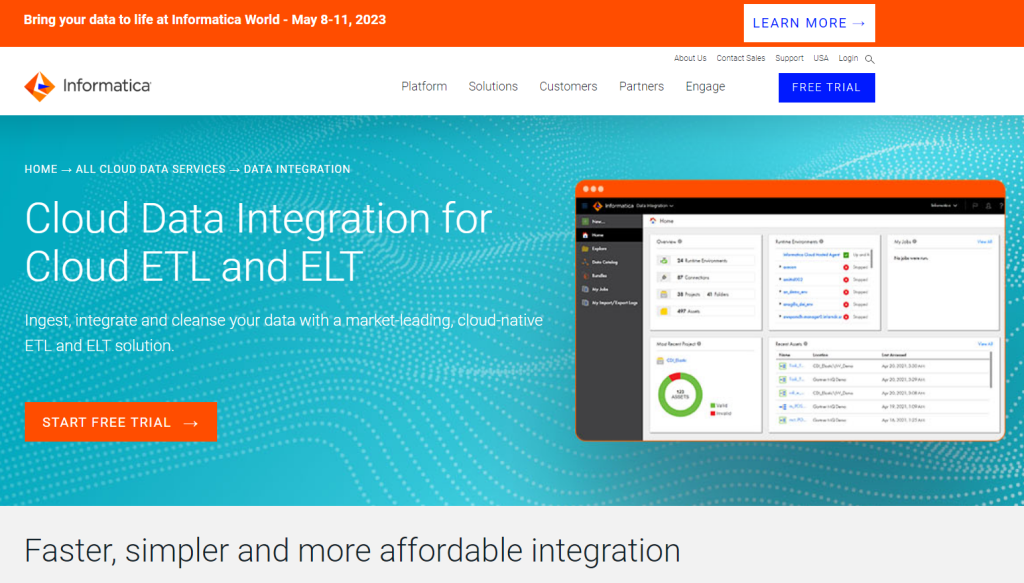
You pay by consumption in Informatica Processing Units (IPUs), quote only. Cloud trials last 30 days. Mind the ownership, though. Informatica joined Salesforce in November 2025, so leaving MuleSoft for Informatica still leaves you with the same vendor. Our Informatica alternatives guide lists other options.
Integrate.io
Integrate.io is a low-code pipeline platform for ETL, ELT, CDC and reverse ETL. You design with drag and drop, and there’s a copilot plus MCP support. The vendor lists 150+ sources and destinations.
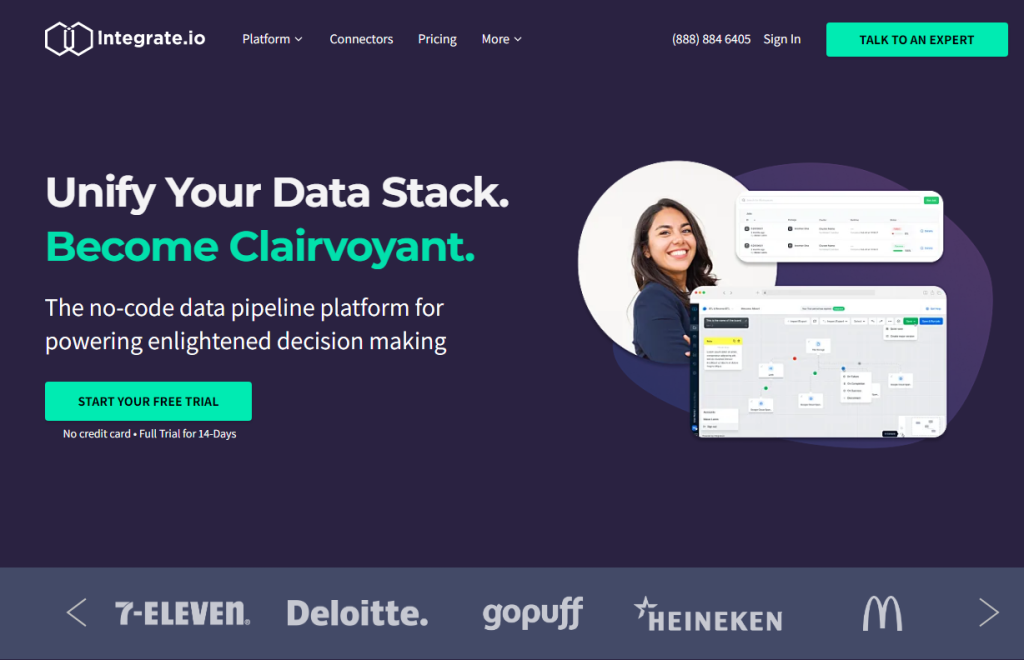
The pricing is the draw: Integrate.io Core costs $1,999 a month with unlimited data volumes, pipelines and connectors, pipelines as often as every 60 seconds, and 30-day onboarding. Support runs 24/7 on every plan, and the free trial lasts 14 days with no credit card. The flat fee makes sense at high volume; for a few million records a month it’s more than usage-priced tools charge.
AWS Glue
AWS Glue is the serverless data integration service from Amazon, and it runs ETL, ELT, batch and streaming jobs. Amazon Q Data Integration can write ETL code from a prompt. Glue has zero-ETL integrations as well.
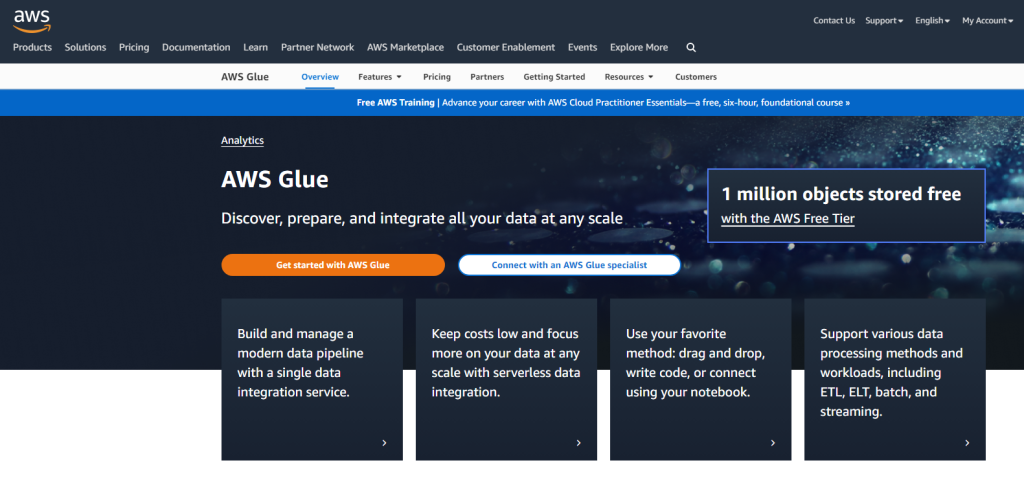
You pay an hourly rate billed by the second. AWS’s own example uses $0.44 per DPU-hour, and rates vary by region. The Data Catalog stores the first million objects and serves the first million requests free. Sources outside AWS’s native list need a connector from AWS Marketplace or a custom one, so Glue fits teams already running on AWS. Compare it with similar services in our AWS Glue alternatives roundup.
API management alternatives
If you mainly use MuleSoft’s API Manager and gateway, these tools replace that layer without an integration engine attached.
Apigee
Apigee is Google Cloud’s API management platform, built for large API programs and API products.
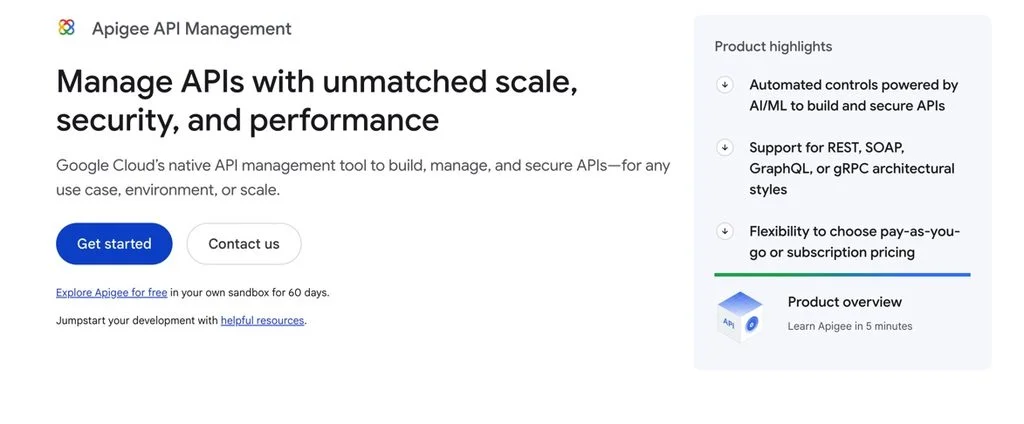
Pay-as-you-go pricing has no upfront commitment and two parts:
- API calls: $20 per million on Standard proxies (up to 50M calls) and $100 per million on Extensible proxies, with lower rates at higher volume.
- Environments: Base at $365 a month per region, Intermediate at $1,460 and Comprehensive at $3,431.
You can evaluate Apigee in a free sandbox for 60 days. Subscription tiers go through sales.
WSO2 API Platform
WSO2 is the open-source pick for API management. All of it is 100% open source, and you can deploy it as SaaS, self-hosted or hybrid. Running more than one gateway already? A single control plane covers WSO2, Kong, AWS, Azure and Envoy gateways.
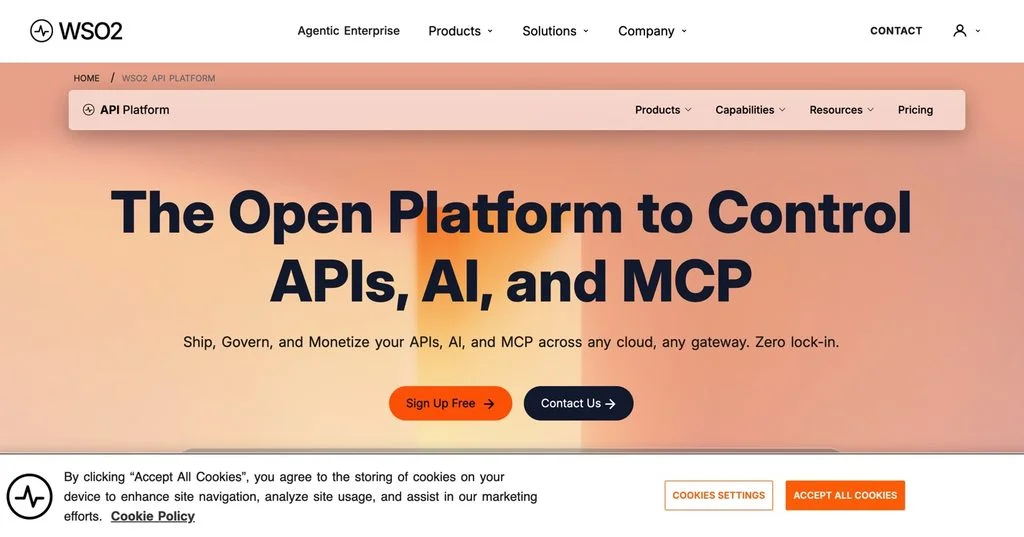
WSO2 leans into AI traffic: an MCP Gateway turns REST APIs into MCP servers, and an LLM Gateway governs outbound model calls. Pricing is pay-as-you-go or enterprise, with no figures on the product page.
Kong Konnect
Kong Konnect manages Kong gateways from a SaaS control plane. The API Management Plus plan starts at $25 a month plus usage, billed monthly, with 1M API requests included and $200 for each additional million. Enterprise is custom and billed annually.
A 30-day free trial needs no credit card. Kong also offers an AI Gateway for LLM, MCP and agent-to-agent traffic. It suits teams with Kubernetes and microservices who want a light gateway rather than a full integration suite.
ELT tools that replace MuleSoft’s data loading
The earlier version of this guide covered several ELT tools. They don’t replace MuleSoft’s API or process layer, but they’re a cheaper answer when MuleSoft only feeds a data warehouse. Here’s where they stand now:
| Tool | Pricing unit | Entry price (US) | Free plan or trial | What changed |
|---|---|---|---|---|
| Airbyte | Credits (Cloud) | Standard $20/month with 5 credits; Plus from $189/month | 14-day trial with 400 credits; Airbyte Core is free and self-hosted | 700+ connectors (vendor-reported) |
| Hevo Data | Events | Starter $299/month billed monthly, $265 annually (5M events) | Free plan up to 1M events/month; 14-day trial | Free plan limited to some connectors |
| Stitch | Rows | Standard from $100/month (5M rows) | 14-day trial | Now part of Qlik |
| Matillion | Credits | Not published | Free trial | Sold as the Data Productivity Cloud, with Maia AI agents on every plan |
| Rivery | Boomi Data Unit credits | $0.9 per credit (Base, billed monthly) | 14 days or 1,000 credits | Now part of Boomi |
We compare these in more depth in our guides to Airbyte alternatives, Hevo Data alternatives and Stitch alternatives.
Open-source MuleSoft alternatives
Teams replacing MuleSoft often ask for an open-source option. In 2026, three of them hold up:
- WSO2 API Platform covers API management and gateways; it’s open source, with paid support if you want it.
- Apache NiFi handles data flows. It’s an Apache-licensed engine with a designer in the browser, data provenance tracking and guaranteed delivery. Routing and moving data is its job. Managing APIs isn’t.
- Airbyte Core for ELT into warehouses, self-hosted.
Talend Open Studio is no longer one of them. Qlik retired it back in January 2024, yet a few roundups keep recommending it. You lose the license fee, not the work. Somebody on your team still has to deploy, patch, scale and monitor these tools.
Checklist before you switch from MuleSoft
Copy this into your migration ticket and fill it in before the first vendor demo:
- List every Mule application and tag it: system API, process flow, batch data job or event handler.
- Write down the connectors each one uses, and flag any custom DataWeave logic.
- Export 90 days of Mule Credit usage per application so vendors quote against your real volume.
- Read the contract for the renewal date, the Pre-Commit balance and the notice period.
- Choose the two hardest flows (the most transformations, the highest volume) and rebuild them in a free trial.
- Count how many records or messages those flows move each month, then price that in every tool’s own unit.
- Run old and new flows side by side until the data in the target matches.
- Settle who owns the new platform, whether that’s a developer team, a data team or business operations.
If the checklist shows most of your workload is data movement, start with a data integration trial. Skyvia’s free plan and 14-day trial let you rebuild a replication or sync job before your MuleSoft renewal comes up. Create a free Skyvia account and test it on your own data.

FAQ for MuleSoft Alternatives

Is Workato better than MuleSoft?
It depends on the work. Workato is a workflow automation platform with 1,200+ connectors (vendor-reported) that adds ETL, ELT and reverse ETL from its Business MCP edition, while MuleSoft adds full API management on top of integration. Workato doesn’t publish edition prices, so compare both quotes on the same workload.
How much does MuleSoft cost in 2026?
Packages from MuleSoft begin at $2,000 a month billed annually, or $24,000 a year. You spend Mule Credits, bought one of three ways: Pre-Purchase, Pre-Commit (which carries a $50K minimum annual commitment) or an Unlimited plan at a custom fixed price. The full portfolio is open during a 30-day free trial.
Is there an open-source or free alternative to MuleSoft?
Yes, for parts of it. WSO2 API Platform is open source for API management, Apache NiFi is an Apache-licensed engine for data flows, and Airbyte Core is a self-hosted ELT tool. Talend Open Studio isn’t an option anymore, since Qlik retired it in January 2024. You still need engineers to deploy and maintain any of them.
How is MuleSoft different from Salesforce?
Salesforce is the CRM company. MuleSoft is the integration platform it owns. Pricing for MuleSoft runs on Mule Credits and sits apart from Salesforce’s CRM licenses. Salesforce has owned Informatica too since November 2025.
What can replace MuleSoft when you’re loading data into a warehouse?
For that job, a data integration or ELT tool usually comes out cheaper. Skyvia, for one, replicates app data into BigQuery, Snowflake, Redshift, Azure Synapse or Databricks, from $79 a month billed annually for 5M records. You could also look at Airbyte, Hevo, Stitch and AWS Glue, though each bills in its own pricing unit.
Why does a cheaper tool end up costing more after the switch?
Usually because the pricing unit and your traffic don’t line up. Boomi’s Pay-as-You-Go charges $0.05 per message and Apigee bills per million API calls. Chatty, high-volume flows add up fast on both. Price your two busiest flows in each tool’s unit during the trial before you sign.
Whichever platform takes over your APIs, the data jobs can move first. Skyvia replicates, imports and syncs data across 200+ connectors with no code, and its free plan needs no credit card. Start with Skyvia Data Integration and move one MuleSoft batch job this week.