Articles • by Iryna Bundzylo • October 22, 2026
The nightly reload used to be no problem at all. It stopped working the week the orders table went past tens of millions of rows. Now the run bleeds into office hours, the production database slows to a crawl while it scans, and the dashboard shows yesterday. Copying only what changed is the obvious fix, and picking the tool that does it is where teams get stuck.
The market for change data capture tools has shifted in the past year. Debezium no longer needs Kafka, IBM renamed its replication product, Talend's standalone CDC reached end of life, and Airbyte changed its prices. Plenty of comparison pages haven't caught up and describe the old versions.
Feature lists won't tell you how a tool captures changes, how fresh it keeps the target, where it runs or what it'll cost you. So that's what we checked for 13 tools, on the vendors' own docs and pricing pages, in October 2026.
Where Should You Start With CDC Tools?
Know where your data lives and how fresh the copy must be? Then half the work of choosing is already done. The details come later; honestly, this table covers most of it.
| Your situation | Look at first | Why |
|---|---|---|
| You run Kafka or want open source with full control | Debezium | Free log-based capture from MySQL, PostgreSQL, Oracle, SQL Server, MongoDB and more, with or without Kafka |
| Everything is on AWS | AWS DMS | Full load plus ongoing replication, billed by the hour |
| Everything is on Google Cloud and the target is BigQuery | Google Cloud Datastream | Serverless, billed per GiB processed, free backfill up to 500 GiB a month |
| Oracle is the core of your estate | Oracle GoldenGate | Oracle's own replication product, with a managed service on OCI |
| Mainframes, SAP or a mix of legacy databases | Qlik Replicate or IBM Data Replication | Broad enterprise source lists, including Db2 z/OS and VSAM |
| You want streaming CDC as a managed service | Estuary or Striim | Log-based capture with continuous delivery; Estuary publishes per-GB prices, Striim quotes paid plans |
| The target is a warehouse and a delay of minutes to an hour is fine | Fivetran, Airbyte or Hevo Data | Managed ELT with log-based CDC for common databases |
| Cloud apps plus SQL Server, scheduled syncs, no engineering team | Skyvia | No-code incremental replication, SQL Server Change Tracking, plans from $79 a month billed annually |
One check comes before everything else, and it's whether there's log-based capture for your exact database and version. Half the list usually falls away right there.
What Do Change Data Capture Tools Do?
A CDC tool has one narrow job. Inserts, updates and deletes in the source get noticed, and those changes are all it sends on. So instead of hauling your 50-million-row orders table across every night, it moves the few thousand rows that changed since the last run. If you want the full background, our guide to change data capture has it; here we'll stick to what helps you pick a tool.
Compare that with classic batch ETL, where whole tables get reloaded or rescanned on a fixed schedule. Downstream analytics, search indexes and apps stay closer to the source this way, and the source database does a fraction of the work per sync.
Where tools differ most is in how they spot changes:
| Method | How it works | Sees hard deletes? | Load on the source |
|---|---|---|---|
| Log-based | Reads the database's transaction log (MySQL binlog, PostgreSQL WAL, Oracle redo log, SQL Server CDC) | Yes | Low: no queries against production tables |
| Query-based (timestamp) | Polls tables for rows with a newer updated_at value | No, unless rows are soft-deleted | Repeated queries on every run |
| Trigger-based | Database triggers write every change to a shadow table | Yes | Extra writes on every transaction |
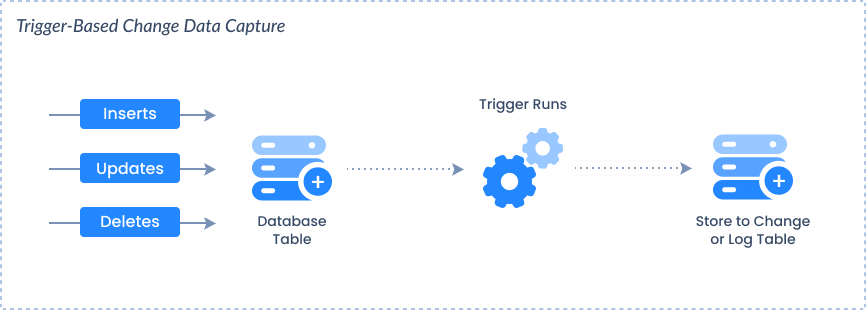
Trigger-based CDC: each change fires a trigger that writes it to a change table.
Production pipelines tend to default to log-based capture, since it catches deletes and barely touches the source. The catch is setup. You'll need log retention, replication permissions and, on some engines, a configuration change plus a restart.
How We Compared These CDC Tools
For CDC, the useful differences are more technical: how changes are captured, how quickly they arrive, what happens during backfill, and how deletes or schema changes are handled.
-
Capture method per source. Log-based for which databases, and what the tool falls back to for the rest.
-
Latency. Continuous streaming or a sync schedule, and the shortest interval on each plan.
-
Initial load and backfill. How the tool copies existing data before it starts reading changes, and whether you can add tables without a full restart.
-
Deletes and schema changes. When a row is deleted in the source, is it deleted in the target too? And what breaks the day someone adds a column?
-
Deployment. Does it run on your servers, as a managed cloud service, or through an agent inside your network?
-
Pricing unit. Rows, events, gigabytes, credits, cores or hours, plus the published starting price.
How CDC tools capture changes
Most CDC tools rely on one of three capture methods: log-based, query-based, or trigger-based. Each handles deletes, source load, and latency differently, so the capture method matters as much as the connector list when you compare CDC tools.
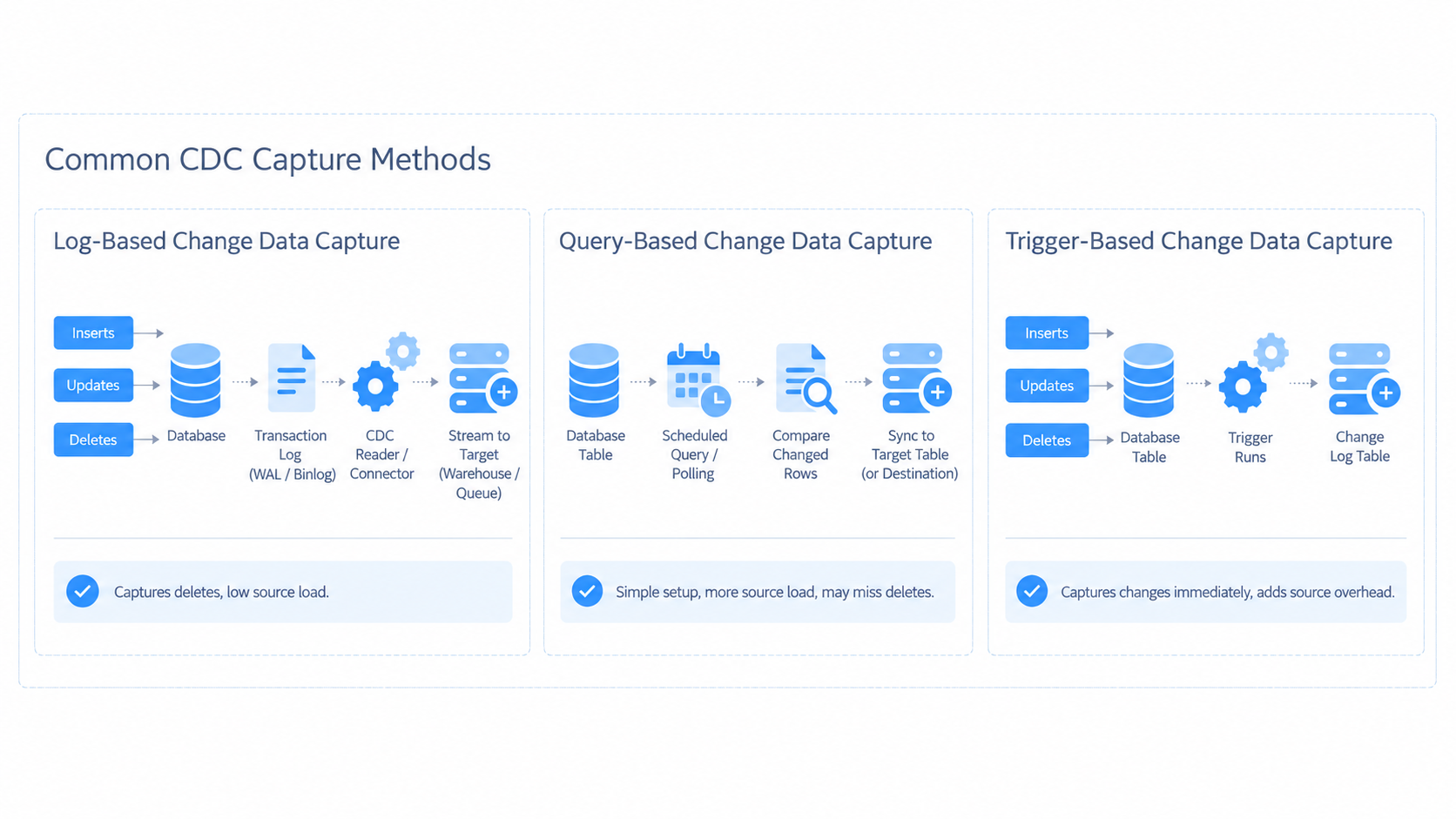
Log-based capture usually gives the lowest source impact and sees deletes reliably. Query-based capture is simpler but can miss deletes and adds more read load. Trigger-based capture can track changes directly, but it adds overhead on the source database.
Change Data Capture Tools Compared
| Tool | Capture method | Delivery | Deployment | Pricing unit | Published starting price |
|---|---|---|---|---|---|
| Debezium | Log-based | Continuous streaming | Self-hosted (Kafka Connect, Debezium Server, Kubernetes) | None | Free, open source |
| Estuary | Log-based for databases, plus SaaS and batch | Continuous ("millisecond latency or batch") | Managed cloud; private and BYOC on Enterprise | GB moved plus connector instances | Free up to 10 GB a month; $0.50 per GB plus $100 per connector instance a month |
| Striim | Log-based | Continuous streaming | Managed cloud or self-managed | Data moved (cloud) | Free Developer plan up to 25M events a month; paid on request |
| AWS DMS | Ongoing replication after a full load | Continuous | AWS managed | Instance-hours or DCU-hours | DMS Serverless from $0.087 per DCU-hour (US East, Ohio) |
| Google Cloud Datastream | CDC plus backfill | Continuous | Google Cloud, serverless | GiB processed | CDC $2.00 per GiB for the first 2,500 GiB a month |
| Oracle GoldenGate | Replication (OCI GoldenGate is the managed service) | Real-time | OCI managed, or licensed software | OCPU-hours (OCI) | OCI GoldenGate $1.3441 per OCPU-hour; GoldenGate Free for Oracle databases up to 20 GB |
| Qlik Replicate | CDC | Real-time | On-premises or cloud | Not published | Quote; free trial |
| IBM Data Replication | Replication with near real-time delivery | Near real-time | IBM software; containerized options in AI Edition | Not published | Quote |
| IBM StreamSets | CDC origins (Oracle through LogMiner and others) | Streaming and batch pipelines | IBM software, 30-day trial | Virtual processor cores (VPCs) | $1,050 per VPC a month; Team package from $4,200 a month |
| Fivetran | Log-based where the database supports it, plus Fivetran Teleport Sync | Scheduled; 1-minute syncs only on Enterprise and Business Critical | Managed cloud; Hybrid Deployment on Enterprise | Monthly active rows (MAR) | Free up to 500,000 MAR a month |
| Airbyte | Log-based CDC (Debezium-based) for Postgres, MySQL, SQL Server, MongoDB | Scheduled: 60, 15 or 5 minutes by plan | Managed cloud or self-hosted | Credits (Cloud) | Core free and open source; Cloud Standard $20 a month |
| Hevo Data | Log-based modes for MySQL, PostgreSQL, SQL Server, MongoDB, Oracle | Scheduled; streaming pipelines on Business Critical | Managed cloud | Events | Free up to 1M events a month; Starter $299 a month billed monthly |
| Skyvia | SQL Server Change Tracking; timestamp-based incremental for other sources | Scheduled: 1 minute on Professional and Enterprise, hourly on Standard | Managed cloud, with an agent for on-premises databases | Records per month | Free plan; Data Integration from $79 a month billed annually, $99 billed monthly |
Open-Source and Streaming Tools for CDC
Debezium
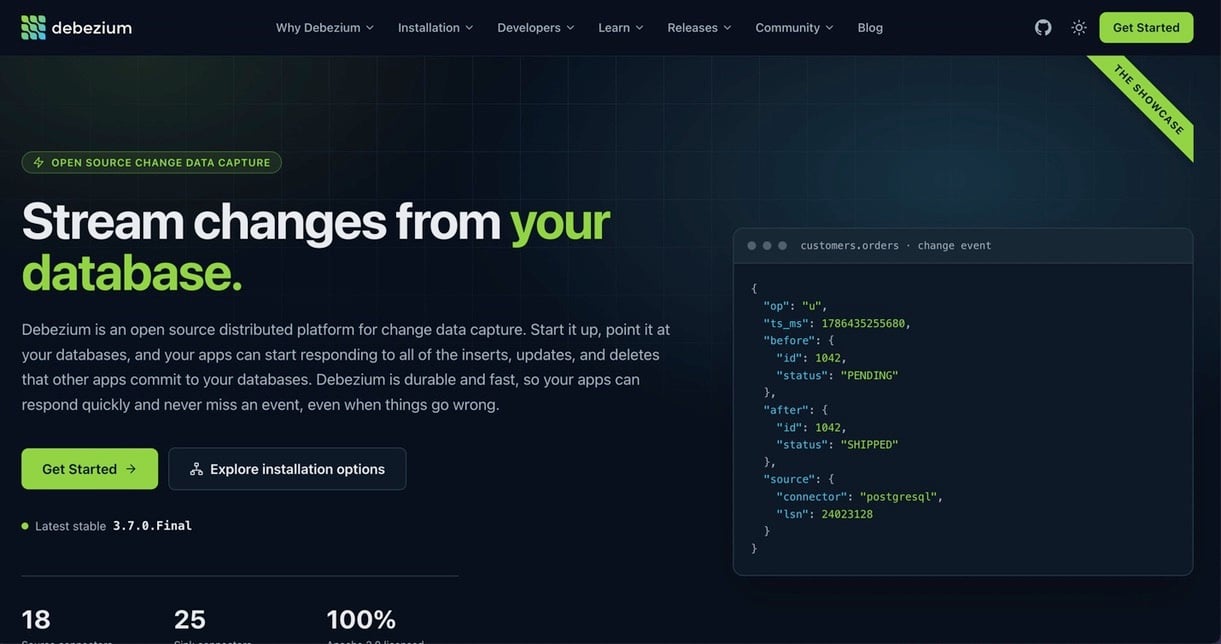
Ask around for open-source, log-based CDC and you'll mostly hear one name: Debezium. Hook it up to MySQL, MariaDB, PostgreSQL, SQL Server, Oracle, MongoDB, Db2, CockroachDB or Cassandra, and each committed row change turns into an event. Its latest release, 3.7, landed on September 29, 2026.
And the old complaint that you need Kafka? That's no longer true. You can still run the connectors in Kafka Connect. Debezium Server, though, works without Kafka and delivers changes to Kinesis, Pub/Sub, Pulsar, Redis, RabbitMQ or NATS. If you're on Kubernetes, the Debezium Operator and the Debezium Platform UI handle pipeline management.
Kafka is now one deployment option for Debezium, not a requirement.
-
Best for: engineering teams. They get log-based capture from many databases without a license fee, and they decide what the events look like.
-
Watch out for: running and monitoring it is on you, and so is the target side (deduplication, deletes, loading the warehouse).
-
Pricing: nothing for the software, since it's open source; the infrastructure bill is yours.
Estuary
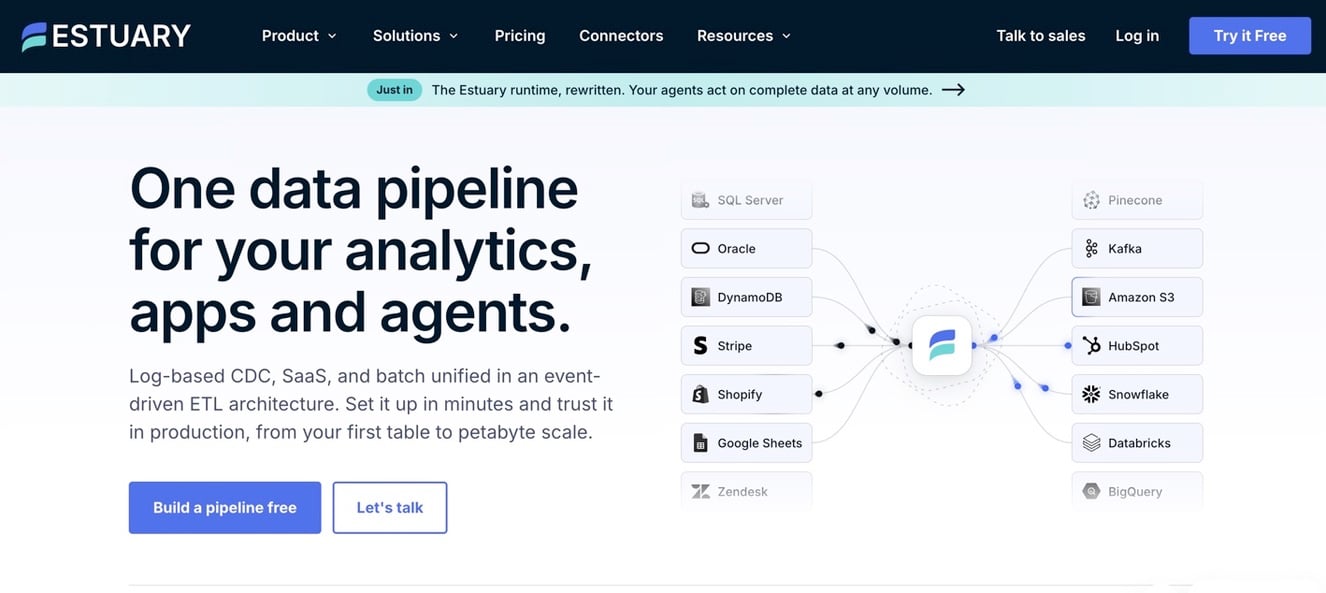
Estuary combines log-based CDC for databases with SaaS and batch sources in one managed pipeline. Its pricing page sums up delivery as "millisecond latency or batch, no extra charge."
-
Best for: teams who'd like streaming CDC without the Kafka cluster, and one tool for both databases and SaaS apps.
-
Watch out for: costs grow with both gigabytes moved and the number of connector instances.
-
Pricing: the Developer plan is free up to 10 GB a month and 2 connector instances. The Cloud plan costs $0.50 per GB plus $100 per connector instance a month for the first six ($50 each after that), with a 30-day free trial. Enterprise adds private and BYOC deployment at a custom price.
Striim
Where Striim differs is the processing it does in the stream: on top of log-based CDC, changes can be filtered, enriched and joined before they reach the target.
-
Best for: enterprises that transform data with SQL while it's still streaming, as in fraud checks or live operational dashboards.
-
Watch out for: Striim Cloud has no public price, and neither does the self-managed Striim Platform.
-
Pricing: the Developer plan is free up to 25M events a month. Striim Cloud bills for data moved, and both paid products are priced on request.
Cloud-Native CDC Services
AWS DMS (Database Migration Service)
The first thing AWS DMS does is a full load of the whole database. After that, it switches to ongoing replication so the target stays current. Its source list takes in Oracle, SQL Server and Azure SQL, PostgreSQL, MySQL-compatible databases, SAP ASE, MongoDB, IBM Db2 for z/OS and even Amazon S3.
-
Best for: AWS customers who migrate databases or feed AWS targets and don't want to look after connectors.
-
Watch out for: on-demand pricing leaves sizing the replication instances to you. DMS Serverless, on the other hand, scales capacity with transaction volume.
-
Pricing: you can pay for on-demand replication instances by the hour, for DMS Serverless by capacity unit (one DCU equals 2 GB of RAM, from $0.087 per DCU-hour Single-AZ in US East, Ohio), or through Database Savings Plans. Homogeneous data migrations cost $0.08 per migration hour. New AWS accounts get Free Tier credits.
Google Cloud Datastream
On Google Cloud, the serverless CDC service is Datastream. Changes come from MySQL, PostgreSQL, Oracle, SQL Server, AlloyDB, Spanner, Salesforce or MongoDB and go into BigQuery, Cloud Storage or Apache Iceberg tables.
-
Best for: BigQuery shops that don't want to run any CDC infrastructure.
-
Watch out for: you pay per GiB of "processed bytes," which Google says can be two to five times the size of the source data.
-
Pricing: CDC costs $2.00 per GiB for the first 2,500 GiB a month and falls to $0.80 per GiB above 10,000 GiB (us-central1). Backfill is free up to 500 GiB a month, then $0.40 per GiB. An idle stream costs nothing, and streams from AlloyDB and Spanner to BigQuery share 100 GiB of CDC free every month per billing account.
Enterprise Replication Platforms
Oracle GoldenGate
GoldenGate is Oracle's real-time replication product for keeping databases in sync across on-premises and cloud systems. OCI GoldenGate is the managed version on Oracle Cloud.
-
Best for: Oracle-centered estates that want replication with Oracle support behind it.
-
Watch out for: the public price covers the OCI managed service; self-managed licenses aren't on the price list.
-
Pricing: OCI GoldenGate lists at $1.3441 per OCPU per hour, or $0.3226 with your own license (BYOL). GoldenGate Free covers Oracle databases up to 20 GB.
Qlik Replicate

Qlik Replicate uses CDC to move data between a long list of systems. Relational coverage takes in Oracle, SQL Server, Db2, MySQL, Sybase and PostgreSQL. Warehouses such as Snowflake, Synapse and Teradata are covered too, along with streaming to Kafka, Confluent, Event Hubs and Kinesis, and SAP, Salesforce and mainframe sources (IMS/DB, Db2 z/OS, VSAM).
-
Best for: large companies that need mainframe, SAP and relational data in one cloud warehouse.
-
Watch out for: there's no published price, so expect a sales cycle before any cost comparison.
-
Pricing: quote only, with a free trial.
Talend, now part of Qlik, used to sell a separate Talend Change Data Capture product, which reached end of life in December 2025. Log-based CDC now sits in Qlik Talend Cloud from the Standard tier up, with a 14-day free trial.
IBM Data Replication
IBM sells its replication product (once called InfoSphere Data Replication) for delivering changes in near real time. It can capture from Db2, Db2 z/OS, Oracle, SQL Server, PostgreSQL, MySQL, VSAM and IMS. On the target side, Db2, Kafka, Snowflake, BigQuery, Oracle and SQL Server are all supported. There's also a newer IBM Data Replication AI Edition, with an AI assistant and containerized deployment for some PostgreSQL and Db2 LUW engines.
-
Best for: shops running Db2 or mainframe systems that need continuous replication and standby copies.
-
Watch out for: expect an enterprise sales cycle and a team with IBM-specific skills.
-
Pricing: on request (IBM offers a live demo).
IBM StreamSets

Streaming and batch pipelines are what IBM StreamSets builds, and its Data Collector comes with CDC origins. Take the Oracle CDC origin: it reads redo logs through Oracle LogMiner.
-
Best for: teams that mix CDC with broader streaming and batch pipeline work in one product.
-
Watch out for: the minimum commitment is four VPCs for 12 months.
-
Pricing: $1,050 per virtual processor core (VPC) a month. Indicative package prices are $4,200 a month for Team, $25,200 for Business unit and $105,000 for Enterprise. A 30-day free trial is available.
Managed ELT Platforms With CDC
Fivetran
Fivetran uses each database's native change mechanism where it can: binary log for MySQL and MariaDB, CDC and Change Tracking for SQL Server, logical replication for PostgreSQL, change streams for MongoDB. It also has proprietary methods, including a binary log reader for Oracle and SQL Server and Fivetran Teleport Sync. Its Oracle LogMiner method is marked for sunset. Since June 1, 2026, Fivetran and dbt Labs have been one company.
-
Best for: analytics teams who want database replication into a warehouse they don't have to babysit, next to 700+ other connectors.
-
Watch out for: 1-minute syncs need Enterprise or Business Critical, and the Standard plan card lists 15-minute syncs.
-
Pricing: you pay by usage, measured in monthly active rows (MAR). Up to 500,000 MAR a month is free. Standard, Enterprise and Business Critical bill by usage, and every new connection starts with a 14-day trial.
Airbyte
For Postgres, MySQL, SQL Server and MongoDB sources, Airbyte offers log-based CDC, and under the hood it's Debezium. CDC incremental sync needs a primary key on most sources.
-
Best for: teams that don't mind hosting an open-source core themselves, want 700+ connectors, and like knowing a managed cloud is there if they need it.
-
Watch out for: on Cloud, syncs top out at once every 60 minutes on Standard, every 15 on Plus, and every 5 on Pro and Enterprise Flex.
-
Pricing: Airbyte Core is free and open source. Cloud Standard costs $20 a month with 5 credits ($5 per extra credit), and Plus starts at $189 a month for 40 credits. For Pro and Enterprise Flex, pricing is based on capacity. Older guides still quote the previous Standard plan, because Airbyte changed that price on September 23, 2026.
Hevo Data
Hevo reads whatever log each database keeps, which means BinLog on MySQL, Change Tracking on SQL Server, logical replication on PostgreSQL, OpLog on MongoDB and Redo Log on Oracle.
-
Best for: small and mid-size teams who want no-code pipelines and log-based capture on the common databases.
-
Watch out for: you can't create new in-pipeline Transformations in Hevo anymore, and it points you to dbt Models and SQL Models instead. Streaming pipelines are listed for Business Critical.
-
Pricing: Free up to 1M events a month. Starter costs $299 a month billed monthly ($265 billed annually), Professional $849 ($750 annually), and Business Critical is custom.
Skyvia
Full disclosure: Skyvia is ours, so we'll be precise about where it fits. Skyvia's replication takes 200+ sources into BigQuery, Snowflake, Redshift, Azure Synapse, Databricks or a database, creating the tables and running a full load before it copies only new and changed records.
SQL Server gets Change Tracking, a lightweight built-in mechanism for identifying changed rows. Every other source is handled with timestamp-based incremental updates.
-
Best for: teams sending cloud apps such as Salesforce or HubSpot, along with SQL Server, into a warehouse on a schedule, without writing code. Deleted records are your call, because you can remove them in the target, flag them in an _is_deleted column or just keep them, and history mode stores every version of a record.
-
Watch out for: this isn't a streaming tool. The shortest interval is one minute on Professional and Enterprise (hourly on Standard, daily on Free and Basic), and log-based capture covers SQL Server only. Schema changes aren't detected automatically.
-
Pricing: every product has a free plan. Data Integration starts at $79 a month billed annually ($99 billed monthly) and is priced by records per month; Professional, with 1-minute schedules, starts at $399 billed annually ($499 monthly). Signup starts a 14-day trial with no credit card.

Do You Need Log-Based CDC?
Not every CDC use case needs transaction-log access or second-level latency. If your warehouse can tolerate updates every few minutes, scheduled incremental replication may be simpler to run and easier to maintain.
Log-based streaming is worth the setup once seconds matter, as with fraud checks, stock levels customers see, event-driven services or a migration that can't go down. For those jobs, look at Debezium, Estuary, Striim, GoldenGate or one of the cloud-native services.
A lot of CDC work, frankly, doesn't need to be that fast. Think of a warehouse whose dashboards refresh hourly, or even once a day. Scheduled incremental replication produces the same numbers there, with much less to operate. SaaS sources like Salesforce or HubSpot are a similar story: there's no transaction log to read, so every tool goes through their APIs regardless.
Here's how we'd decide. Would 15-minute-old data change a single decision? If it wouldn't, a managed ELT tool is the sensible first step, and streaming CDC can wait for the tables that turn out to need it.
CDC Problems You'll Probably Hit (and Fixes)
| Challenge | What goes wrong | What to do |
|---|---|---|
| Initial load | The first full copy of a large table competes with production traffic | Run it off-peak, and check whether the tool can backfill tables without restarting the pipeline |
| Deletes | Query-based capture never sees a hard delete, so deleted rows live on in the target | Use log-based capture, or soft deletes with a flag column |
| Schema changes | A new or renamed column stops the pipeline or loads as nulls | Test a column change in staging and read the tool's schema-change behavior before production |
| Log retention | If the pipeline pauses longer than the database keeps its logs, changes are lost and a resync follows | Set log retention above your longest expected outage |
| Duplicates and ordering | Retries deliver the same change twice or out of order | Make target loads idempotent (merge on primary key) and check the tool's delivery guarantee |
| Permissions | Log-based capture needs replication privileges that security teams question | Use a dedicated replication user with only the rights the connector documents |
How to Choose a Change Data Capture Tool
Answer these before you book any demos:
1. Which databases and versions are sources? Check that the tool supports log-based capture for each one, not just "connects to" it.
2. Where do changes go? A warehouse, Kafka, another database, or several targets at once.
3. How fresh must the target be? Seconds, minutes or hours. This splits streaming tools from scheduled ELT.
4. Where can the tool run? Will it live in a managed cloud, inside your own VPC, or on a server on-premises right by the database?
5. What happens on a delete and on a schema change? A slide proves nothing here, so ask to see both live.
6. How is it priced? Rows, events, gigabytes, cores or hours. Estimate one normal month and one peak month in that unit.
7. Who will run it? An open-source tool is free to download and costs engineering time every week after.
Because almost every vendor here has a free plan or trial, you can push your heaviest table through your two favorites before signing.
Are your sources cloud apps and SQL Server, and is a schedule fresh enough? Then try Skyvia replication on the free plan and see how many records a month your tables actually change.
FAQ for Change Data Capture Tools
What's the best change data capture tool?No single tool wins, since the answer turns on your sources and how fresh the data must be. Debezium is the usual choice for open-source, log-based capture. If you've committed to one cloud, AWS DMS or Google Cloud Datastream usually makes more sense, and GoldenGate suits Oracle-centered estates. Fine with a delay of minutes and a warehouse as the target? A managed ELT tool such as Fivetran, Airbyte, Hevo Data or Skyvia is easier to run.
What are the downsides of change data capture?CDC adds moving parts that batch loads don't have. Log-based capture needs replication permissions and enough log retention. On top of that, the first full load can strain the source, and schema changes or retries may break a pipeline or duplicate rows if the target load isn't idempotent. Query-based CDC takes less setup, though hard deletes slip past it.
How does change data capture work?Change data capture identifies inserts, updates, and deletes after the initial load and sends only those changes downstream. Depending on the tool, it can read the database transaction log, poll tables for updated rows, or use triggers to record changes.
Can you use CDC without running Kafka?Yes. Debezium Server works standalone, shipping changes to Kinesis, Pub/Sub, Pulsar, Redis, RabbitMQ or NATS. And with managed services such as AWS DMS, Google Cloud Datastream, Estuary or the ELT platforms, there's no message broker for you to operate.
Is log-based CDC better than query-based CDC?For production databases, usually yes. Log-based capture reads the transaction log, so it sees deletes and puts little load on the source, while query-based capture polls tables for newer timestamps and misses rows that were deleted. Query-based capture is still fine for small tables or sources without an accessible log.
Is there a free change data capture tool?Debezium is free and open source, and Airbyte Core is free to self-host. Several managed tools have free plans with limits: Estuary up to 10 GB a month, Fivetran up to 500,000 monthly active rows, Hevo Data up to 1M events a month and Striim Developer up to 25M events a month. Skyvia has a free plan for every product.
How is CDC different from batch ETL?Batch ETL runs on a schedule and may reload whole tables or pull changes in batches, so the target is only as fresh as the last run. CDC moves only the inserts, updates and deletes since the last sync, which keeps the target closer to the source and the source less busy. You can use both: CDC for large transactional tables and batch loads for small reference data.
Can CDC tools capture changes from Salesforce or other SaaS apps?Some can, though not through a transaction log, since SaaS apps don't expose one. Google Cloud Datastream, for one, lists Salesforce as a source, and Estuary handles SaaS sources next to databases. Managed ELT tools like Fivetran, Airbyte, Hevo Data and Skyvia go through each app's API on a schedule to pull new and changed records.
Ready to keep a warehouse in sync without running CDC infrastructure? Create a free Skyvia account and set up scheduled replication from your cloud apps and SQL Server.